
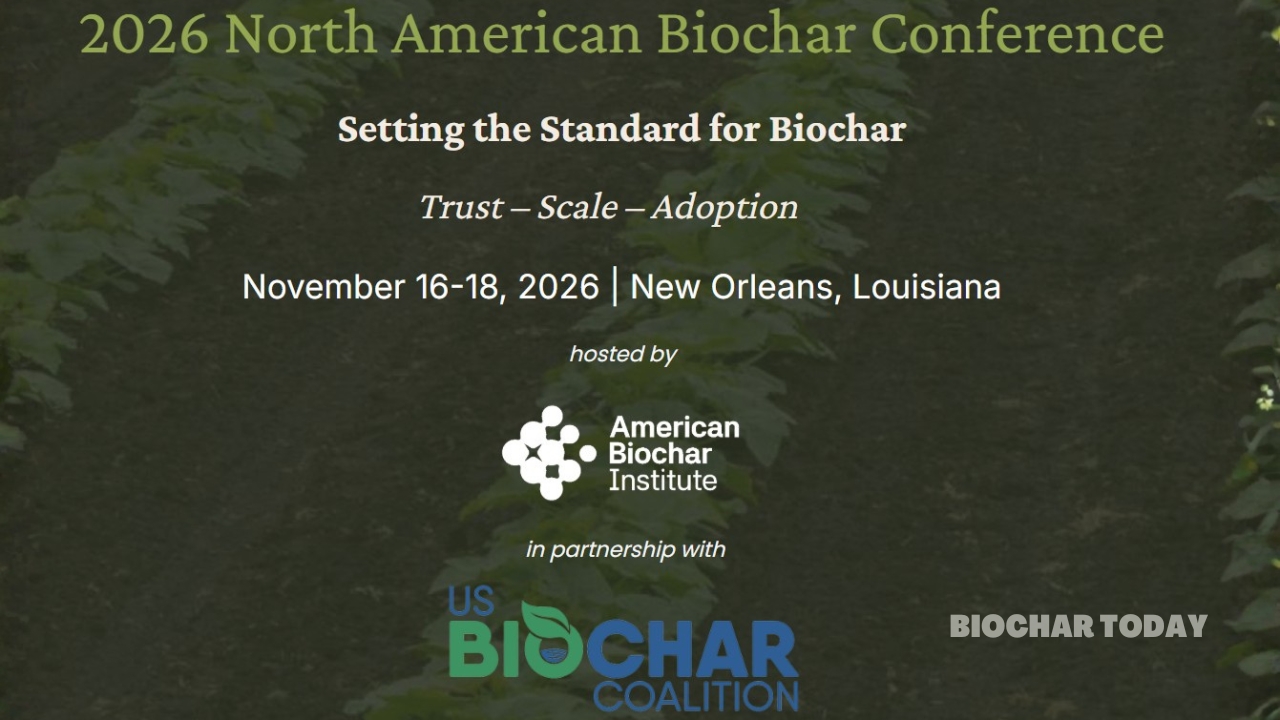
The American BiocharBiochar is a carbon-rich material created from biomass decomposition in low-oxygen conditions. It has important applications in environmental remediation, soil improvement, agriculture, carbon sequestration, energy storage, and sustainable materials, promoting efficiency and reducing waste in various contexts while addressing climate change challenges. More Institute (ABI) has officially entered into a strategic partnership with the U.S. Biochar Coalition (USBC) to co-host the 2026 North American Biochar Conference (NABC). Scheduled to take place from November 16 to 18 in New Orleans, Louisiana, this flagship event represents the premier annual gathering for the continental biochar sector. The primary objective of this joint venture is to unite project developers, commercial producers, researchers, and financial investors to create a structured framework for sector deployment. By consolidating organizational resources, the conference aims to establish a definitive roadmap designed to scale industrial impacts across international carbon and agricultural markets.
The collaborative initiative directly addresses the critical challenge of fragmentation and slow commercial adoption within the North American carbon removal ecosystem. Historically, the biochar sector has operated in decentralized siloes, with a pronounced disconnect separating scientific research, market standard developers, and advocacy organizations. This systemic division creates regulatory ambiguities, dampens investor confidence, and stalls the transition of pyrolysisPyrolysis is a thermochemical process that converts waste biomass into bio-char, bio-oil, and pyro-gas. It offers significant advantages in waste valorization, turning low-value materials into economically valuable resources. Its versatility allows for tailored products based on operational conditions, presenting itself as a cost-effective and efficient More technologies from small-scale applications to large-scale industrial deployment. Without a unified organizational strategy and standardized market pathways, the industry faces prolonged friction in validating credit permanence and establishing consistent end-use commercial demand.
To overcome these structural hurdles, ABI and USBC are combining their respective institutional strengths to deliver a centralized, market-driven platform. ABI leverages its long-standing expertise in advancing specialized end-use market standards across industrial, infrastructure, and agricultural sectors. Concurrently, USBC brings its robust capacity as a national trade association dedicated to regulatory advocacy and commercial scaling. By combining their networks, the two entities have designed an event framework focused heavily on cross-disciplinary workshops, policymaker engagement, and capital deployment strategies to foster immediate market integration.
The strategic alignment between ABI and USBC is expected to accelerate commercial project development and build cross-sector institutional trust. By establishing a unified front, the conference will provide participants with actionable regulatory updates, verified methodologies for carbon credit validation, and standardized protocols for alternative agricultural applications. These structural pathways will reduce transactional risks for institutional investors and ease corporate sourcing constraints. Ultimately, this operational synergy establishes the definitive groundwork needed to transform biomassBiomass is a complex biological organic or non-organic solid product derived from living or recently living organism and available naturally. Various types of wastes such as animal manure, waste paper, sludge and many industrial wastes are also treated as biomass because like natural biomass these More waste management into a highly predictable, climate-relevant carbon removal infrastructure.


Leave a Reply