
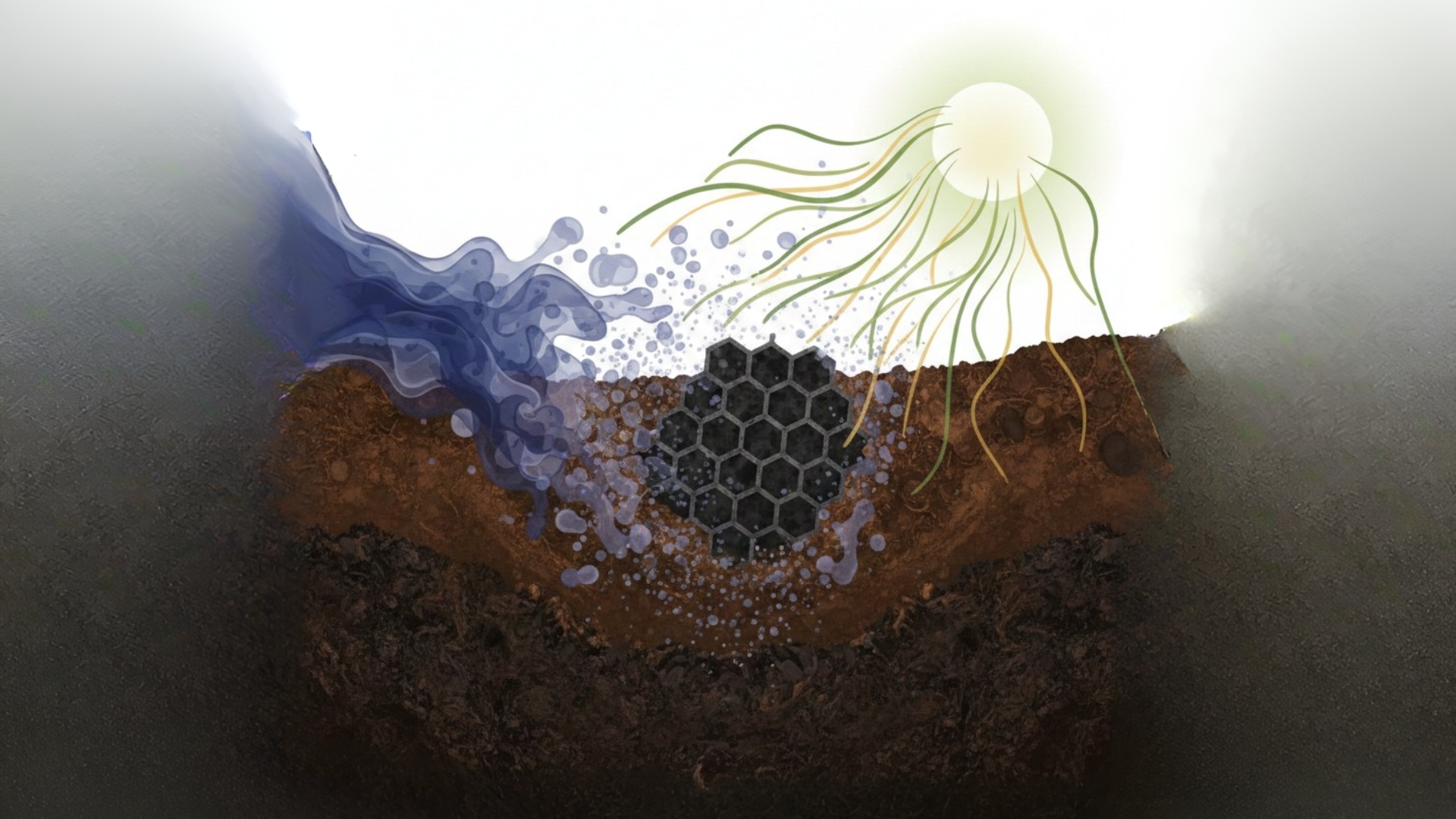
Key Takeaways
- Adding biocharBiochar is a carbon-rich material created from biomass decomposition in low-oxygen conditions. It has important applications in environmental remediation, soil improvement, agriculture, carbon sequestration, energy storage, and sustainable materials, promoting efficiency and reducing waste in various contexts while addressing climate change challenges. More to antibiotic-contaminated soil is an effective cleanup method, significantly reducing harmful antibiotic levels.
- Biochar, especially that made from agricultural waste at medium temperatures, works best.
- The soil’s health improves with biochar, as it increases pHpH is a measure of how acidic or alkaline a substance is. A pH of 7 is neutral, while lower pH values indicate acidity and higher values indicate alkalinity. Biochars are normally alkaline and can influence soil pH, often increasing it, which can be beneficial More and organic matter, which also helps the natural soil microbes thrive and break down antibiotics.
- The longer the biochar is in the soil, the better it works to remove antibiotics.
- Higher soil pH and higher biochar application rates also lead to better antibiotic removal.
Biochar is emerging as a critical tool in the global fight against soil antibiotic contamination. A meta-analysis recently published in the journal Scientific Reports by Wendan Xia, Yueting Liu, Mingbo Tang, Dishen Li, and Guohui Zhang provides strong, integrated evidence supporting its effectiveness. The research, which pooled data from 44 articles, focused on two prevalent types of antibiotics, sulfonamides (SAs) and tetracyclines (TCs), which pose a significant threat to soil ecosystems and human health when they accumulate in the environment.
The central finding of the analysis is a substantial reduction in antibiotic levels following biochar application. Specifically, SAs concentration decreased by 54.8%, while TCs concentration saw a 20.9% reduction. This powerful remediation effect is largely due to the adsorption properties of biochar. Its complex structure and chemical surface allow it to trap antibiotic molecules through multiple mechanisms, including electrostatic interactions, hydrogen bonding, and pi-\pi electron donor acceptor interactions. The analysis noted that SAs were removed more effectively than TCs, which is likely because SAs are smaller and more hydrophobic, making them better suited for hydrophobic interactions and filling the tiny pores within the biochar. TCs, with their larger structure and different ionization states, experience size exclusion and weaker electrostatic interactions, limiting their adsorption.
Beyond its direct action as an adsorbent, biochar also acts as a powerful soil conditioner, indirectly boosting the natural processes of antibiotic degradation. The study confirmed that biochar application significantly enhanced several key soil properties. Soil pH increased, primarily because of biochar’s alkaline composition and the presence of ash-derived metal ions. This increase in pH is crucial because it promotes the solubility and release of dissolved organic carbon (DOC), which subsequently increased . Furthermore, soil organic matter (SOM) and total organic carbon (TOC) increased. These increases are beneficial as they provide essential carbon sources and improved nutrient availability for soil microorganisms. The positive impact extended to soil fertility metrics, with an increase in cation exchange capacity (CEC.
The meta-analysis highlights that biochar’s ecological function is tied to an increase in soil microbial diversity. Both the Chao and Shannon indices, measures of microbial richness and evenness, increased significantly. Biochar’s rich pore structure creates a favorable microenvironment, shielding microorganisms from adverse conditions and reducing competition. The higher levels of SOM and TOC also serve as a steady nutrient flow, expanding the microbial ecological niche and supporting the microbial breakdown of antibiotics.
The research also identified optimal conditions for biochar production and application. Biochar derived from agricultural waste (such as straw and husks) exhibited the highest efficiency, achieving the greatest reductions for both SAs and TCs. This is likely due to the higher pore development, larger surface area, and abundant oxygen-containing functional groups in agricultural waste biochar, which facilitate strong hydrogen bonding with the antibiotics. For production conditions, biochar generated at intermediate pyrolysisPyrolysis is a thermochemical process that converts waste biomass into bio-char, bio-oil, and pyro-gas. It offers significant advantages in waste valorization, turning low-value materials into economically valuable resources. Its versatility allows for tailored products based on operational conditions, presenting itself as a cost-effective and efficient More temperatures (300-500oC) proved the most effective for removing both antibiotic classes. This moderate temperature range balances increased aromaticity and carbon content with the retention of critical surface functional groups and organic matter, which aids hydrogen bonding and CEC.
The environment in which the biochar is applied also matters. Biochar was most effective at removing SAs in alkaline soils compared to acidic and neutral soils. This is because alkaline conditions cause SAs to become negatively charged, increasing their susceptibility to microbial or chemical breakdown. Furthermore, the removal efficiency of biochar for both SAs and TCs was found to increase with prolonged experimental duration (over 60 days showed the most significant reductions), confirming that long-term application is necessary for optimal performance. The study also clearly showed a linear relationship where the antibiotic contents decreased as the biochar application rate increased, directly correlating a higher amount of biochar with greater adsorption capacity and more microbial habitat.
This meta-analysis provides critical, data-driven insights for developing an economically viable strategy for remediating soil antibiotic contamination, guiding the strategic selection and application of biochar under diverse environmental conditions.
Source: Xia, W., Liu, Y., Tang, M., Li, D., & Zhang, G. (2025). Meta-analysis reveals the effect of biochar on sulfonamides and tetracyclines in soil. Scientific Reports, 15(42393).



Leave a Reply