
Key Takeaways
- Paddy soils (used for rice farming) are much better at soaking up carbon dioxide (CO2) from the atmosphere than upland soils.
- The cbbL gene, which helps microbes fix CO2, is 10 to 1,000 times more common than the cbbM gene in both soil types.
- Adding biocharBiochar is a carbon-rich material created from biomass decomposition in low-oxygen conditions. It has important applications in environmental remediation, soil improvement, agriculture, carbon sequestration, energy storage, and sustainable materials, promoting efficiency and reducing waste in various contexts while addressing climate change challenges. More (a charcoal-like material) dramatically changes the types of CO2 fixing microbes in the soil, especially near rice roots.
- Nutrients, particularly different forms of nitrogen, and soil wetness (redox potential) are the main factors controlling how well microbes fix CO2
- This study provides a roadmap for using biochar and specific farming practices to lock carbon away in agricultural soils more effectively.
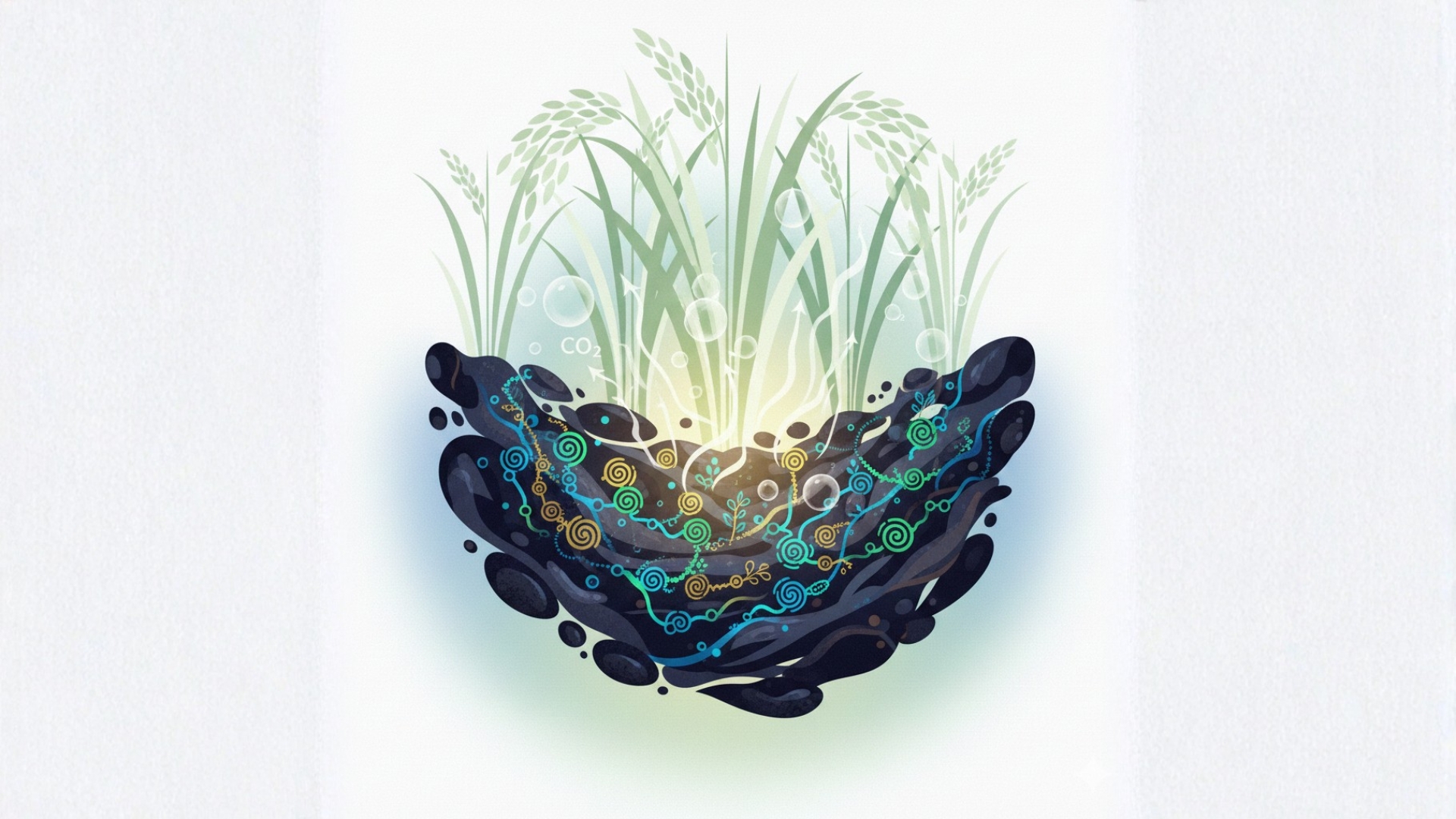
New research from Huimei Jiang and colleagues, published in Biochar, delves into the hidden world of soil microbes and their capacity to fix atmospheric carbon dioxide, a process often overshadowed by plant photosynthesis. The study explores how soil type (paddy versus upland), the plant root zone (rhizosphere), and the agricultural amendment biochar influence the potential and activity of microbial CO2 fixation through the Calvin cycle. The core finding is that soil type and the application of biochar are primary drivers of this crucial process, with the potential to explain up to 67% of the variation in key genetic indicators.
The Calvin-Benson-Bassham cycle is the most widespread CO2fixation pathway in farmland soils, catalyzed by the RubisCO enzyme. This enzyme’s large subunit is encoded by two functional genes, cbbL (Form I) and cbbM (Form II), which serve as markers for autotrophic carbon assimilation. Across both upland and paddy soils, the cbbL gene consistently dominated the cbbM gene, with a higher copy number by one to three orders of magnitude. The study confirmed that paddy soils, characterized by alternating wet and dry conditions, generally exhibit a stronger autotrophic carbon fixation potential, harboring one to two orders of magnitude more cbbM genes and tenfold greater RubisCO enzyme content than upland soils. The root zone, or rhizosphere, was also identified as a hotspot for CO2fixation genes and RubisCO activity, particularly in paddy soil.
Biochar application, a practice often used to improve soil properties, demonstrated a complex, non-uniform effect. In paddy soils, biochar amendment significantly reshaped the structure of autotrophic microbial communities. Importantly, the effect was gene-specific: biochar notably enhanced the relative abundance of Rhodopseudomonas within cbbM-bearing communities but decreased it in $cbbL$-bearing ones. This suggests that biochar induces a functional shift among facultative autotrophic taxa, highlighting a nuanced trade-off in carbon assimilation pathways. The random forest prediction models revealed that the relative abundance of cbbL and its ratio to total bacteria were reliably predicted in paddy soil, with the models explaining 53.69% and 67% of the variation, respectively. In these soils, inorganic nitrogen, redox potential (Eh), and urease activity were the main predictors. Conversely, in upland soils, the cbbL gene abundance was only marginally predictable (19.64% variation explained), mainly by nitrogen availability and microbial biomassBiomass is a complex biological organic or non-organic solid product derived from living or recently living organism and available naturally. Various types of wastes such as animal manure, waste paper, sludge and many industrial wastes are also treated as biomass because like natural biomass these More carbon.
The distinct environmental conditions of the two soil types account for these varying microbial responses. Paddy soils, with their low-oxygen and high CO2 microenvironments, favor the cbbM gene, which is less selective for CO2 and thus better suited for microaerobic niches. Conversely, the neutral to alkaline pHpH is a measure of how acidic or alkaline a substance is. A pH of 7 is neutral, while lower pH values indicate acidity and higher values indicate alkalinity. Biochars are normally alkaline and can influence soil pH, often increasing it, which can be beneficial More of upland soil was the primary factor correlated with cbbL abundance and the cbbL/16S ratio, suggesting that soil acidity directly affects the physiological conditions that promote cbbL-harboring microbes.
Furthermore, the study illuminated the interconnectedness of microbial functions. The Calvin cycle-mediated CO2 fixation was found to couple with various other biogeochemical pathways, including methylotrophy, methanotrophy, iron oxidation and respiration, nitrogen fixationNitrogen is a crucial nutrient for plant growth, but plants can’t directly absorb it from the air. Nitrogen fixation is a process where certain bacteria convert atmospheric nitrogen into a form that plants can use. Biochar can provide a home for these nitrogen-fixing bacteria, enhancing More and reduction, and arsenate reduction and detoxification. This multifunctionality underscores the broader ecological significance of these autotrophic microbes beyond simple carbon storage.
Collectively, these results emphasize that effective soil carbon sequestration strategies must be tailored to the specific soil type and its micro-environmental conditions. While cbbL is the dominant gene, the more sensitive cbbM gene and its associated RubisCO activity are crucial indicators of CO2 fixation activity, which are disproportionately influenced by biochar and nitrogen status. The study provides a mechanistic foundation for developing soil-type-specific, biochar-based management practices aimed at optimizing microbial carbon assimilation in agricultural ecosystems.
Source: Jiang, H., Han, S., Zhang, H., Liu, T., Huang, S., Zhu, X., Fang, J., Mu, J., & Zhu, X. (2025). Calvin cycle driven autotrophic CO2-fixation traits and autotrophic microbial communities in paddy (Anthrosol) and upland (Vertisol) soils: rhizosphere effects and impacts of biochar. Biochar, 7(1), 118.





Leave a Reply