
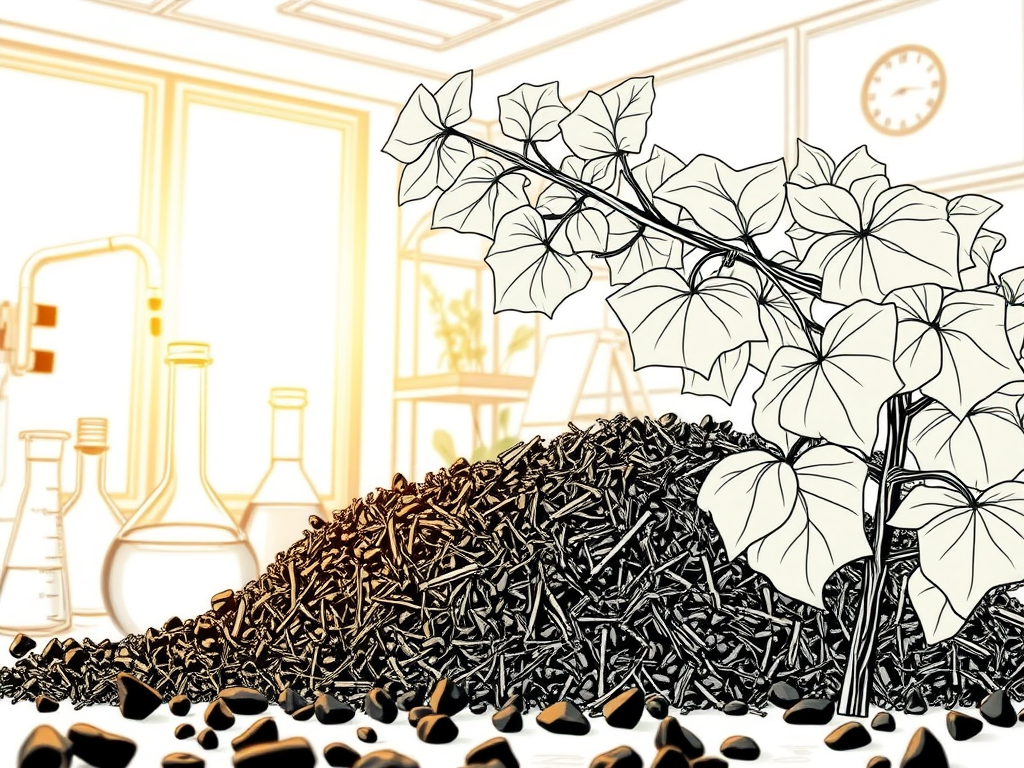
The escalating concentration of carbon dioxide (CO2) in the atmosphere, reaching an average of 419.3 ppm in 2023, and record emissions of 37.4 Gt, has intensified the global focus on efficient CO2 capture technologies. Traditional methods like chemical absorption face challenges due to high investment costs, significant thermal regeneration requirements, and potential environmental impacts. This has spurred interest in sustainable alternatives such as pressure swing adsorption (PSA), which is comparatively economical, scalable, and compact, requiring no heat or complex chemicals for regeneration. In a recent study published in ACS Omega, Daniel Mammarella, Katia Gallucci, and Andrea Di Giuliano explored the potential of biocharBiochar is a carbon-rich material created from biomass decomposition in low-oxygen conditions. It has important applications in environmental remediation, soil improvement, agriculture, carbon sequestration, energy storage, and sustainable materials, promoting efficiency and reducing waste in various contexts while addressing climate change challenges. More derived from vineyard pruning waste as a CO2 sorbent in PSA systems.
This innovative research focused on utilizing biochar from vineyard pruning pellets, a widely available agro-industrial waste, previously produced via pyro-gasification at two different Equivalence Ratios (ERs): 0.15 and 0.30. These biochar samples were then chemically activated to enhance their CO2 sorption capabilities. The study rigorously tested both as-received and activated biochar samples under pressure swing adsorption at room temperature and pressures of 5, 7, or 9 bar. The results were promising: the CO2-sorption capacities (Y) of these biochar samples were comparable to, or even surpassed, those of conventional reference sorbents. Activated biochar samples, particularly those produced at an ER of 0.15, exhibited the highest sorption capacities, reaching over 5.7 mmol CO2.
The enhanced performance of activated biochar is directly linked to a significant increase in its specific surface area (SBET) after activation, compared to negligible values in as-received biochar. This suggests that factors beyond just surface area contribute to sorption capacity, including the presence of trace elements like magnesium, potassium, calcium, phosphorus, and sulfur, which can act as additional active sites for CO2 adsorption. These elements were found in higher concentrations in the biochar produced at an ER of 0.15.
To systematically understand the factors influencing CO2 sorption, a 2³ factorial design of experiments was employed, considering pressure (P), equivalence ratio (ER), and “activation” as key variables. The statistical analysis revealed that activation and pressure had the most significant and positive main effects on CO2 sorption capacity. Increasing pressure consistently led to higher CO2 capture, while activation dramatically boosted performance across all pressure levels. The equivalence ratio, on the other hand, had a negative but less impactful effect. The interaction between pressure and activation was also significant, indicating that the positive effect of pressure was amplified when the biochar was activated.
The researchers developed an empirical linear regression model that effectively predicts the CO2 sorption capacity based on these factors. This model demonstrated high accuracy, with a determination coefficient (R2) of 0.995, meaning it explains 99.5% of the observed variation in CO2 sorption capacity. Crucially, the model’s extrapolation potential was validated against traditional Langmuir adsorption isotherms, showing deviations lower than ±5% in the extended pressure range of 4 to 11 bar. This predictive capability is vital for designing and scaling up industrial PSA systems for CO2 capture, as it allows for estimation of the required sorbent material and associated costs.
The study concluded that biochar derived from vineyard pruning waste, especially when chemically activated, offers a sustainable and efficient solution for CO2 capture via PSA. The consistent performance of the biochar over multiple PSA cycles, with no observed performance deterioration or loss of mechanical stability, further highlights its potential for long-term industrial applications. Future research will focus on practical considerations for industrial scaling, such as using industrially formed sorbent shapes (e.g., pellets) and evaluating the influence of transport phenomena and temperature variations, which are typically negligible at the laboratory scale.
Source: Mammarella, D., Gallucci, K., & Di Giuliano, A. (2025). Biochar from Waste Vineyard Pruning as a CO2 Sorbent in Pressure Swing Adsorption: Experimental and Modeling Study. ACS Omega.




Leave a Reply