
Key Takeaways
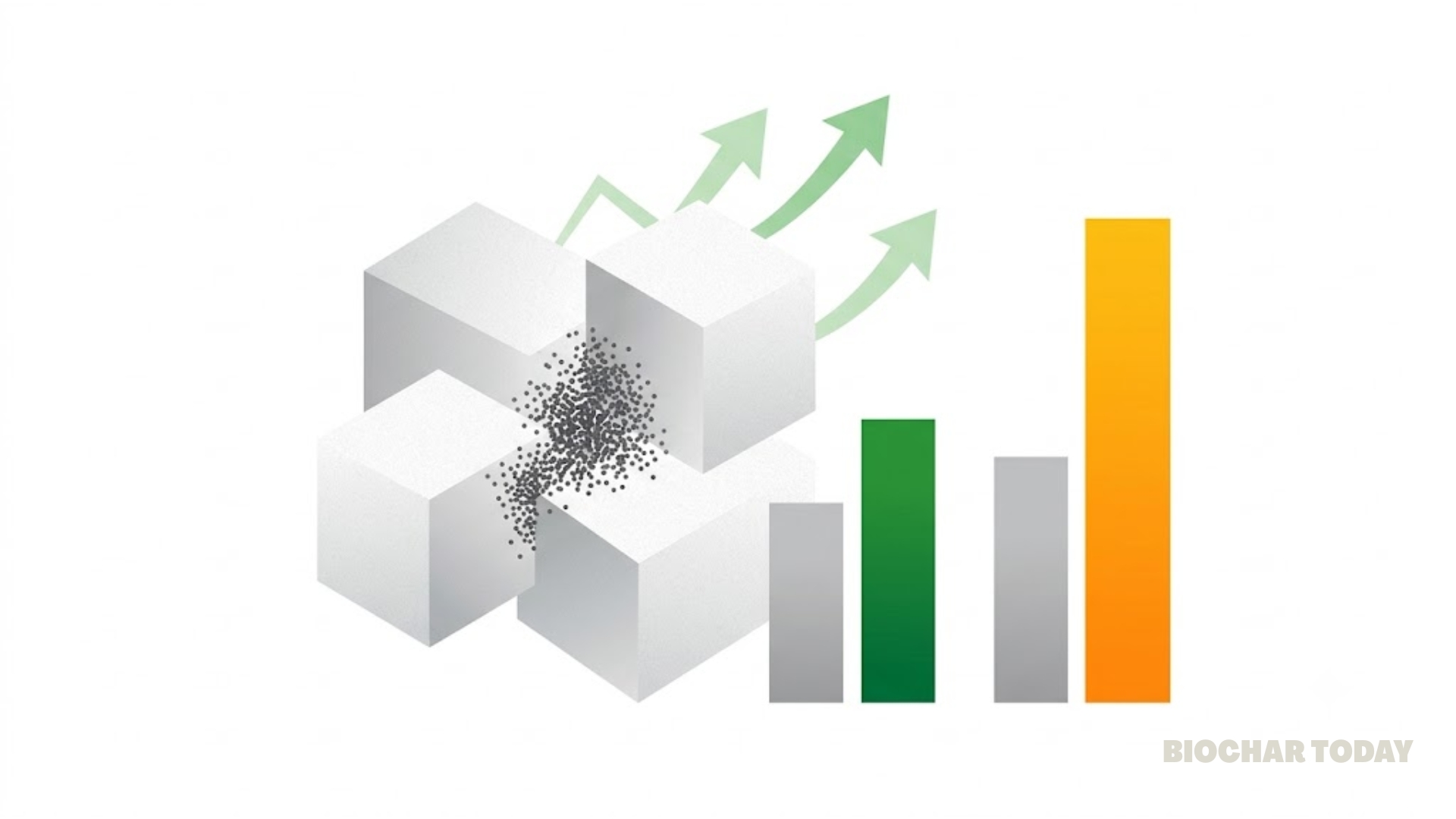
- Adding a small amount of fine coconut shell powder to natural hydraulic lime significantly improves its early strength and speeds up setting time.
- Fine carbon particles create internal pathways that help the material absorb higher amounts of carbon dioxide from the surrounding air.
- The optimal recipe uses two percent fine carbon powder by weight, balancing structural strength with maximum carbon storage capacity.
- Over time, absorbed carbon dioxide transforms inside the material into stable limestone minerals that fill micro-gaps and create a denser internal structure.
- This approach offers an eco-friendly material for restoring historical structures and constructing modern, low-carbon buildings.
In a study published in BiocharBiochar is a carbon-rich material created from biomass decomposition in low-oxygen conditions. It has important applications in environmental remediation, soil improvement, agriculture, carbon sequestration, energy storage, and sustainable materials, promoting efficiency and reducing waste in various contexts while addressing climate change challenges. More X, researchers Hao Zhang, Jiangtao Qu, Yue Gu, Yikun Li, Ao Li, and Zhenhua Wei investigated how biochar particle size and dosage affect the carbon dioxide absorption and mechanical properties of natural hydraulic lime. Natural hydraulic lime is widely favored in historic masonry restoration and eco-friendly construction due to its lower production energy demands, superior breathability, and natural ability to reabsorb ambient carbon dioxide during curing. However, its slow early strength development and moderate carbonation rates have limited its broader application in modern sustainable construction. By adding biochar—a porous, carbon-negative material derived from biomassBiomass is a complex biological organic or non-organic solid product derived from living or recently living organism and available naturally. Various types of wastes such as animal manure, waste paper, sludge and many industrial wastes are also treated as biomass because like natural biomass these More pyrolysis—the research team sought to create a high-performance, carbon-sequestering building material without compromising physical structural integrity.
The researchers evaluated biochar derived from coconut shells across three distinct particle sizes, corresponding to 100-mesh, 200-mesh, and 325-mesh, incorporated at dosages ranging from 1% to 5% by weight of the binder. Mechanical testing demonstrated that fine biochar particles significantly enhance mortar strength, particularly during the initial stages of curing. Mortar containing 2% of 325-mesh biochar achieved a 35.7% increase in compressive strength at three days, a 42.1% increase at seven days, and maintained a 10.9% improvement at twenty-eight days compared to unmodified control samples. The fine 325-mesh particles possess a large specific surface area that allows them to fill microscopic voids between lime grains, accelerating densification and structural rigidity. However, exceeding the 2% threshold led to a decline in mechanical strength across all particle sizes because excess porous carbon disrupted binder continuity and increased overall matrix porosityPorosity of biochar is a key factor in its effectiveness as a soil amendment and its ability to retain water and nutrients. Biochar’s porosity is influenced by feedstock type and pyrolysis temperature, and it plays a crucial role in microbial activity and overall soil health. Biochar More.
In addition to physical strength improvements, the addition of biochar substantially improved the gas absorption kinetics and total carbon sequestration capacity of the natural hydraulic lime. At a 2% dosage, the 325-mesh biochar increased carbon dioxide uptake by 14.6% after six hours and 11.9% after twenty-four hours of exposure, while increasing the overall carbonation rate by 3.2%. Microscopic and mineralogical characterizations confirmed that the highly porous network of biochar particles acts as an internal gas transport system, facilitating deeper carbon dioxide diffusion beyond the outer surface layer. Furthermore, biochar physically adsorbs gas molecules, creating localized areas of high carbon dioxide concentration within the material pores. This local enrichment drives the conversion of calcium hydroxide into stable, highly crystalline calcite, filling micro-voids and permanently locking away greenhouse gas within the building material.
The findings provide a clear framework for utilizing biochar to engineer low-carbon, durable lime materials. By balancing biochar fineness and dosage, builders and conservators can optimize early load-bearing capacity while maximizing direct atmospheric carbon capture. This biochar-modified natural hydraulic lime provides a practical, low-carbon alternative for preserving heritage masonry structures and advancing sustainable, green architectural practices.
Source: Zhang, H., Qu, J., Gu, Y., Li, Y., Li, A., & Wei, Z. (2026). Influence of biochar dosage and particle size on CO2 uptake and mechanical properties of natural hydraulic lime. Biochar X, 2, e017.


![Eucalyptus Wood Waste-Derived Biochar Achieves a Ninety-Eight Percent Removal Efficiency for Benzo[ghi]perylene in Vehicle-Wash Wastewater](https://biochartoday.com/wp-content/uploads/2026/10/SCIENCE-BLOGS-2026-2026-10-19T160523.703.jpg)


Leave a Reply