

By Giya Merline Kuriakose (Technical Assistant, Advanced Centre of Environmental Studies and Sustainable Development (ACESSD), Mahatma Gandhi University)
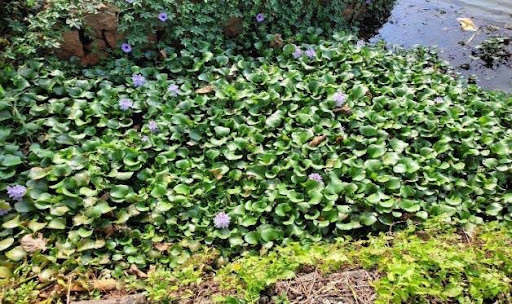
Water hyacinth, known to scientists as Eichhornia crassipes, is notorious for being one of the world’s most invasive aquatic weeds. This plant thrives in favorable conditions, quickly taking over lakes, rivers, and rice fields. Its rapid growth disrupts fishing, water transport, and local wildlife, making it a real problem for people and nature alike. But there’s a surprising silver lining: water hyacinth can absorb harmful heavy metals from water, making it a potential eco-hero.


Our research team at the Advanced Centre of Environmental Studies and Sustainable Development (ACESSD) in Kerala, India, including Miss Amalu Suresh, Sashaika Sajan, Shanty C. B., Soya Parveen, and Dr. Shanthi Prabha V, has discovered an ingenious way to turn this troublesome weed into something valuable. We have figured out how to convert water hyacinth into biocharBiochar is a carbon-rich material created from biomass decomposition in low-oxygen conditions. It has important applications in environmental remediation, soil improvement, agriculture, carbon sequestration, energy storage, and sustainable materials, promoting efficiency and reducing waste in various contexts while addressing climate change challenges. More, a renewable and low-cost adsorbent. Biochar is produced through pyrolysisPyrolysis is a thermochemical process that converts waste biomass into bio-char, bio-oil, and pyro-gas. It offers significant advantages in waste valorization, turning low-value materials into economically valuable resources. Its versatility allows for tailored products based on operational conditions, presenting itself as a cost-effective and efficient More, a process that involves heating organic material in the absence or limited supply of oxygen. This transformation not only mitigates the negative impact of this invasive species but also produces a valuable material for environmental applications.


The study focused on the conversion of E. crassipes biomassBiomass is a complex biological organic or non-organic solid product derived from living or recently living organism and available naturally. Various types of wastes such as animal manure, waste paper, sludge and many industrial wastes are also treated as biomass because like natural biomass these More spiked with copper (II) sulfate pentahydrate (CuSO4.5H2O) into biochar. The team analyzed the feedstockFeedstock refers to the raw organic material used to produce biochar. This can include a wide range of materials, such as wood chips, agricultural residues, and animal manure. More (initial biomass) and the resultant biochar using various techniques, including Fourier-transform infrared spectroscopy (FTIR) and scanning electron microscopy (SEM). These analyses helped characterize the properties of both the feedstock and the biochar. To detect the presence of heavy metals in the feedstock and biochar samples, the Acid Digestion Method was employed, followed by Inductively Coupled Plasma Mass Spectrometry (ICP-MS) analysis. This comprehensive approach ensured precise detection and measurement of heavy metal content.

The results were exciting. The biochar was found to be safe for use in soil without the risk of heavy metals leaking out. This discovery offers a double benefit: it helps manage an invasive weed and provides a safe, efficient way to clean up heavy metal pollution.
The findings of this study indicate that transforming water hyacinth into biochar offers a dual benefit. First, it provides an effective means of utilizing an otherwise problematic weed. Second, the resultant biochar serves as an efficient organic material for removing heavy metals from aqueous solutions. This innovative use of biochar derived from aquatic weeds not only enhances soil health but also offers a sustainable solution for environmental remediation.

By harnessing the potential of water hyacinth, we can address the challenges posed by this invasive species while creating a valuable resource for soil amendmentA soil amendment is any material added to the soil to enhance its physical or chemical properties, improving its suitability for plant growth. Biochar is considered a soil amendment as it can improve soil structure, water retention, nutrient availability, and microbial activity. More and heavy metal remediation. Moreover, the same can be used as a better heavy metal adsorbent from water also. This study paves the way for further exploration into the utilization of aquatic weed-derived biochar, contributing to sustainable environmental practices and improved soil health. This groundbreaking research not only redefines our approach to invasive species but also turns a formidable foe into a powerful ally in the quest for a cleaner, healthier planet.

Giya Merline Kuriakose is the Technical Assistant at the Advanced Centre of Environmental Studies and Sustainable Development (ACESSD), Mahatma Gandhi University, Kerala, India. I am passionate about conducting research on biochar and have successfully completed various studies and student projects in this field. Our team has published numerous papers and is actively engaged in innovative projects aimed at utilizing biochar for environmental management and sustainability.



Leave a Reply