
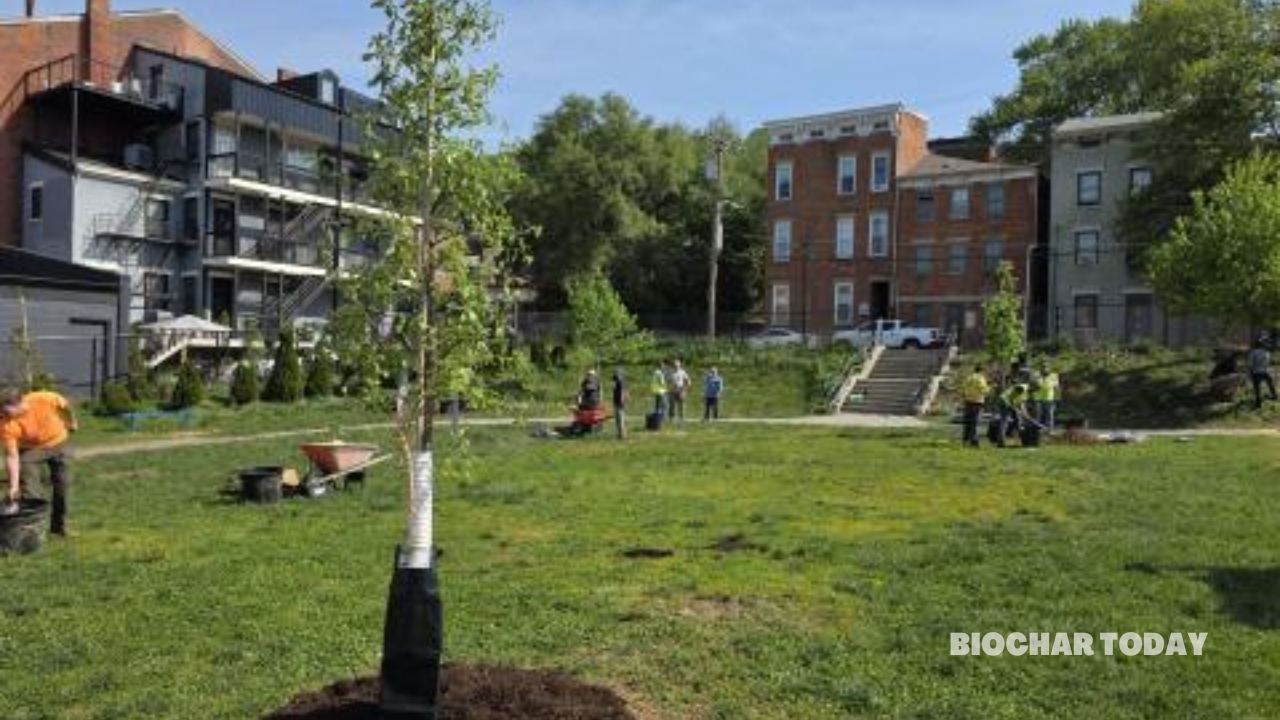
In the United States, Cincinnati Parks and Great Parks of Hamilton County, in collaboration with private consultant Carbon Harvest LLC, have commenced the development of a localized biocharBiochar is a carbon-rich material created from biomass decomposition in low-oxygen conditions. It has important applications in environmental remediation, soil improvement, agriculture, carbon sequestration, energy storage, and sustainable materials, promoting efficiency and reducing waste in various contexts while addressing climate change challenges. More production and composting infrastructure. Backed by financial support from Bloomberg Philanthropies, this municipal-scale initiative aims to establish a self-sustaining regional market for biochar. The program involves repurposing organic materials generated within the local park systems to produce high-quality soil amendments. By transitioning from out-of-state procurement to domestic production, the municipal partnership seeks to optimize resource management while actively advancing urban forestry goals and regional climate resilience.
The primary operational challenge addressed by this initiative is the inefficient and costly management of urban organic waste, which historically contributed to greenhouse gas emissions. Cincinnati Parks regularly generates substantial volumes of wood debris from tree pruning and maintenance, which previously released sequestered carbon back into the atmosphere through natural decomposition. Simultaneously, Great Parks faced recurring financial expenditures to haul away and dispose of tons of animal manure produced annually at the Winton Woods Farm & Equestrian Center. Furthermore, newly planted trees in the region frequently encounter high mortality rates due to the compacted, nutrient-poor clay soils characteristic of local urban environments.
To resolve these overlapping logistical and environmental challenges, the organizations designed an integrated, circular manufacturing framework. Cincinnati Parks is establishing a centralized production facility at its Sinton East Operation Center to process abundant wood waste into biochar via a high-temperature pyrolysisPyrolysis is a thermochemical process that converts waste biomass into bio-char, bio-oil, and pyro-gas. It offers significant advantages in waste valorization, turning low-value materials into economically valuable resources. Its versatility allows for tailored products based on operational conditions, presenting itself as a cost-effective and efficient More machine. Concurrently, Great Parks has initiated construction on a specialized composting facility in Winton Woods to process its surplus manure. Carbon Harvest LLC manages the operational integration, combining the raw biochar with the composted manure to generate a nutrient-rich, pre-conditioned soil amendmentA soil amendment is any material added to the soil to enhance its physical or chemical properties, improving its suitability for plant growth. Biochar is considered a soil amendment as it can improve soil structure, water retention, nutrient availability, and microbial activity. More that optimizes moisture retention and stabilizes root systems.
This collaborative framework yields measurable environmental and financial outcomes. The completed production facility will generate at least 300 tons of biochar annually, capturing hundreds of tons of carbon dioxide that would otherwise escape into the atmosphere. Utilizing the blended biochar amendment accelerates the composting timeline, mitigates agricultural odors, and improves the survivability of newly planted urban trees, directly counteracting local heat island effects. Financially, the project reduces municipal waste management costs, while the distribution strategy allocates one-third of the material for public tree canopies and sells the remaining two-thirds to commercial markets, utilizing product sales and verified carbon credits to ensure long-term fiscal self-sufficiency.


Leave a Reply