
A Global Challenge with Local Roots
Every year, millions of tonnes of crop residues are burned in open fields across the world, releasing massive amounts of carbon dioxide, particulate matter, and other pollutants. In India, the problem of stubble burning particularly from rice and wheat crops has become a pressing environmental issue, contributing to smog episodes and dangerously poor air quality.
The smoke is rich in fine particulate matter (PM2.5), carbon monoxide, and other harmful gases that linger in the air for days. These pollutants travel far beyond rural fields, choking nearby towns and large cities alike. In northern India, post-harvest burning often drives Air Quality Index (AQI) levels into the “severe” category, leading to school closures, reduced outdoor activity, and even flight disruptions.
The health impacts are equally alarming, prolonged exposure to such air pollution is linked to respiratory illnesses, aggravated asthma, cardiovascular problems, and reduced lung function, especially in vulnerable populations like children and the elderly. The economic costs, from healthcare burdens to lost productivity, further underscore the urgent need for sustainable solutions.
For me, this isn’t just an environmental statistic, it’s a daily reality. Living in Punjab, where stubble burning peaks after harvest seasons, I see first-hand the urgency to find viable, scalable alternatives to this practice.
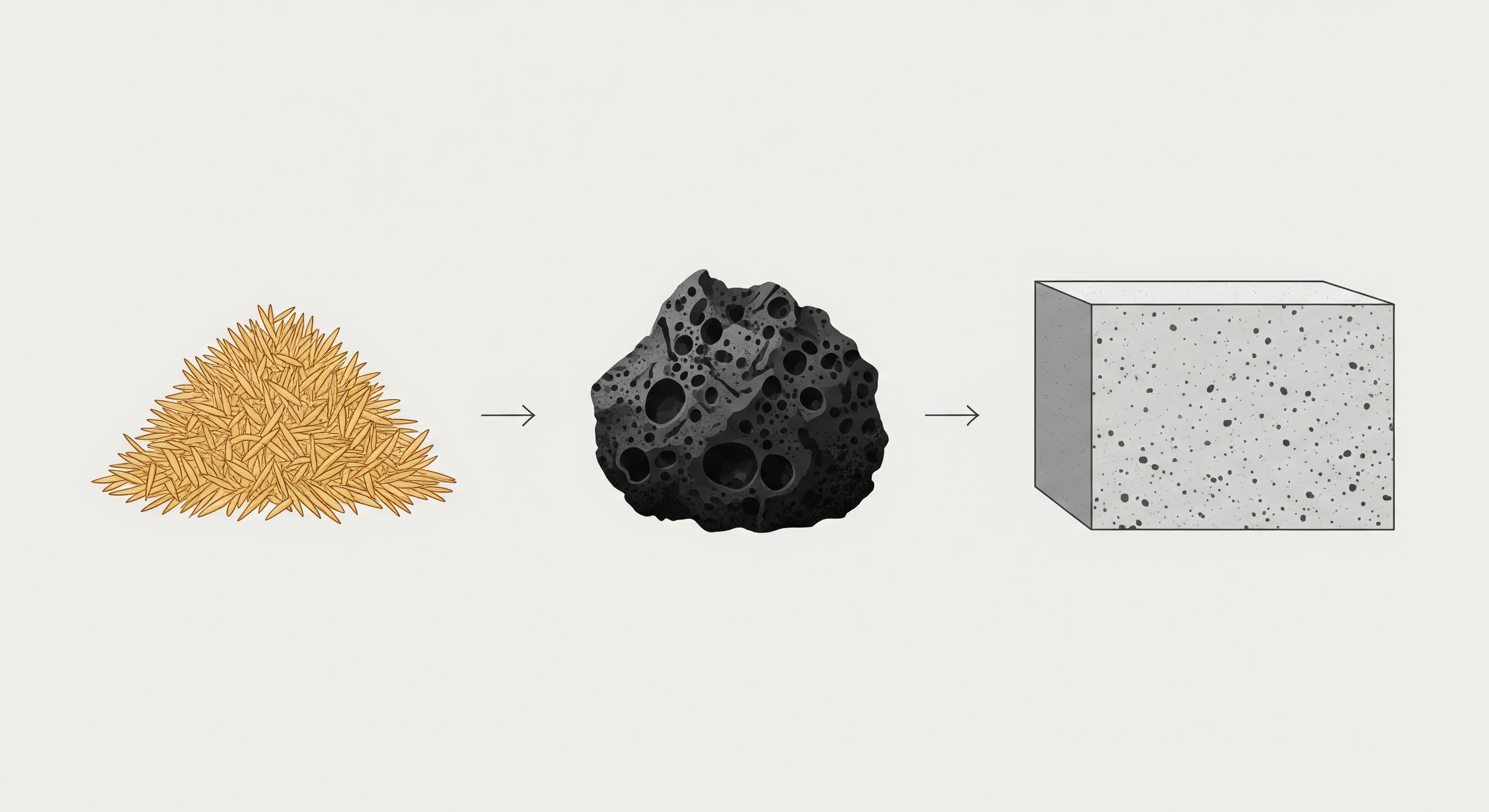
One promising solution? Transforming this agricultural waste into biocharBiochar is a carbon-rich material created from biomass decomposition in low-oxygen conditions. It has important applications in environmental remediation, soil improvement, agriculture, carbon sequestration, energy storage, and sustainable materials, promoting efficiency and reducing waste in various contexts while addressing climate change challenges. More, and then integrating it into one of the most widely used man-made materials on Earth, cement.
From Waste to Resource: What is Biochar?
Biochar is a carbon-rich, stable material produced when biomassBiomass is a complex biological organic or non-organic solid product derived from living or recently living organism and available naturally. Various types of wastes such as animal manure, waste paper, sludge and many industrial wastes are also treated as biomass because like natural biomass these More (like crop residues) is heated in a low-oxygen environment, a process known as pyrolysisPyrolysis is a thermochemical process that converts waste biomass into bio-char, bio-oil, and pyro-gas. It offers significant advantages in waste valorization, turning low-value materials into economically valuable resources. Its versatility allows for tailored products based on operational conditions, presenting itself as a cost-effective and efficient More. Unlike simple burning, pyrolysis locks much of the carbon into a solid form that resists decomposition for hundreds to thousands of years.
It’s often touted for its soil-improvement and carbon-sequestration benefits. But my research focuses on something different: using biochar as a partial replacement for cement in construction materials.
Why cement? Because cement production alone accounts for nearly 8% of global CO2 emissions. Replacing even a small fraction of cement with a sustainable alternative can create big environmental savings without compromising performance (Rashid and Singh 2023).
The Cement-Biochar Connection
At first glance, adding biochar to cement might sound unconventional. Cement is a finely balanced, carefully engineered binder, and even small changes to its composition can affect strength, durability, and workability. Yet biochar offers an intriguing opportunity because of its unique physical and chemical properties.
One of its most important traits is its high surface area and porous structure. These tiny pores, invisible to the naked eye, can store and gradually release water during cement hydration. This “internal curing” effect can help the cement paste develop more completely, improving strength and reducing cracking (Rashid et al. 2024b).
Biochar also plays a role in carbon sequestration. The carbon locked into its stable structure during pyrolysis remains fixed for decades, even centuries, once embedded in concrete. This means every cubic metre of biochar–cement composite isn’t just a building material—it’s also a long-term carbon store.
Chemically, the surface of biochar contains functional groups that can interact with the products of cement hydration, influencing the way crystals form in the microstructure. This interaction can lead to a denser, more refined pore network, which often translates into improved durability (Rashid et al. 2024a).
The challenge and the focus of my research has been to fine-tune the pyrolysis process and the mix proportions to maximize these benefits.
My Research Journey: From Pyrolysis to Performance
My journey with biochar began quite literally in the fields, standing among the golden stubble left behind after the rice harvest. While many see this as waste to be burned, I saw it as a resource with untapped potential. The process started with collecting stubble waste directly from farms, ensuring it was free from contaminants like plastic, glass, or metal debris. Once collected, the biomass was carefully washed to remove soil, dust, and residual agrochemicals, followed by sun-drying to bring down its moisture content and prepare it for thermal processing.
The next step was perhaps the most critical—optimizing the pyrolysis process. This involved experimenting with different temperatures and residence times to achieve the ideal balance between carbon content, surface area, and pore structure. By varying pyrolysis temperatures (450°C, 500°C, and 550°C) and residence times, I could see how these conditions influenced the biochar’s structure, surface chemistry, and performance. For example, biochar produced at 550°C tended to have a more ordered carbon structure and greater stability, while biochar from lower temperatures retained more oxygen-containing functional groups, which can enhance bonding in cement paste (Rashid et al. 2025b).
Beyond production, I explored physical modifications such as ball milling to reduce particle size, increase surface area, and alter pore distribution (Rashid et al. 2025a). This step proved important for improving how biochar disperses in the cement matrix. I also examined accelerated carbonation curing (ACC), a process that exposes fresh composites to controlled CO2, allowing the material to sequester additional carbon while improving mechanical performance. This combination of controlled pyrolysis, particle refinement, and CO₂ curing formed the backbone of my experimental program, bringing together multiple levers to enhance both sustainability and performance.
The Results So Far
The results from this research have been encouraging. At carefully optimized dosages—often around 5% to 7.5% by weight of cement—biochar has consistently enhanced both early-age and long-term compressive strength compared to control mixes. In some cases, strength gains reached as high as 40%, a remarkable outcome for a partial cement replacement. Durability indicators also improved: water absorption and void content were reduced, suggesting that biochar can help create a denser and more impermeable microstructure.
One of the most exciting outcomes has been the carbon sequestration potential. Under accelerated carbonation curing, biochar-cement composites not only maintained their mechanical strength but also absorbed significantly more CO2 than traditional mixes. This means the material could serve as both a structural element and a carbon storage medium. Biochar’s inherent porosityPorosity of biochar is a key factor in its effectiveness as a soil amendment and its ability to retain water and nutrients. Biochar’s porosity is influenced by feedstock type and pyrolysis temperature, and it plays a crucial role in microbial activity and overall soil health. Biochar More and functional groups act as active sites for CO2 binding, effectively locking carbon within the cement matrix. This means the material not only reduces cement consumption but also directly captures greenhouse gases, two sustainability wins in one innovation.
Of course, it hasn’t been without challenges, biochar’s high porosity can reduce fresh mix workability, which requires adjustments to water content or superplasticizer dosage. But with careful mix design, these hurdles can be overcome.
Why This Matters Beyond the Lab
The impact of this work extends far beyond academic interest. In many regions, especially in northern India, stubble burning remains a persistent environmental challenge, contributing to poor air quality, greenhouse gas emissions, and soil nutrient loss. By creating a viable, high-value use for this agricultural residue, we can transform it from a pollution source into a carbon-rich resource that supports both cleaner environments and more sustainable construction practices.
For farmers, biochar production could provide a viable economic incentive to move away from open-field stubble burning, turning what was once an environmental liability into a valuable product. For the construction industry, even partial replacement of cement with biochar represents a chance to reduce the sector’s carbon footprint while maintaining performance standards. And for the planet, the combination of reduced cement emissions and long-term carbon sequestration offers a tangible path toward climate mitigation.
This is a rare example of a “triple win” solution: improved rural livelihoods, greener infrastructure, and real progress toward carbon reduction goals. With the right policies, incentives, and industrial uptake, such solutions can shift the balance in how we produce both food and buildings.
Looking Ahead
While these laboratory-scale results are promising, the next step is to bridge the gap to real-world application. That means developing clear guidelines for producing biochar tailored to cementitious use, scaling up production in a way that is economically viable, and conducting pilot projects in collaboration with industry. A key focus will be exploring the incorporation of higher, yet optimal, dosages of biochar as a cement replacement—maximizing its potential for carbon sequestration while still maintaining the mechanical and durability requirements of construction materials.
There is also exciting potential for combining biochar with alternative binders, such as geopolymers, which could further lower the carbon footprint of construction materials. Equally important is assessing the life-cycle performance of biochar-cement composites to ensure that environmental benefits are genuine and sustained over time. My vision is to see stubble waste transformed from a seasonal pollution problem into a cornerstone of sustainable construction, a future where cleaner skies, stronger communities, and climate resilience are all built into the same material.
References
- Rashid, S., A. Goyal, A. B. Danie Roy, and M. Singh. 2025a. “Effect of Physical Modification of Biochar on Its Characteristics and Cementitious Properties.” J. Mater. Civ. Eng. https://doi.org/10.1061/JMCEE7.MTENG-20957.
- Rashid, S., A. Goyal, A. B. D. Roy, and M. Singh. 2025b. “Exploring the Potential of Stubble Waste Biochar for Sustainable Construction: Influence of Production Temperature on Cementitious Properties BT – Bio-Based Building Materials – Proceedings of ICBBM 2025.” S. Amziane, R. D. Toledo Filho, M. Y. R. da Gloria, and J. Page, eds., 771–782. Cham: Springer Nature Switzerland.
- Rashid, S., A. Goyal, A. B. Roy, and M. Singh. 2024a. Exploring the Potential of Stubble Waste Biochar as Sustainable Construction Material.
- Rashid, S., A. Raghav, A. Goyal, D. R. A.B., and M. Singh. 2024b. “Biochar as a sustainable additive in cementitious composites: A comprehensive analysis of properties and environmental impact.” Ind. Crops Prod., 209: 118044. https://doi.org/https://doi.org/10.1016/j.indcrop.2024.118044.
- Rashid, S., and M. Singh. 2023. “An Investigation on Carbon Dioxide Incorporated Sustainable Ready-Mix Concrete Using OPC and PPC.” Arab. J. Sci. Eng. https://doi.org/10.1007/s13369-023-08106-y.




Leave a Reply