
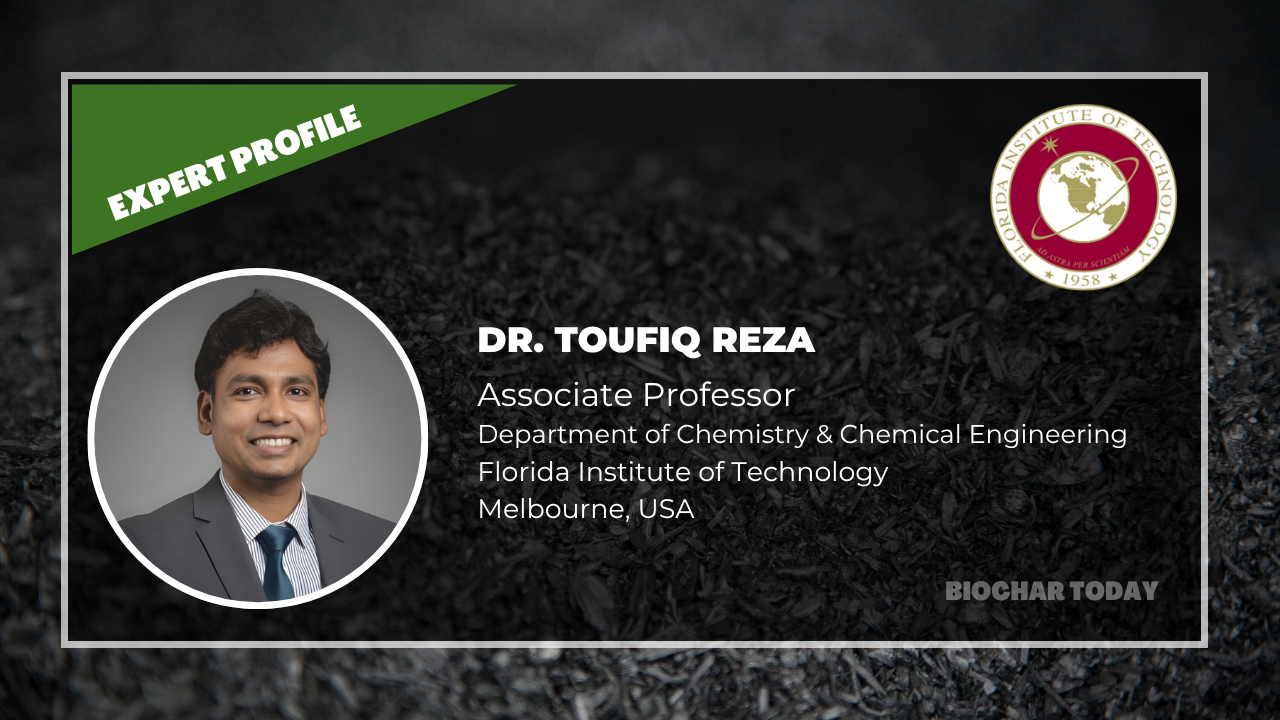
Dr. Toufiq Reza is a recognized expert in the field of sustainable materials engineering, currently serving as an Associate Professor of Department of Chemical Engineering and leading the Biofuels Research Lab at the Florida Institute of Technology. He also seves as a visiting research scientist of National Aeronautics and Space Administration (NASA). His expertise is fundamentally rooted in the science of converting waste feedstocks into high-value biocharBiochar is a carbon-rich material created from biomass decomposition in low-oxygen conditions. It has important applications in environmental remediation, soil improvement, agriculture, carbon sequestration, energy storage, and sustainable materials, promoting efficiency and reducing waste in various contexts while addressing climate change challenges. More and other materials, a focus he developed while earning his M.S. and PhpH is a measure of how acidic or alkaline a substance is. A pH of 7 is neutral, while lower pH values indicate acidity and higher values indicate alkalinity. Biochars are normally alkaline and can influence soil pH, often increasing it, which can be beneficial More.D. in Chemical Engineering from the University of Nevada, Reno, with specific work on thermal conditioning and Hydrothermal Carbonization (HTC) of lignocellulosic biomassBiomass is a complex biological organic or non-organic solid product derived from living or recently living organism and available naturally. Various types of wastes such as animal manure, waste paper, sludge and many industrial wastes are also treated as biomass because like natural biomass these More. This foundation was further cemented during his tenure as a Research Scientist at the Leibniz Institute for Agricultural Engineering in Germany, where he specialized in the efficient production of biochar from organic wastes.
Dr. Reza’s specific and impactful expertise in the biochar field is centered on Hydrothermal Carbonization (HTC) of various waste feedstocks to produce materials known as hydrochar. This process is critical because it converts raw biomass into a high-quality, lignite-type solid fuel. A primary application of his research is environmental remediation, where he utilizes this biochar technology for the removal of nutrients and toxins, notably to mitigate Harmful Algal Blooms (HABs), a vital project that has secured substantial funding from agencies like the USDA and EPA. Furthermore, he is at the forefront of developing biochar composite materials, demonstrating their use in advanced applications like carbon capture through research on zeolite-modified hydrochar that significantly enhances CO2 adsorption performance. This comprehensive approach, spanning production, advanced characterization, and application for both energy solutions and environmental cleanup, establishes Dr. Reza as a leading authority in the sustainable conversion of waste-to-resources, a contribution acknowledged by his inclusion in the World’s Top 2% Cited Scientists list from 2020 through 2024.
It is my privilege to introduce Dr. Toufiq Reza to the readers of Biochar Today.
Shanthi Prabha: Dr. Reza, you’re recognized as a ‘World Top 2% Scientist.’ While others might focus on different areas, you’ve built a world-class research program on what many people would just call ‘waste’—things like manure, sargassum, and food scraps. What is the hidden, high-impact potential you see in these feedstocks that the rest of us are missing?
Dr. Toufiq Reza: I would say the availability and economics of organic waste. Even with the improvement of recovery, recycle, and reuse, we will still have plenty of waste around us. This is truly a sustainable source of feedstockFeedstock refers to the raw organic material used to produce biochar. This can include a wide range of materials, such as wood chips, agricultural residues, and animal manure. More. It is also very challenging and fascinating to work with them, as each feedstock is different from each other and they are even different among themselves. Just look into our trash bin, each day we eat different food and produce different waste. No wonder why this well-known sustainable feedstock has yet to find a uniform conversion technology.
SP: You lead the Biofuels Research Lab at Florida Tech, focusing on biochar from waste feedstocks. What, in your opinion, is the most problematic waste feedstock today that holds the most untapped promise for creating biochar?
TR: In my opinion, it varies with the location. For instance, we are currently worried about Sargassum inundation, which might not be a problem to the rest of the U.S. It is also an opportunistic feedstock and a very tricky one due to seasonal availability. Organic fraction of municipal solid waste or food waste is a common feedstock, but the heterogeneity makes this as a challenging feedstock.
SP: A lot of your recent, heavily-funded research is on remediating Harmful Algal Blooms (HABs). This is a massive issue in Florida and beyond. How exactly does biochar work to mitigate these blooms? Are you filtering the water, adsorbing toxins, or is something else happening?
TR: Indeed, harmful algal bloom is a serious problem for Florida in every aspect from environment, ecology, and economy. We believe biochar could play vital role in tackling this issue. Much of the earlier research involves biochar socks for nutrient removal. Removing nutrients is important and it could prevent the harmful algal bloom, however, if the bloom is already happening, there is a need to control and mitigate the bloom. We found that biochar itself can absorb harmful algal bloom toxins. However, it is unable to remove the harmful algal bloom cells without modification. Therefore, we have been exploring various biochar modifications that removes harmful algal bloom and it’s toxins simultaneously.
SP: One of your EPA-funded projects specifically mentions using Sargassum-derived biochar. That’s a brilliant example of turning a major environmental problem into a solution. What are the biggest technical challenges in converting seaweed into a consistent, effective biochar?
TR: Yes, that was exactly the idea to convert a regional problem into a viable solution. We are still in the early stages of the research. There are two challenges associate with sargassum biochar for harmful algal bloom remediation, (1) the quality of sargassum biochar is lower than the wood-derived biochar, due to its high ashAsh is the non-combustible inorganic residue that remains after organic matter, like wood or biomass, is completely burned. It consists mainly of minerals and is different from biochar, which is produced through incomplete combustion. Ash Ash is the residue that remains after the complete More and halogen content. This prompt additional preprocessing steps for biochar production, (2) lack of reliable and consistent source of sargassum at the industrial scale.
SP: Beyond just cleaning water, you’re also researching biochar-based seagrass restoration. This sounds more proactive. How can biochar be used to help seagrass grow, and what have your results shown so far?
TR: Seagrass is an inherent component of the marine ecology and a healthy seagrass bed results in enhancing water quality, promoting biodiversity, and flourishing aquaculture. Based on terrestrial applications, we now are confident that biochar enhances soil quality and improve crop production, however, biochar application for seagrass growth is largely unknown. We have started to explore biochar to improve seagrass health and growth. The data, yet to be published, are very promising, as we see as low as 1% biochar addition improves seagrass health and growth.
SP: Your research isn’t just about char; you’re also an expert in Deep Eutectic Solvents (DES). This isn’t a term we hear every day. How do these “designer solvents” intersect with your work, and can they help create better biochar products?
TR: Deep eutectic solvents are tunable, green, and biocompatible. They can be designed for specific applications like biochar functionalization and carbon capture from pyrolysisPyrolysis is a thermochemical process that converts waste biomass into bio-char, bio-oil, and pyro-gas. It offers significant advantages in waste valorization, turning low-value materials into economically valuable resources. Its versatility allows for tailored products based on operational conditions, presenting itself as a cost-effective and efficient More process to reduce carbon footprint. Our recent works include DES-functionalized biochar to target harmful algae toxin removal from water. We are still exploring many opportunities that combines biochar/pyrolysis with DES.
SP: A recent LinkedIn post highlighted your new paper on a “zeolite-modified hydrochar composite” for carbon capture. What’s the “superpower” of this composite? Is this a more effective, stable way to sequester carbon than just burying raw biochar in soil?
TR: Zeolite-modified composites have added benefits, especially for carbon capture application that we studied in this paper. We showed in our study that 5% addition of ZSM5 improves carbon capture on activated biochar a few folds due to enhanced porosityPorosity of biochar is a key factor in its effectiveness as a soil amendment and its ability to retain water and nutrients. Biochar’s porosity is influenced by feedstock type and pyrolysis temperature, and it plays a crucial role in microbial activity and overall soil health. Biochar More and functionality. In prior studies, zeolite-modified biochars have also proven effective for soil improvement and enhanced crop production.
SP: This next one is fascinating. You’ve published on “co-activation of Martian Regolith and Hydrochar” and you’re a Visiting Professor at NASA. What’s the goal here? Are we talking about farming on Mars, and how does hydrochar make that scientifically possible?
TR: In order to sustain Mars missions, growing food on Mars is critical. Unfortunately, Martian regolith (soil) lacks carbon and nutrients. What we are trying is to convert inedible parts of the food plants (like tomato plants) into biochar to improve regolith carbon and nutrient content and also improve porosity and water retention. In my opinion, this is a vital step towards sustainable agriculture in the Space.
SP: From Florida’s estuaries to the soils of Mars, you’re showing that biochar isn’t just one single product. Where do you see the most immediate and impactful future for this technology? Is it in agriculture, remediation, or advanced materials?
TR: Biochar technology has been advancing at a rapid pace. Although much of the earlier studies focused on soil amendmentA soil amendment is any material added to the soil to enhance its physical or chemical properties, improving its suitability for plant growth. Biochar is considered a soil amendment as it can improve soil structure, water retention, nutrient availability, and microbial activity. More and carbon sequestration, we believe that biochar has a lot more to offer. In my opinion, water application of biochar research has been emerging as an immediate and impactful sector. Also, pyrolysis byproducts are also grabbing attention and much immediate research have been around valorization of pyrolysis byproducts like wood vinegar, pyrolysis gas, and pyrolysis crude.
SP: As a “Top 2% Scientist” who is incredibly productive , what advice do you give your graduate students who want to make a real-world impact in the biowaste and biochar sector?
TR: Two most common pieces of advice I always give my students are (1) look into the impact of the research. It has to reach to the community and bring value to the people and the environment. And (2) a successful technology has to be economically viable, simple, and effective. The waste sector is always on a breakeven scenario, and the stakeholder will only be interested in technology when we bring real value to the industry. Industry will also likely not to take the risk, and it is our job to derisk biochar technology so that the industry can make the decision quicker and easier.
SP: Your research on ‘co-activation of Martian Regolith and Hydrochar’ is fascinating—it feels like you’re writing the real science manual for what Mark Watney had to improvise. Is the ultimate goal to help future Mars colonists move beyond just surviving on potatoes and establish a truly sustainable food system, perhaps one that relies a bit less on… ‘creative’ fertilizer recipes?
TR: We have to think about independency of the Mars colony. It is not sustainable for the colony to rely on supply from Earth. We have to think creatively about the constraints on the Mars atmosphere and plan accordingly with the food sustainability. The knowledge we gathered on the Earth is vital to survive on Mars, but we need to think beyond on how a colony can be self-sufficient.
SP: Finally, your work is generating a lot of new ideas for our community. Where is the best place for our “Biochar Today” readers to follow your research, find your publications, and see what your lab is working on next?
TR: The Biochar Today readers could follow my work on my LinkedIn and University website. Research Gate and Google Scholar are also easier to find our publications. Of course, the readers could always email me and ask their questions.
- LinkedIn: https://www.linkedin.com/in/toufiq-reza-5051a420/
- Webpage: https://research.fit.edu/reza/
- Research Gate: https://www.researchgate.net/profile/M_Toufiq_Reza
- Google Scholar: https://scholar.google.com/citations?hl=en&user=tj18MicAAAAJ&view_op=list_works&sortby=pubdate




Leave a Reply