
Key Takeaways
- BiocharBiochar is a carbon-rich material created from biomass decomposition in low-oxygen conditions. It has important applications in environmental remediation, soil improvement, agriculture, carbon sequestration, energy storage, and sustainable materials, promoting efficiency and reducing waste in various contexts while addressing climate change challenges. More isn’t just fancy charcoalCharcoal is a black, brittle, and porous material produced by heating wood or other organic substances in a low-oxygen environment. It is primarily used as a fuel source for cooking and heating. More; it’s an engineered carbon derived from biomassBiomass is a complex biological organic or non-organic solid product derived from living or recently living organism and available naturally. Various types of wastes such as animal manure, waste paper, sludge and many industrial wastes are also treated as biomass because like natural biomass these More waste, designed to be stable and multi-functional.
- Its most famous use, dating back centuries, is creating Terra Preta—exceptionally fertile, long-lasting dark earth soils in the Amazon.
- Biochar is an all-in-one farm tool: it boosts soil water retention by up to 100% in sandy soils, increases crop yields, and reduces the need for chemical fertilizers.
- Beyond the farm, it’s a critical material for advanced technology, improving battery electrodes, strengthening concrete, and acting as a sustainable pigment in ink.
- Using biochar in a “cascade” maximizes its value: first in animal feed, then in compost, and finally as a stable carbon sink in soil.
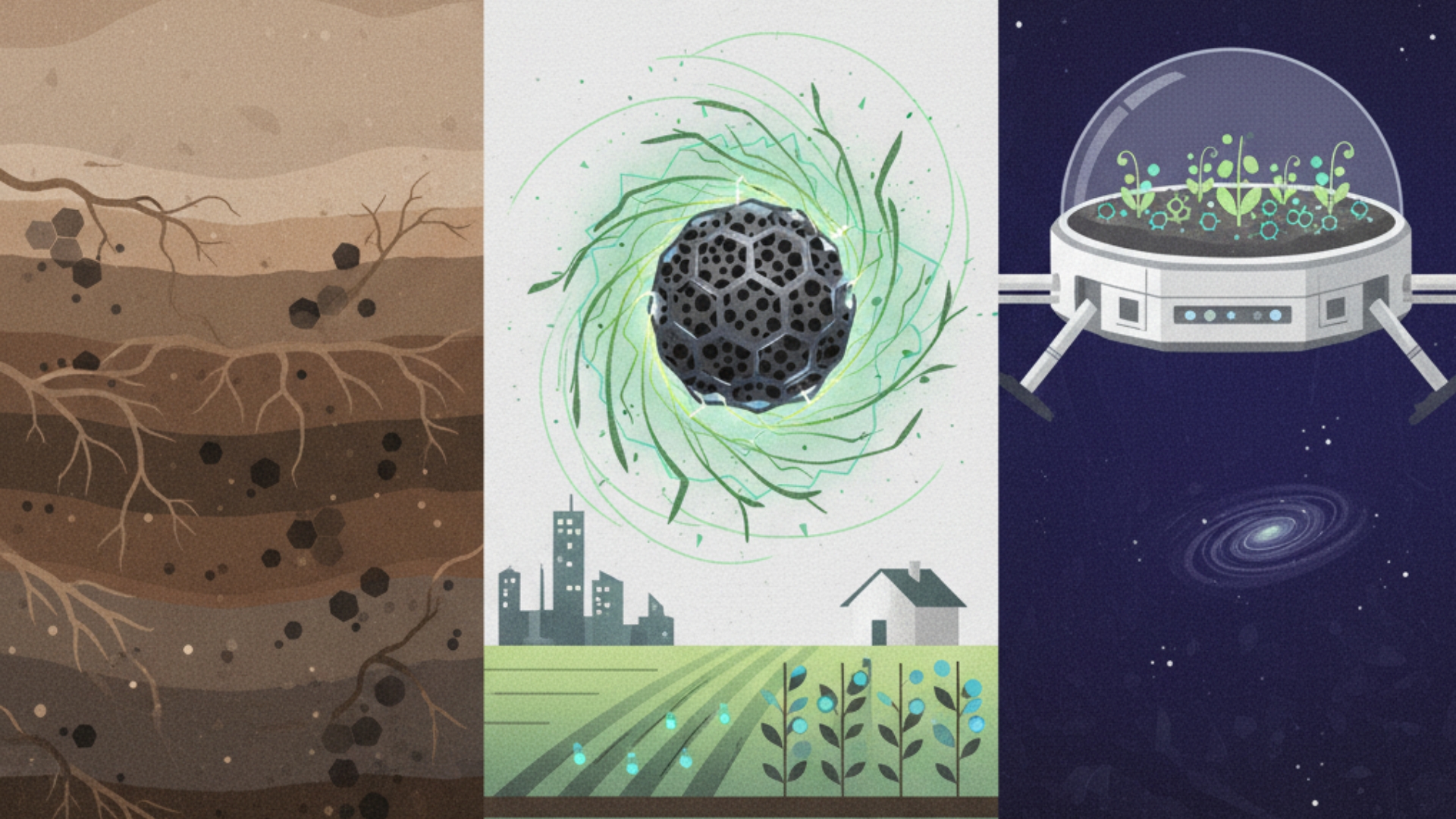
Imagine a single material derived from farm waste that can hold carbon for centuries, help astronauts grow food on Mars, and make your phone battery last longer. Yes, the stable carbon-rich substance biochar- historically, its fundamental application was as a soil amendmentA soil amendment is any material added to the soil to enhance its physical or chemical properties, improving its suitability for plant growth. Biochar is considered a soil amendment as it can improve soil structure, water retention, nutrient availability, and microbial activity. More, a legacy proven by the existence of the famous, fertile Terra Preta soils in the Amazon basin. These soils, created by ancient inhabitants, remain highly fertile centuries later, demonstrating biochar’s remarkable stability and long-term benefit.
Biochar on the Farm and Beyond
Today, biochar is much more than a simple soil additive; it is recognized for applications across numerous fields, sometimes referred to as the start of a “carbon renaissance”.
In agriculture, biochar acts as a powerhouse, addressing core challenges. It improves the availability of nutrients like potassium and generally increases crop yields. Critically, it helps farmers fight drought by dramatically increasing the soil’s water holding capacityWater holding capacity is the amount of water that soil can retain. Biochar can significantly increase the water holding capacity of soil, improving its ability to withstand drought conditions and support plant growth. More (WHC). In sandy soils, studies have documented that biochar can increase WHC by 30% to a full 100%. This improvement is driven by its intricate network of pores that act as tiny physical reservoirs for water and nutrients. Furthermore, its use can shift the soil’s biological environment, favoring bacteria over fungi, thus altering the soil’s microbial community.
The use of biochar also extends to animal health. When added as a feed supplement in livestock farming, it improves digestion, helps adsorb toxins, and boosts overall productivity and feed efficiency. A practical benefit is a rapid decrease in diarrhea incidence and calmer animals. As the biochar passes through the animal, it becomes enriched with nitrogen, turning the excreted biochar-manure complex into a more valuable organic fertilizer, minimizing nutrient losses.
Engineering Carbon for a High-Tech World
Biochar’s utility is so broad because its properties can be fine-tuned. The key to high performance lies in careful production: maximizing structural stability and conductivity, often achieved by using higher processing temperatures.
In sustainable energy, modified biochar is an excellent candidate for supercapacitor electrodes. Modifications increase its surface area and conductivity, yielding devices with specific capacitance and energy density 1.6 to 6.0 times higher than those made with materials from simpler production methods. This same adaptable structure also shows promise for use in large-scale redox flow batteries. For energy recovery, converting waste feedstocks like coffee grounds into biochar can increase their Higher Heating Value (HHV) by up to 83.11%, making it a viable solid biofuel.
In construction, when added at low replacement rates (e.g., 3 wt% or less than 5% of cement mass), biochar acts as a nucleation site that enhances the microstructure of concrete, improving mechanical strength and durability. Due to its inherent porosityPorosity of biochar is a key factor in its effectiveness as a soil amendment and its ability to retain water and nutrients. Biochar’s porosity is influenced by feedstock type and pyrolysis temperature, and it plays a crucial role in microbial activity and overall soil health. Biochar More, it can also act as a building insulator, regulating humidity and offering relatively lower thermal conductivity than standard concrete. Blending it with clay creates indoor plasters that can absorb water up to six times their weight and help maintain indoor humidity levels.
Finally, the applications reach into the most unexpected niches:
- Air Purification: In biofiltration systems, it adsorbs gaseous pollutants like H2S, which are then metabolized by microorganisms living on the biochar surface.
- Industrial Pigments: It serves as a sustainable substitute for carbon black in inks, and its electrical properties allow it to be used in screen-printed thin films.
- Biomedicine: Its porosity makes it a carrier for drugs in advanced drug delivery systems, and it acts as a scaffold material in regenerative medicine to support cell growth.
- Space Agriculture: It is the key amendment used to convert barren Mars or Lunar regolith simulants into soil suitable for food crop growth in crewed space missions.
The sheer versatility of biochar demands a cascading use approach. A single batch can first be used for its high energy potential, then as a feed additive for livestock, enriching the resulting manure, and finally worked into the soil, where its high aromaticity and stability guarantee its function as a stable long-term carbon sink for generations. Making this resource universally understood and standardized is the next step to ensuring it becomes a common, transformative tool in our sustainable future.




Leave a Reply