
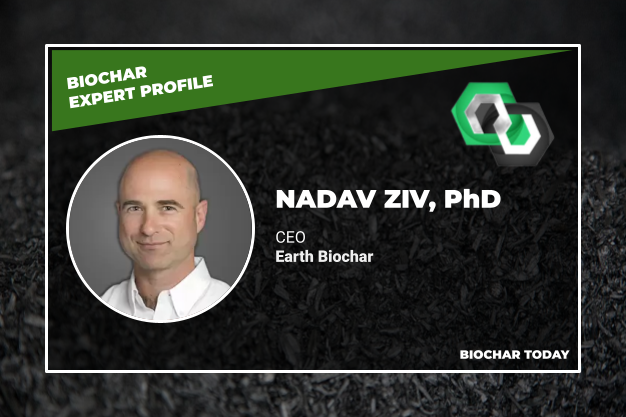
This is the fourth in a new series of Biochar Expert Profiles, where we celebrate those who have dedicated their passion, expertise, and innovation to advancing the field of biocharBiochar is a carbon-rich material created from biomass decomposition in low-oxygen conditions. It has important applications in environmental remediation, soil improvement, agriculture, carbon sequestration, energy storage, and sustainable materials, promoting efficiency and reducing waste in various contexts while addressing climate change challenges. More. These experts come from all walks of life: renowned scientists whose groundbreaking research has redefined possibilities, emerging researchers whose fresh perspectives are shaping the future, industry leaders who are growing the market through new technologies and business models, and unsung heroes who work tirelessly to enrich soils with biochar. Whether it’s their pioneering techniques, insightful discoveries, or unwavering dedication, these individuals are the heart and soul of the biochar revolution. By highlighting their contributions and sharing their knowledge, this series aims to inspire the biochar community at large.
The career trajectory of Dr. Nadav Ziv is a witness to the unexpected intersections of scientific disciplines and the power of applied research. With a foundation in medical neurobiology, culminating in a PhD focused on the mechanisms of chronic pain, Nadav’s analytical mind and problem-solving skills found a new outlet in the realm of sustainable agriculture. His morphing from the intricacies of the human brain to the complexities of soil health began in his own backyard, where the challenge of managing agricultural waste, specifically date palm fronds, sparked a profound interest in biochar. This initial curiosity blossomed into Earth Biochar Ltd., a company now integral to Israel’s largest organic recycling park, OR.
Nadav’s leadership and R&D expertise have been pivotal in developing CompoChar, a specialized biochar-based growing medium that exemplifies his commitment to practical, effective solutions for farmers and gardeners. He champions a holistic approach, viewing biochar not as an isolated product, but as a component within a broader system of regenerative agriculture and environmental stewardship. His work extends beyond soil enhancement, exploring biochar’s potential in water purification and waste treatment, reflecting a deep understanding of its versatile applications. Moreover, As an IBI Board Member, he also contributes to the global advancement of biochar understanding and implementation.
Nadav’s perspective, shaped by both scientific rigor and entrepreneurial drive, offers valuable insights into the ongoing evolution of biochar technology and its role in addressing global environmental challenges. I am excited to share this insightful conversation with the Biochar Today readership.
Shanthi Prabha: You started in neuroscience, studying the complexities of the human brain, and now you’re leading a biochar company. That’s quite a twist! What led you from medical research to biochar, soil and sustainability?
Nadav Ziv: My doctoral research focused on the study of pain, and we discovered a mechanism that explains how acute pain becomes chronic. In my last role, I managed a physiology lab that trained first-year medical students on the activity of muscle and nerve cells, and in the following year, on the physiology of all body systems using very advanced medical equipment. During these years, I moved with my family from the city of Jerusalem to the countryside and was exposed to the problem of handling agricultural wood waste, mainly date palm fronds. I have always loved thinking about problems and looking for solutions. The issue of wood waste caught my attention. Biochar as a solution for excess wood waste was one of the first directions I explored. Ten years have passed since then. In the last two years, our development has focused on treatments for plant diseases using biochar. Learning about the diseases and thinking about ways to treat them brings me back ‘home’ in terms of my professional journey
SP: Earth Biochar started as a backyard project for managing farm waste and is now part of Israel’s largest organic recycling facility. Did you ever expect it to grow this big? What were some key moments in that journey?
NZ: In the early years, I produced biochar in simple facilities that I built myself from palm branches from the orchard of my kibbutz. I was still working at the university, and I did the production on weekends in the orchard. The first experiments using biochar were in the kibbutz’s vegetable growing areas. I quickly realized that to obtain reliable results, I needed to collaborate with researchers in the field. From the very beginning, the orientation of my biochar project was towards a business direction with a very strong research and scientific emphasis. I was fortunate to meet the managers of Compost Or – the largest compost factory in Israel. Together, we established Earth Biochar. I was an active partner in the transformation that the compost factory underwent, becoming a recycling park for organic waste. Today, four companies operate on the factory grounds, treating organic waste in different ways in a model of collaboration and circular economy. In my view, such infrastructure is the best model for establishing such businesses.
SP: Biochar is being called a hope for sustainable agriculture. In simple terms, what makes it so unique, and why should farmers and gardeners be paying attention?
NZ: Biochar is a soil additive made from carbon. Soils in general, and especially agricultural soils, undergo depletion of carbon content, which is very important for their health and to support life within them. Increasing the carbon content in the soil through the application of biochar also enhances water retention and increases microbial diversity. We participated in research that showed that biochar prevented the development of a fungal soil disease called Fusarium crown rot. Our best-selling product for agricultural soil and gardening is biochar that has undergone composting, making it biologically active and nutrient-rich (CompoChar). Thanks to CompoChar, some farmers significantly reduce the use of pesticides because the plants are less diseased. Our mission at Earth Biochar is to produce specialized biochar products that replace some of the mineral fertilizers and some of the toxic pesticide sprays. In my opinion, this is the most sustainable agriculture.
SP: You’ve developed gasifier prototypes and experimented with agricultural waste like palm fronds. What were some of the biggest technical challenges you faced along the way?
NZ: I recommend anyone who is considering entering the field of biochar to start by working with simple facilities. Understanding the process of carbonization/pyrolysis, the quality of the product, and its properties must be a combination of hands-on learning with theoretical learning. There are not many professional fields that one can enter immediately without a large financial investment. A small and simple facility like Kon-Tiki or TLUD is inexpensive and allows you to start gaining experience in production, use, and marketing. Every challenge encountered along the way, such as types of materials, small production capacity, learning about fire safety, and dealing with the dangers of incompletely extinguished biochar, is critical.
SP: CompoChar is a soilless growing media for agriculture and gardening. How does it work, and what makes it different from traditional soil amendments?
NZ: I will take this opportunity to share an insight that might sound provocative but helps me in developing my business: “No one wants to buy biochar.” I think this is one of the obstacles for other biochar producers worldwide and perhaps even for the entire field. If you ask many gardeners and farmers, you will find that as a product, biochar is still anonymous. Additionally, its marketing is unclear, it doesn’t have a defined function, and sometimes it requires additional steps after the sale, such as ‘charging’ with nutrients and microorganisms, which is often a limitation for customers. My analogy for biochar is flour. No one wants to buy flour. Everyone wants bread, rolls, croissants, etc. All of these are products with a defined function. To sell the flour, the baker had to perform a few more steps like mixing with other ingredients, kneading, and baking to create a product that the customer wants. I think we biochar producers need to go the extra mile for our customers. We need to produce ready-to-use biochar. An example of this is our CompoChar. It is a basic soil product. We mix 30% biochar with 70% compost in the middle of the process and allow the biochar to be charged with nutrients and a microbial system. The customer only needs to apply it to the soil and reap the benefits.
SP: There’s much talk about biochar’s role in carbon sequestration and climate change. From your experience, how much potential does it have in helping us combat global warming?
NZ: I started my business with the goal of preventing polluting biomassBiomass is a complex biological organic or non-organic solid product derived from living or recently living organism and available naturally. Various types of wastes such as animal manure, waste paper, sludge and many industrial wastes are also treated as biomass because like natural biomass these More fires. Unfortunately, such fires still occur frequently in my area, wasting all the carbon that plants absorbed during photosynthesis and, moreover, releasing toxic gases due to uncontrolled burning. Within agricultural and urban biomass that is inevitably produced and pruned, millions of tons of CO2 are stored, which can be turned into a resource through a relatively simple process. I believe that household waste also has great potential for pyrolysisPyrolysis is a thermochemical process that converts waste biomass into bio-char, bio-oil, and pyro-gas. It offers significant advantages in waste valorization, turning low-value materials into economically valuable resources. Its versatility allows for tailored products based on operational conditions, presenting itself as a cost-effective and efficient More as an alternative to landfill and the release of potent greenhouse gases like methane. I don’t know if we can reverse the situation solely through such actions, but biochar is just one tool, and if we utilize its mechanism along with other methods and mechanisms, there is a chance we can slow down the rate of human emissions.
SP: Israel is known for its cutting-edge agricultural technology. How does biochar fit into that landscape, and what kind of support is there for biochar innovation in the country?
NZ: Israel is a very small country, and as far as I know, Earth Biochar is the only company in the field of biochar. However, there are many interested parties, and I believe new groups will join the effort, and there is definitely a room for everyone. Israel is advanced in agricultural technologies and also very advanced in water treatment and recycling technologies. There is, of course, a very strong connection between water and agriculture in a semi-arid area like Israel. As the Israeli representative in the biochar arena, I can say that we are trying to create as many interfaces as possible with companies and researchers in agricultural technologies and also creating collaborations in water technologies, mainly in the context of treating wastewater with pollutants using filtration with special types of biochar that replace activated carbonActivated carbon is a form of carbon that has been processed to create a vast network of tiny pores, increasing its surface area significantly. This extensive surface area makes activated carbon exceptionally effective at trapping and holding impurities, like a molecular sponge. It is commonly More. Additionally, we have developed biochar products from municipal sewage sludge that undergo pyrolysis and are free of pollutants and pathogens, currently used by farmers in Israel for vegetable cultivation. There is great interest in our biochar in the field of regenerative agriculture, and we are collaborating with farmers and organizations that promote the field.
SP: As an IBI Board Member and CEO, you see both the research and business sides of biochar. What are the biggest obstacles preventing wider adoption, and what do you think needs to change?
NZ: I see how scientific research is exploring biochar and moving forward with inspiring developments not only in agriculture but also as activated carbon for pollutant absorption, as electrodes used as sensors in biological systems, and even in green concrete and asphalt, and much more. On the other hand, I see the industry in this field still struggling with the reality of the ‘valley of death’ for businesses, where setting up factories is still expensive, economic feasibility is uncertain, production capacity is low, the price of biochar is relatively high for most agricultural customers, and there is a problem with properly marketing a product with good potential but still not mature enough like well-known and good solutions.
The solution? Bridging the scientific knowledge in a way that manufacturers can use it practically. In this context, I am sure that your work at Biochar Today is doing wonders in making knowledge accessible in an available and attractive way. I can tell you that I created a collection of Biochar Today posts and sent them ‘as is’ to customers in the wine vineyard growing sector as part of marketing to the growers’ agronomists.
Additionally, I think the International Biochar Initiative (IBI) played a very significant role in raising awareness of biochar and even as an authoritative source of knowledge at a time when there was very little information about biochar. The IBI gave the critical push within the IPCC to be included in the prestigious club of carbon capture mechanisms and legitimate carbon credit trading. The IBI has a significant role both today and in the future, mainly in creating a center for meeting and connecting different parties, creating a supportive international community, creating opportunities, and a sense of belonging. Our power as a community is much greater than the sum of us individually.
SP: What new applications or breakthroughs in biochar technology are you most excited about? Are there any emerging markets where you see huge potential?
NZ: I have no doubt that the technology for producing biochar in pyrolysis facilities will develop as a method for treating and breaking down pollutants such as PFAS, micro-pollutants, pharmacological substances, pesticides, and other toxins. We have a tool that can heal many damages caused by years of polluting industrial activity. Earth Biochar has a project with Israel’s national water company, ‘Mekorot’, specifically in developing a method for breaking down PFAS in sewage sludge and creating a biochar filter to absorb pollutants from wastewater. I hope that the correct and open concept of regenerative agriculture will expand and become a common practice. Biochar has much to contribute to agriculture that supports soil health and uses minimal toxic substances. Biochar is essentially a sponge, and this material really ‘asks’ for connections with additional components. For example, we are part of a consortium of the Israel Innovation Authority that deals with developing the use of the black soldier fly for treating organic waste, and we are researching the combination of frass in our biochar. The frass-biochar connection is synergistic. The biochar is charged with available nitrogen, a healthy microbial system, and bio-stimulants like chitin that enhance plant immunity. This is just one example of a specific connection, and it is clear to me that in other places, interesting and fruitful connections are found that we would be happy to learn from.
SP: Do you have some lovely snaps from your experimental garden to share? If So, please.
NZ: My home garden truly thrives on biochar, but this is relatively new, and I must give credit to my wife, who has been saying for years that “the shoemaker goes barefoot” if I sell biochar to gardens and greenhouses all over Israel, but she doesn’t benefit from it at home… In the last two years, I have converted our entire garden to grow on Earth Biochar products. We live in a desert area, and gardening here is not trivial, so you could say I use the garden as a testing lab for products still in development and examine how they perform in a very harsh climate. I can say that using our biochar products also helps improve my marriage life 😉.
SP: For researchers, entrepreneurs, or startups looking to get into the biochar industry, what’s your best advice? What are the key things they should know before diving in?
NZ: In general, I suggest that researchers and entrepreneurs look for each other and try to work together. When it works, the manufacturer gains insights into the use of biochar that are much higher than what we can achieve alone. For researchers, the advantage is the opportunity to work with a real market product, creating a connection between science and the real world. I suggest that entrepreneurs focus on their customers and not fall in love with the concept of biochar. Ultimately, the business will thrive if there are enough customers who love your product and are happy to pay for it. There are many other aspects related to any business, such as supply chain, logistics, branding, marketing, and sales, which are no different in the biochar business and should not be forgotten.
SP: As someone who has studied both the brain and biochar, how would you do it if you had to compare soil health to brain health? Is biochar like a multivitamin for soil, or is it more like a full-on therapy session?
NZ: In my opinion, there is a lot in common and parallel when comparing the health of the brain and body to the health of the soil. When I hold biochar in my hand, I see the element carbon. These are atoms that were once air, then became wood and fruit, and later were consumed by an animal or human, and now after pyrolysis, they are again in my hand in the pure form of carbon. Carbon is nature’s Lego blocks, and its connections create living beings. Today, when we introduce biochar products into conventional agriculture, I feel that its first mission is to detoxify the soil. At the same time, we are introducing a healthy microbial system into the soil, like good yogurt for our stomach. These are our simple uses today. If we know how to wisely work with this wonderful Lego blocks of nature and create from it the products for food production and water preservation, we will succeed in improving our environment, health, and climate.





Leave a Reply