
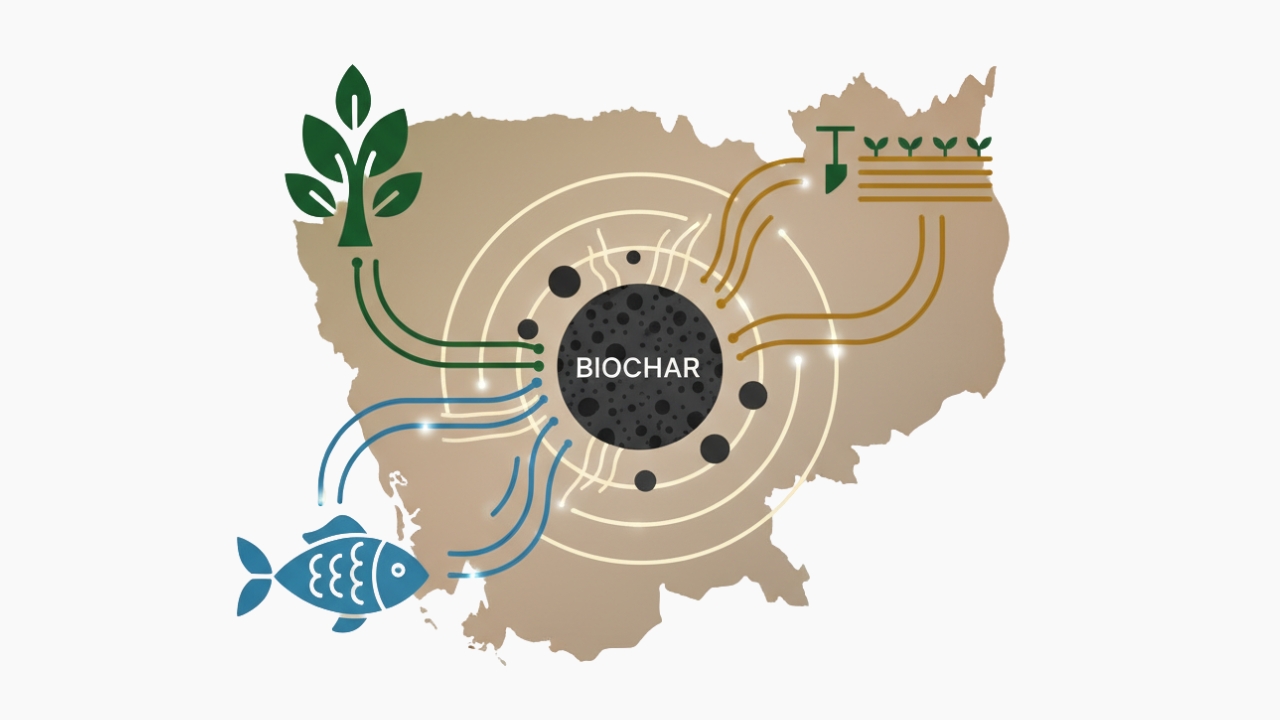
The nations along the Mekong River are undeniably captivating, rich in biodiversity and vital waterways. Yet, as I explored in the latest premium profile for our Nations of BiocharBiochar is a carbon-rich material created from biomass decomposition in low-oxygen conditions. It has important applications in environmental remediation, soil improvement, agriculture, carbon sequestration, energy storage, and sustainable materials, promoting efficiency and reducing waste in various contexts while addressing climate change challenges. More series, Cambodia – a nation deeply tied to the Mekong’s resources – is at a critical environmental crossroads. Its resource-intensive economy, reliant on agriculture, fishing, and forestry, faces severe challenges: rampant deforestation, high greenhouse gas emissions from its staple rice production, and escalating water quality issues for its rural and fishing communities.
The verdict seems clear: Cambodia has a unique opportunity to leverage its most abundant agricultural waste stream – rice husks, as well as other waste biomasses – to strategically deploy biochar and pivot from climate vulnerability toward a path of regenerative development.
What is the Forest and Farm Biochar Connection?
Cambodia has one of the world’s highest rates of forest loss, driven by commercial expansion and the need for new farmland. When land is cleared, the remaining soil is often poor, making reforestation efforts difficult.
This is where biochar provides a dual benefit:
- Reforestation Success: Incorporating biochar into nursery soil or degraded land acts as a powerful soil conditioner, dramatically improving the survival and growth rates of native tree seedlings by retaining water and nutrients.
- Reducing Pressure: By boosting the productivity of existing, degraded agricultural plots, biochar reduces the economic incentive for farmers to clear new forest land. Utilizing biochar made from forest residues or rice husks helps regenerate these old plots, maximizing current yields and creating a more compelling economic choice than expansion.
How can Biochar Decarbonize the Paddy Field?
Rice is central to Cambodian life, but the wet cultivation practices in its vast paddies release significant amounts of potent greenhouse gasses: methane (CH4) and nitrous oxide (N2O). Crucially, rice milling generates an estimated 1.74 million tonnes of rice husks annually, a massive waste stream that is often poorly managed.
The solution is a perfect circular-economy fit: Rice Husk Biochar (RhB).
RhB is an ideal amendment for paddy soil. Related studies show that its incorporation can not only increase rice yield—by as much as a 16% average—but also significantly reduce N2O emissions.
This isn’t just theory. Enterprises like Husk Ventures are already proving this on the ground, having created the region’s first European Biochar Certification (EBC) facility from organic rice husks. Their results are staggering: average crop yield increases of 44% and an average income boost for smallholder Cambodian farmers of 23%. This transforms a national waste problem into an affordable, high-quality fertilizer.
How can Biochar Improve Cambodia’s Water Security?
The health of the Mekong River and Tonle Sap Lake is non-negotiable for Cambodia’s fishing industries and public health. Contamination from runoff and waste is a major risk.
Biochar offers a decentralized, low-cost solution for water purification. Its highly porous structure is a powerful adsorbent, binding to and removing contaminants like heavy metals, ammonia, and excess nutrients (nitrates and phosphates).
This is directly applicable to the vital fishing sector. In aquaculture systems, biochar can be used as a biofilter medium to dramatically improve water quality, reducing toxic levels of ammonia and nitrite, which in turn boosts the health and survival rate of cultured fish species. Projects like the V-BIOCHAR initiative are already training local communities to build simple pyrolysisPyrolysis is a thermochemical process that converts waste biomass into bio-char, bio-oil, and pyro-gas. It offers significant advantages in waste valorization, turning low-value materials into economically valuable resources. Its versatility allows for tailored products based on operational conditions, presenting itself as a cost-effective and efficient More units from local materials to produce this life-saving filter media.
How can we Build an Accessible Biochar Ecosystem in the Mekong Region?
While neighboring countries often lead in industrial biochar scale-up, Cambodia is building a strong foundation focused on decentralized, community-level impact. The success of companies like Husk Ventures, who can generate Carbon Removal Credits (CRC) to subsidize the cost of biochar for small farmers, combined with localized training programs like V-BIOCHAR, is crucial. By emphasizing low-cost pyrolysis technology transfer, biochar production becomes an accessible small-scale enterprise, essential for a country with highly decentralized agriculture.
Cambodia is in a position to transform a source of pollution (its massive rice husk residue) into a strategic asset for climate mitigation, land restoration, and public health improvement.
For an in-depth analysis of the socio-economic factors driving deforestation, the specific facts and figures, and the financial mechanisms driving the biochar market in Cambodia, read the full profile in our Nations of Biochar series.


Leave a Reply