
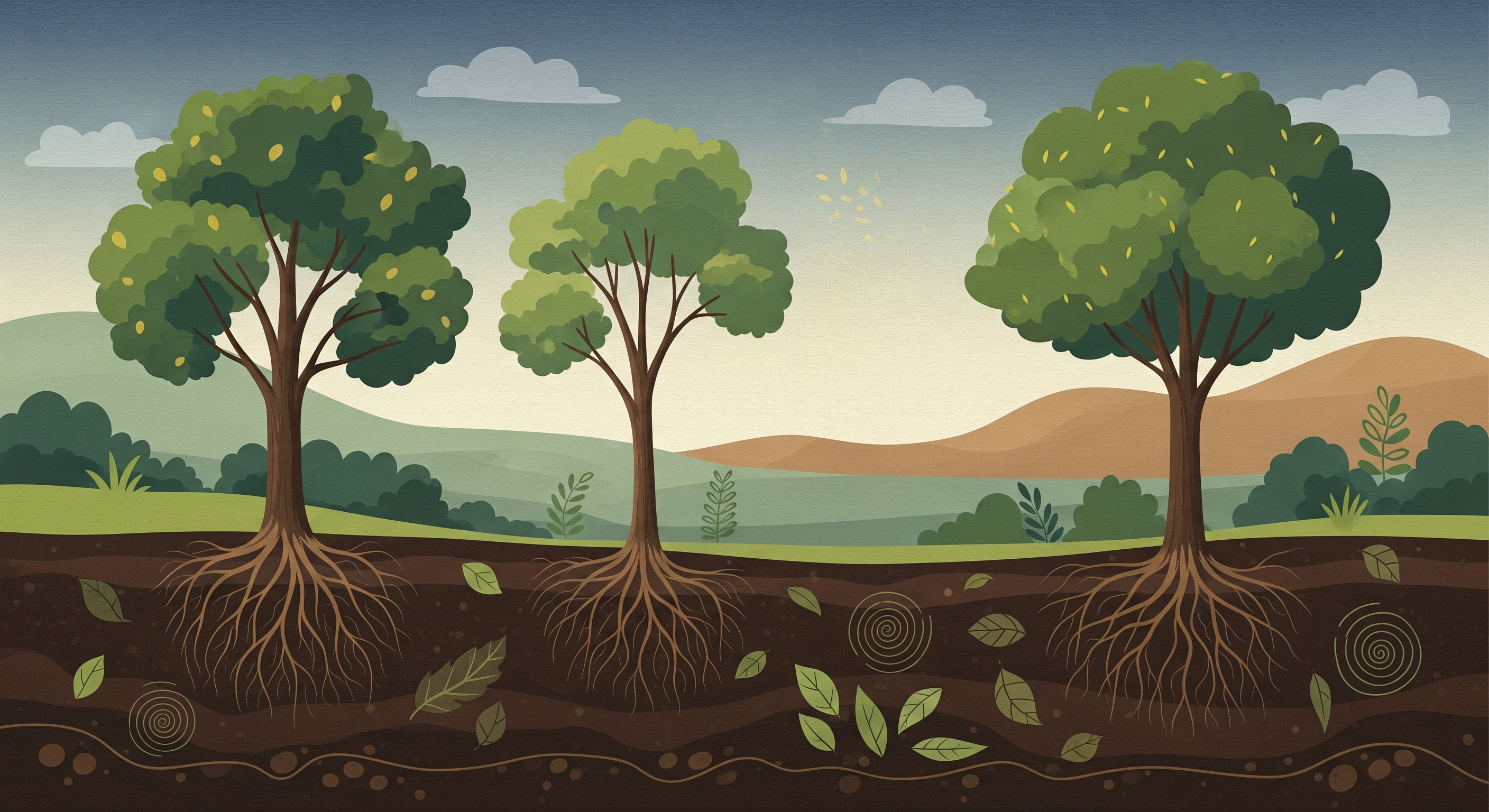
The atmospheric concentration of carbon dioxide (CO₂) has reached an alarming 429 parts per million (ppm). According to the 2024 UN Environment Programme’s Emissions Gap Report, annual global CO₂ emissions in 2023 reached 57 gigatonnes, with the average annual per capita emission standing at 6.6 tonnes of CO₂ equivalent. These staggering figures underscore the urgent need for scalable, stable, and efficient carbon dioxide removal (CDR) technologies.
ARR: Nature’s Oldest Carbon Sink
Afforestation, Reforestation, and Revegetation (ARR) — categorized under Nature-Based Solutions (NbS) — is the most traditional and widely practiced method of CDR. ARR works by capturing atmospheric carbon through biomassBiomass is a complex biological organic or non-organic solid product derived from living or recently living organism and available naturally. Various types of wastes such as animal manure, waste paper, sludge and many industrial wastes are also treated as biomass because like natural biomass these More accumulation and soil carbon enhancement. This technique has long been recognized by the Intergovernmental Panel on Climate Change (IPCC) and incorporated into the UNFCCC’s Clean Development Mechanism (CDM) since the early 2000s.
Several landmark afforestation and reforestation initiatives across the globe have played a pivotal role in addressing environmental degradation and enhancing climate resilience. The Green Belt Movement in Kenya, founded in 1977 by Wangari Maathai, focused on environmental conservation and empowering communities through tree planting. In 1978, China launched the Great Green Wall to combat desertification and sandstorms by restoring forests in the Gobi and Taklamakan deserts. The Pearl River Basin CDM A/R Project, initiated in 2006, marked China’s first afforestation project registered under the Clean Development Mechanism (CDM) following the Kyoto Protocol. In 2011, the Bonn Challenge, spearheaded by Germany and the IUCN, set an ambitious target to restore 350 million hectares of degraded land globally by 2030. India launched the Green India Mission in 2014 under its National Action Plan on Climate Change (NAPCC), with the goal of increasing forest cover by 5 million hectares over a decade.
Although ARR holds significant potential for carbon removal and microclimate improvement, its long-term effectiveness is often hindered by various implementation challenges. Permanence risks remain a major concern, as forests are highly vulnerable to wildfires, which can abruptly reverse years of carbon sequestration efforts. Additionally, pest infestations can severely weaken trees, reducing their ability to absorb and store carbon. Low sapling survival rates are common, often resulting from poor soil nutrition, inadequate irrigation, and exposure to harsh climatic conditions during early growth stages. Degraded soil quality further exacerbates these issues, limiting both plant viability and the potential for optimal carbon capture. Moreover, the delayed nature of carbon sequestration in trees—often requiring several decades to reach peak capacity—poses a temporal challenge in the context of urgent climate mitigation goals.
These barriers call for innovation — and this is where BiocharBiochar is a carbon-rich material created from biomass decomposition in low-oxygen conditions. It has important applications in environmental remediation, soil improvement, agriculture, carbon sequestration, energy storage, and sustainable materials, promoting efficiency and reducing waste in various contexts while addressing climate change challenges. More enters the frame.
Biochar: A Natural Ally to ARR
Biochar is a porous, carbon-rich material known for its long-term stability, largely due to the presence of recalcitrant carbon. A study by Chiaramonti et al., (2024) found that biochar contained inertinite—a highly stable form of carbon—that remained unchanged even after 15 years in soil. Inertinite, as noted by Sanei et al., (2024), is considered the most stable type of maceral in the Earth’s crust and serves as a benchmark for assessing organic carbon permanence.
When integrated into ARR projects, biochar plays a vital role in enhancing long-term carbon storage in soils while also supporting carbon removal by improving soil health, promoting plant growth, and fostering beneficial microbial activity.
ARR and Biochar: Backed by Scientific Synergy
In a study by Drake et al., (2015), biochar was added to soil at rates of 0, 1, 3, and 6 tonnes per hectare, along with a mix of forest tree seeds at three locations in western Victoria, Australia. The highest dose (6 t/ha) led to a 15.6% increase in soil carbon in low-carbon soils. This treatment also improved nutrient availability, which supported better plant growth. Across all three sites, biochar application increased soil phosphorus, nitrate (NO₃⁻-N), and electrical conductivity, while reducing ammonium (NH₄⁺-N). The interaction between biochar and soil enhanced nitrogen cycling, improving plant access to nutrients and water, and ultimately increasing seedling survival by reducing competition for limited resources.
Lefebvre et al., (2019) studied the impact of combining biochar with fertilizer on Guazuma crinite and Terminalia amazonia over a six-month period, using a total of 1,100 plants. Biochar was applied at two rates—1 kg/plant and 5 kg/plant. The results showed that the 1 kg/plant biochar plus fertilizer treatment led to better plant performance, including higher survival rates, greater height and stem diameter, more leaves, and increased above- and below-ground biomass. In contrast, the 5 kg/plant application resulted in poorer growth and lower survivability, likely due to nutrient immobilization, underscoring the importance of applying biochar at appropriate rates.
Another article presents biochar as a sustainable strategy for wildfire prevention. Forest thinnings, which typically act as fuel for wildfires, can be converted into biochar and returned to the soil. This not only reduces the available fire fuel but also helps retain soil moisture, thereby lowering the risk of fire outbreaks triggered by dry conditions.
A review study by (Iacomino et al., 2022) highlights that biochar can help control harmful organisms such as fungi, oomycetes, viruses, bacteria, nematodes, and weeds. It does this by supporting beneficial microbes in the root zone, suppressing nematodes, absorbing phytotoxic compounds from plants and microbes, and preventing the germination of parasitic weeds.
Overall, biochar improves soil health by creating a more balanced and resilient ecosystem, which supports healthier plant growth.
Global Examples of ARR-Biochar Synergy
Seedball Kenya is an initiative aimed at restoring degraded lands across Africa by reintroducing native tree species. Each seed is coated with biochar, which shields it from predators as well as from extreme temperatures, until the rainy season begins. Once it absorbs moisture, the seedball helps maintain a damp microenvironment around the seed, promoting successful germination. Since September 2016, the initiative has distributed over 41.9 million seedballs.
Forests by Heartfulness (India) utilizes activated biochar in the Hearty Culture Dense Forest (HDF) technique to accelerate the creation of mini-forests at Kanha Shanti Vanam. Spanning a total area of 10,000 acres, the initiative currently supports 40 afforestation projects across India, achieving a sapling survival rate of 85–90%.
The agroforestry project in Northern Kenya, in collaboration with PlantVillage, supports plantation efforts in the arid regions of Northern Kenya. In this initiative, biochar is applied alongside chicken and cow manure. Additionally, activation with mycorrhizal fungiThese are friendly fungi that form a partnership with plant roots. They act like an extension of the root system, helping plants access water and nutrients more effectively. Biochar can create a cozy habitat for these helpful fungi, boosting their growth and improving plant health. More enhances plant resilience against pests, harsh climatic conditions, helping to mitigate water stress and improve nutrient availability.
In Nepal, the afforestation project by Ithaka Nepal and MinErgy, initiated in 2015, has been using biochar-based organic fertilization. The project is implemented in Bandipur and Ratanpur, and the carbon credits generated have been sold in voluntary carbon markets, providing an additional income source for participating families.
In Germany, extreme drought and bark beetle infestations have severely damaged forests. To restore these areas, Naturetreet, in partnership with Novocarbon, is applying biochar during replanting efforts. The biochar improves plant resilience to drought, enhances microbial diversity, and contributes to increased soil carbon content.
An afforestation project in Massachusetts, USA, aims to develop a Miyawaki forest through a collaboration between Makepeace Companies and Sustainable Redbrook. For this initiative, the soil blend includes 10% biochar, which accelerates the development of native forest species, improves site resilience, and enhances carbon capture.
Why It Matters
The integration of biochar with ARR offers a powerful, nature-based solution for scalable and sustainable carbon removal. This synergy not only improves sapling survival, soil moisture retention, and microbial health, but also strengthens nutrient cycling and resistance to pests and diseases—key factors for long-term ecosystem resilience, simultaneously mitigating wildfire risks and promotes circular biomass utilization. Most importantly, it bridges the temporal limitations of biological sequestration with the long-term stability of engineered carbon storage, making it a promising pathway for achieving durable, gigaton-scale carbon removal.
References
- Chiaramonti, D., Lotti, G., Vaccari, F. P., & Sanei, H. (2024). Assessment of long-lived Carbon permanence in agricultural soil: Unearthing 15 years-old biochar from long-term field experiment in vineyard. Biomass and Bioenergy, 191, 107484. https://doi.org/https://doi.org/10.1016/j.biombioe.2024.107484
- Drake, J. A., Carrucan, A., Jackson, W. R., Cavagnaro, T. R., & Patti, A. F. (2015). Biochar application during reforestation alters species present and soil chemistry. The Science of the Total Environment, 514, 359–365. https://doi.org/10.1016/j.scitotenv.2015.02.012
- Iacomino, G., Idbella, M., Laudonia, S., Vinale, F., & Bonanomi, G. (2022). The Suppressive Effects of Biochar on Above-and Belowground Plant Pathogens and Pests: A Review. Plants, 11, 3144. https://www.mdpi.com/2223-7747/11/22/3144
- Lefebvre, D., Román-Dañobeytia, F., Soete, J., Cabanillas, F., Corvera, R., Ascorra, C., Fernandez, L. E., & Silman, M. (2019). Biochar Effects on Two Tropical Tree Species and Its Potential as a Tool for Reforestation. In Forests (Vol. 10, Issue 8). https://doi.org/10.3390/f10080678
- Sanei, H., Rudra, A., Przyswitt, Z. M. M., Kousted, S., Sindlev, M. B., Zheng, X., Nielsen, S. B., & Petersen, H. I. (2024). Assessing biochar’s permanence: An inertinite benchmark. International Journal of Coal Geology, 281, 104409. https://doi.org/https://doi.org/10.1016/j.coal.2023.104409




Leave a Reply