
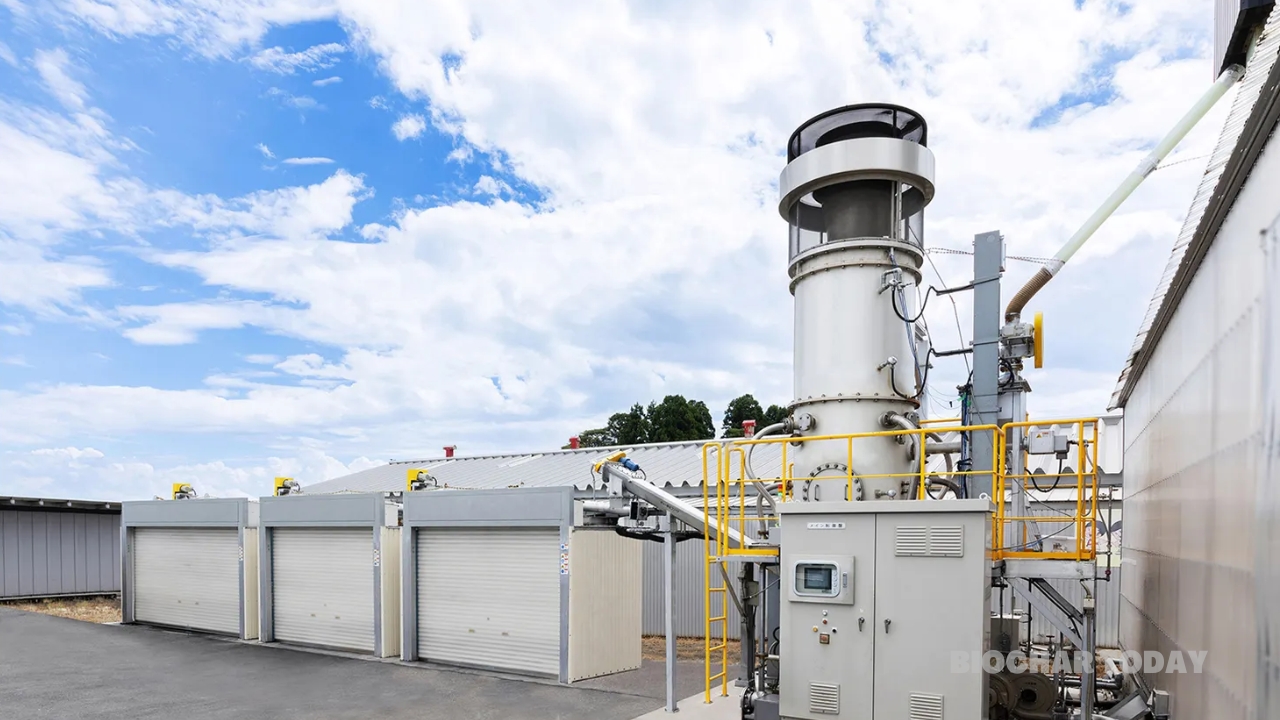
Yanmar Energy System Co., Ltd. has officially begun accepting commercial orders in Japan for a new continuous biocharBiochar is a carbon-rich material created from biomass decomposition in low-oxygen conditions. It has important applications in environmental remediation, soil improvement, agriculture, carbon sequestration, energy storage, and sustainable materials, promoting efficiency and reducing waste in various contexts while addressing climate change challenges. More production system designed specifically for rice husks. Commercialized following field demonstrations that began in 2023, the system converts low-density agricultural residue into high-surface-area biochar intended for agricultural soil amendmentA soil amendment is any material added to the soil to enhance its physical or chemical properties, improving its suitability for plant growth. Biochar is considered a soil amendment as it can improve soil structure, water retention, nutrient availability, and microbial activity. More. Targeted at agricultural grain storage and rice-processing facilities that generate substantial organic residues, the unit connects waste management with soil enrichment and carbon sequestration through a localized, circular framework.
The commercialization directly addresses persistent operational and environmental challenges associated with managing massive agricultural residues in Japan, where the rice sector produces roughly two million metric tons of husks annually. Managing this volume presents significant logistics and environmental hurdles, as open burning faces tightening regulatory restrictions and community opposition. Uncontrolled low-temperature combustion releases smoke, odors, and fine particulate matter, while also posing health risks related to the potential formation of carcinogenic crystalline silica under poor combustion conditions.
To resolve these technical and environmental constraints, Yanmar engineered a high-temperature carbonization mechanism that suppresses smoke, odor, and crystalline silica formation while producing a highly porous biochar. The machinery operates with a rated processing capacity of 100 kilograms of rice husk input per hour, yielding approximately 25 kilograms of zero-moisture biochar hourly for up to 100 hours of continuous operation. The thermal process is ignited using a 3.2-kilowatt electric heating element for approximately 1.5 hours, after which self-sustaining exothermic heat drives the reaction without requiring fossil fuels or secondary combustion burners, limiting average continuous power demand to roughly 1.5 kilowatts.
The system’s operational deployment yields measurable agronomic, environmental, and operational outcomes. Agronomically, the resulting biochar features high porosityPorosity of biochar is a key factor in its effectiveness as a soil amendment and its ability to retain water and nutrients. Biochar’s porosity is influenced by feedstock type and pyrolysis temperature, and it plays a crucial role in microbial activity and overall soil health. Biochar More and surface area, enhancing nutrient adsorption, soil water retention, and drainage performance when incorporated into agricultural fields. Environmentally, converting labile husk carbon into recalcitrant biochar locks carbon into a stable structure that resists biological decomposition, facilitating long-term carbon sequestration. Operationally, automated controls and remote monitoring systems enable continuous, unattended overnight run cycles, allowing processing facilities to offset waste management liabilities while generating functional soil amendments.





Leave a Reply