
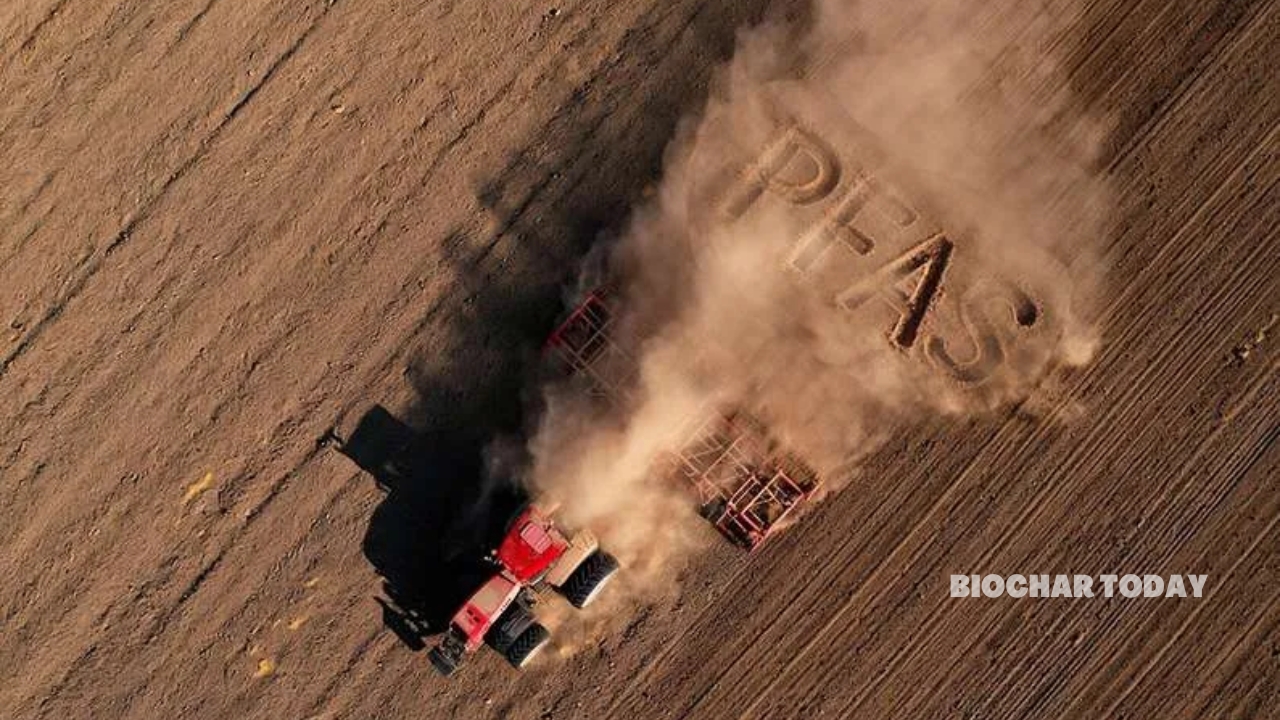
Researchers led by Yale University have developed an integrated thermal and phytoremediationThis is a technique that uses plants to clean up contaminated soil or water. Biochar can enhance phytoremediation by improving soil conditions and promoting plant growth, allowing plants to absorb and break down pollutants more effectively. More framework designed to remove per- and polyfluoroalkyl substances (PFAS) from contaminated agricultural soils across the United States. Published in the Proceedings of the National Academy of Sciences (PNAS), the study evaluates a multi-step intervention combining basalt rock dust, hemp cultivation, and biocharBiochar is a carbon-rich material created from biomass decomposition in low-oxygen conditions. It has important applications in environmental remediation, soil improvement, agriculture, carbon sequestration, energy storage, and sustainable materials, promoting efficiency and reducing waste in various contexts while addressing climate change challenges. More production. By leveraging soil chemical manipulation alongside biomassBiomass is a complex biological organic or non-organic solid product derived from living or recently living organism and available naturally. Various types of wastes such as animal manure, waste paper, sludge and many industrial wastes are also treated as biomass because like natural biomass these More thermal processing, the strategy offers a scalable approach to restoring farmland safety while simultaneously sequestering atmospheric carbon dioxide.
The study addresses the widespread contamination of United States agricultural lands by persistent synthetic “forever chemicals,” primarily perfluorooctane sulfonate (PFOS) and perfluorooctanoic acid (PFOA). Decades of applying municipal sewage sludge as crop fertilizer have accumulated toxic PFAS loads in soils, forcing agricultural operations in states like Maine to halt crop production due to safety risks. Traditional soil remediation protocols rely on heavy excavation followed by incineration, an approach that carries prohibitive costs estimated at $1.6 million per hectare—cumulatively amounting to an $8 trillion national burden—while destroying soil biological functionality.
To overcome these technical and economic barriers, the Yale University team formulated a sequential remediation mechanism. First, farmers apply basalt rock dust to soil, which alters soil pHpH is a measure of how acidic or alkaline a substance is. A pH of 7 is neutral, while lower pH values indicate acidity and higher values indicate alkalinity. Biochars are normally alkaline and can influence soil pH, often increasing it, which can be beneficial More and increases the mobility and bioavailability of PFAS compounds. Next, hyperaccumulating crops such as hemp and perennial grasses are cultivated to absorb the mobilized contaminants into their plant tissue. Finally, the harvested crop biomass undergoes high-temperature thermal pyrolysisPyrolysis is a thermochemical process that converts waste biomass into bio-char, bio-oil, and pyro-gas. It offers significant advantages in waste valorization, turning low-value materials into economically valuable resources. Its versatility allows for tailored products based on operational conditions, presenting itself as a cost-effective and efficient More to produce biochar, a process that neutralizes PFAS toxicity. The resulting biochar is subsequently spread over highly contaminated fields to bind remaining synthetic chemicals and prevent off-site environmental migration.
The modeling demonstrated that basalt rock dust application accelerates plant uptake of PFOS, increasing soil chemical depletion rates by 20 to 40 percent. Applying the post-pyrolysis biochar to affected fields immobilizes residual contaminants, reducing toxic PFAS surface runoff by 95 percent and bringing contaminated United States soils below regulatory safety thresholds within ten years. Economically, this combined approach reduces annual remediation expenditures from $1.6 million to $1,460 per hectare. Furthermore, national implementation of the rock dust and biochar protocol would sequester 10.5 million metric tons of carbon dioxide annually.


Leave a Reply