
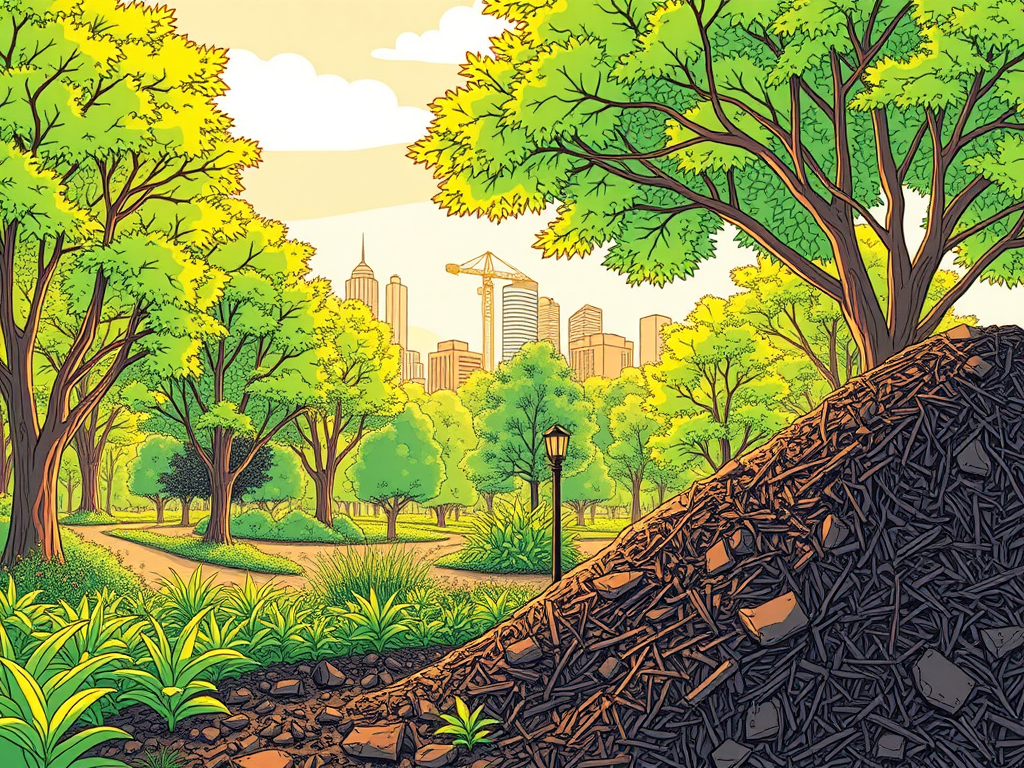
Traditional urban development often reduces green spaces, disrupting ecological balance, worsening the urban heat island effect, and diminishing air quality. To counter these trends, a promising approach involves converting urban wood waste into biocharBiochar is a carbon-rich material created from biomass decomposition in low-oxygen conditions. It has important applications in environmental remediation, soil improvement, agriculture, carbon sequestration, energy storage, and sustainable materials, promoting efficiency and reducing waste in various contexts while addressing climate change challenges. More, a carbon-negative material that offers a multitude of environmental and economic benefits. A review by Gamal El Afandi, Muhammad Irfan, Amira Moustafa, Salem Ibrahim, and Santosh Sapkota, published in Urban Science, comprehensively evaluates the potential of woody biomassBiomass is a complex biological organic or non-organic solid product derived from living or recently living organism and available naturally. Various types of wastes such as animal manure, waste paper, sludge and many industrial wastes are also treated as biomass because like natural biomass these More biochar systems for sustainable urban management in the United States.
Urban forests play a crucial role in mitigating climate change by absorbing atmospheric carbon dioxide and sequestering it in plant biomass and soil. Biochar, a carbon-dense material produced from biomass through pyrolysisPyrolysis is a thermochemical process that converts waste biomass into bio-char, bio-oil, and pyro-gas. It offers significant advantages in waste valorization, turning low-value materials into economically valuable resources. Its versatility allows for tailored products based on operational conditions, presenting itself as a cost-effective and efficient More, offers a stable form of carbon that prevents the release of CO2 and CH4 that would otherwise occur during natural decomposition. This process not only sequesters carbon but also generates renewable energy. Studies estimate that biochar systems can reduce global greenhouse gas emissions by approximately 3.4% to 6.3% in CO2 equivalents, with nearly half of this reduction attributed to permanent carbon sequestration.
The properties of biochar are significantly influenced by the type of feedstockFeedstock refers to the raw organic material used to produce biochar. This can include a wide range of materials, such as wood chips, agricultural residues, and animal manure. More and pyrolysis conditionsThe conditions under which pyrolysis takes place, such as temperature, heating rate, and residence time, can significantly affect the properties of the biochar produced. More. For instance, wood-derived biochar, with its higher lignin content, generally exhibits a greater surface area compared to grass-based alternatives, fostering more organo-mineral complexes that serve as nutrient reservoirs for microbial populations. Higher pyrolysis temperatures increase the carbon content, aromaticity, porosityPorosity of biochar is a key factor in its effectiveness as a soil amendment and its ability to retain water and nutrients. Biochar’s porosity is influenced by feedstock type and pyrolysis temperature, and it plays a crucial role in microbial activity and overall soil health. Biochar More, and surface area of biochar, enhancing its adsorption capabilities. This makes biochar a versatile material for various urban applications.
One significant application is enhancing urban soil health. Biochar improves soil structure, increases water retention, and boosts nutrient availability, which is crucial for plant vitality in urban settings, especially during droughts. A meta-analysis on forest restoration indicated an average 41% increase in tree biomass with biochar application. Biochar has also been shown to reduce soil pHpH is a measure of how acidic or alkaline a substance is. A pH of 7 is neutral, while lower pH values indicate acidity and higher values indicate alkalinity. Biochars are normally alkaline and can influence soil pH, often increasing it, which can be beneficial More while increasing nitrogen availability and microbial respiration. Additionally, biochar can suppress plant pathogens like Phytophthora species, thereby fortifying host plant defense responses. Its ability to improve soil moisture retention also reduces irrigation requirements for turfgrass, which accounts for approximately 70% of residential water usage in the U.S..
Biochar-based solutions are also vital for stormwater management in urban environments, where untreated runoff often accumulates contaminants like heavy metals and pesticides. Biochar’s porous structure makes it an effective and sustainable alternative to activated carbonActivated carbon is a form of carbon that has been processed to create a vast network of tiny pores, increasing its surface area significantly. This extensive surface area makes activated carbon exceptionally effective at trapping and holding impurities, like a molecular sponge. It is commonly More for filtering pollutants. Research shows biochar media blends can achieve over 95% removal rates for dissolved copper and zinc from stormwater. Integrating biochar into green roof systems not only enhances moisture retention and plant growth but also demonstrates improved pH buffering capacity and significantly lower total nitrogen and chemical oxygen demand levels in runoff, reducing urban non-point-source pollution. An optimal 10% biochar content in green roofs can facilitate the greatest reduction in peak stormwater flow and the longest delay in outflow.
Beyond environmental benefits, biochar offers economic opportunities. Urban trees in the continental U.S. sequester approximately 22.8 million tons of carbon annually, valued at around USD 460 million. They also remove about 711,000 metric tons of air pollutants annually, translating to an economic value of about USD 3.8 billion. Converting urban wood waste, estimated at 46 million tons of fresh-weight merchantable wood annually, into biochar diverts material from landfills and can generate between USD 89 million and USD 786 million depending on derived products.
Case studies from U.S. cities highlight the practical viability. Boulder, Colorado, pilots a system converting 200 tons of biomass into 30 tons of biochar annually, with the potential to process all municipal tree waste. Minneapolis, Minnesota, is investigating biochar to manage wood waste from emerald ashAsh is the non-combustible inorganic residue that remains after organic matter, like wood or biomass, is completely burned. It consists mainly of minerals and is different from biochar, which is produced through incomplete combustion. Ash Ash is the residue that remains after the complete More borer infestations, with a proposed pilot unit to produce roughly 4 tons of biochar daily. The CharBoss mobile biochar production system, evaluated by a life cycle assessment, demonstrated a net removal of approximately -2.70 metric tons of CO2 equivalent per ton of biochar produced, potentially yielding 2403.81 MT CO2 equivalent annually in marketable carbon dioxide removal certificates.
The integration of biochar into urban planning offers a promising pathway for cities to transition towards carbon-negative energy systems and foster sustainable urban ecosystems. This approach addresses not only waste management but also climate change mitigation, soil health improvement, and the creation of new market opportunities.
Source: El Afandi, G., Irfan, M., Moustafa, A., Ibrahim, S., & Sapkota, S. (2025). A Review on Carbon-Negative Woody Biomass Biochar System for Sustainable Urban Management in the United States of America. Urban Sci., 9(6), 214.



Leave a Reply