
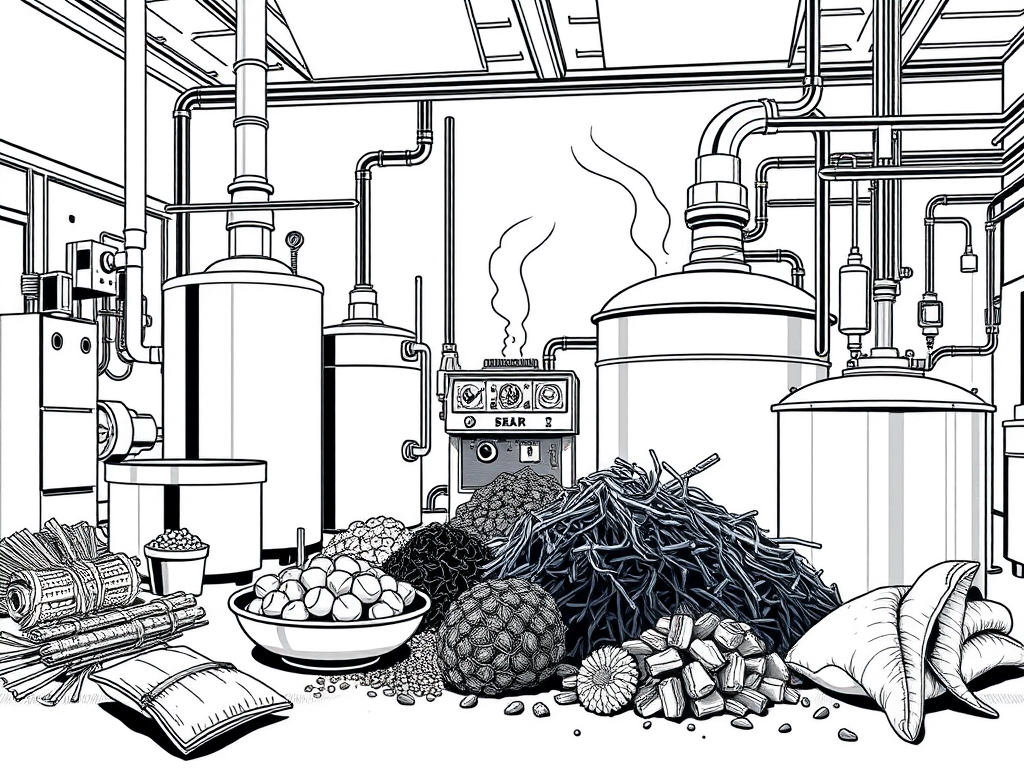
The palm oil industry generates substantial waste, including oil palm empty fruit bunches (EFB) and palm oil mill effluent (POME). Converting these wastes into high-value bioenergy products offers a sustainable solution to greenhouse gas emissions and resource scarcity. A study by Nur Atiqah Mohamad Aziz, Kai Ling Yu, Hassan Mohamed, and colleagues, published in Clean Technologies and Environmental Policy, successfully demonstrated an integrated process of wet torrefaction and gasificationGasification is a high-temperature, thermochemical process that converts carbon-based materials into a gaseous fuel called syngas and solid by-products. It takes place in an oxygen-deficient environment at temperatures typically above 750°C. Unlike combustion, which fully burns material to produce heat and carbon dioxide (CO2), gasification More to convert EFB and POME into high-heating-value (HHV) biocharBiochar is a carbon-rich material created from biomass decomposition in low-oxygen conditions. It has important applications in environmental remediation, soil improvement, agriculture, carbon sequestration, energy storage, and sustainable materials, promoting efficiency and reducing waste in various contexts while addressing climate change challenges. More, bio-oil, and syngasSyngas, or synthesis gas, is a fuel gas mixture consisting primarily of hydrogen and carbon monoxide. It is produced during gasification and can be used as a fuel source or as a feedstock for producing other chemicals and fuels. More.
The process began with wet torrefaction of EFB and POME at 200°C for 30 minutes, resulting in biochar with an HHV of 22.6 MJ/kg, representing a 31% increase from raw EFB. This step also reduced moisture content from 8.68% to 3.1% and volatile content from 75% to 69.99%. The presence of POME, which is slightly acidic and contains organic compounds, nutrients, and carbon, likely contributed to increased carbon content (from 44.92% to 54.24%) and decreased oxygen content (from 49.1% to 39.81%) in the resulting biochar. This mild temperature of 200°C proved sufficient for effective carbon concentration.
Following wet torrefaction, the biochar underwent gasification at temperatures ranging from 700°C to 900°C. This further enhanced the biochar’s HHV to 23.8 MJ/kg, a 38% increase compared to raw EFB. The gasification process yielded biochar (39-55%), bio-oil (12-20%), and syngas (27-44%). The solid yield was higher at 700°C (55%) than at 900°C (39%), with higher temperatures promoting the breakdown of lignin and cellulose, leading to reduced solid yield. Gas chromatography analysis of the syngas identified carbon dioxide (CO2) (0.003 mmol/mL), hydrogen (H2) (0.002 mmol/mL), methane (CH4) (0.002 mmol/mL), and carbon monoxide (CO) (0.005 mmol/mL). Notably, H2 and CO2 concentrations peaked at 700°C, while CO production was highest at 900°C. The H2/CO ratio ranged from 0.13 to 0.51, with the highest ratio observed at 700°C.
This integrated approach offers a sustainable energy solution by utilizing palm oil mill waste, showcasing the feasibility of co-producing high-quality biochar and syngas. The study highlights that the HHV of the torrefied EFB/POME biochar is comparable to lignite coal and superior to previously torrefied EFB/water products, making it suitable for co-firing applications. While this study primarily focused on temperature during gasification, future research could explore other parameters like gasification agents, heating rates, and residence times to further optimize efficiency and gas composition.
Source: Aziz, N. A. M., Yu, K. L., Mohamed, H., Zainal, B. S., Mahlia, T. M. I., Ong, H. C., Hamid, H. A., Kania, D., Salehmin, M. N. I., & Yap, T. Y. H. (2025). Conversion of palm oil mill wastes into high-value biochar and syngas using wet torrefaction and gasification with palm oil mill effluent as a liquid stream. Clean Technologies and Environmental Policy.




Leave a Reply