
Key Takeaways
- Waste Tea Turns into a Metal Fixer: A functional material called nZVI@BC, made from waste tea leaves and iron nanoparticles, was used as an additive.
- Safer Fertilizer Achieved: This additive significantly enhanced the compost’s safety, reducing the toxic, mobile copper fraction (bioavailable Cu) by a remarkable 43.14%.
- Bacteria and Phosphorus are Key: The immobilization wasn’t just chemistry; compost bacteria (Clostridia) first helped release available phosphorus (AP), which then reacted with the copper to form stable, non-toxic copper-phosphate minerals.
- Excellent Compost Quality: The final compost, even with the additive, maintained optimal conditions (pHpH is a measure of how acidic or alkaline a substance is. A pH of 7 is neutral, while lower pH values indicate acidity and higher values indicate alkalinity. Biochars are normally alkaline and can influence soil pH, often increasing it, which can be beneficial More, EC, CEC) for agricultural use, proving it’s both safe and high-quality for soil amendmentA soil amendment is any material added to the soil to enhance its physical or chemical properties, improving its suitability for plant growth. Biochar is considered a soil amendment as it can improve soil structure, water retention, nutrient availability, and microbial activity. More.
A new study published in the journal Industrial Crops & Products by Wenqing Yang, Yuanping Zhong, and colleagues presents a sustainable solution for two critical challenges in the agro-industrial sector: managing agricultural and livestock waste and mitigating the environmental risk of heavy metals in organic fertilizers. The research focuses on transforming waste tea residues into a functional additive, biochar-loaded nano zero-valent iron (nZVI@BC), and applying it to swine manure composting to produce a safe, value-added soil amendment.
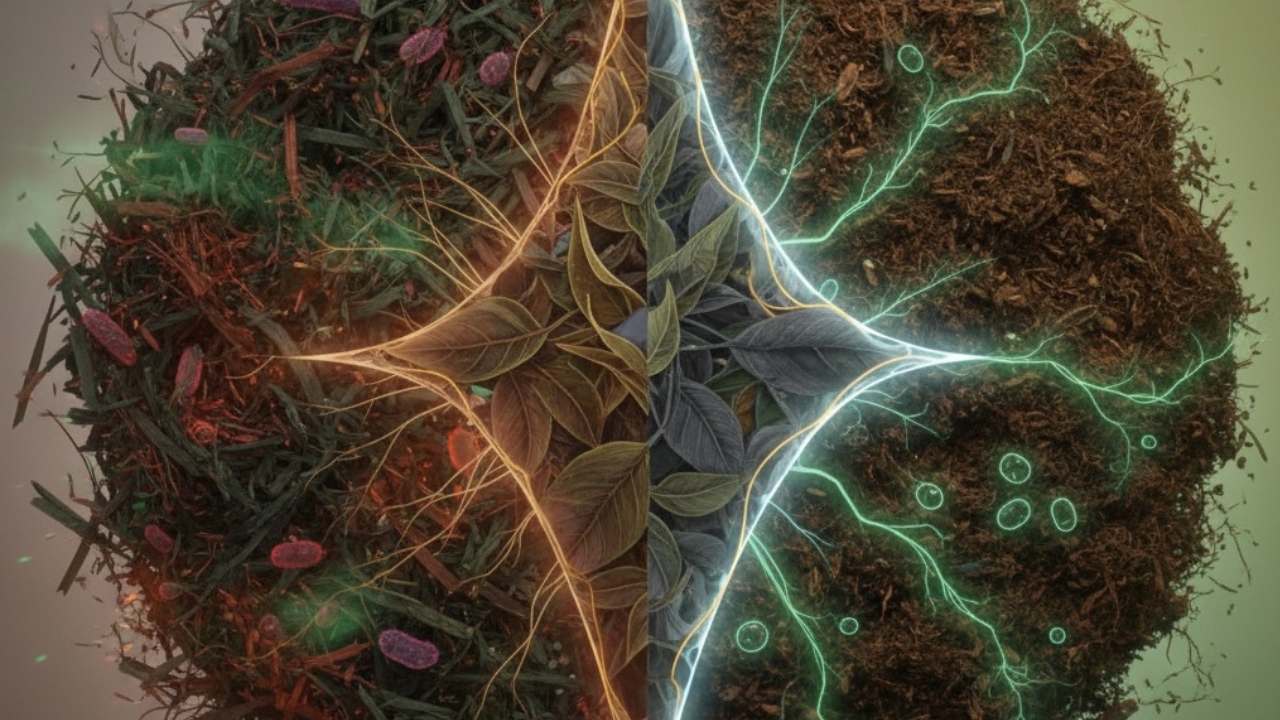
Swine manure compost, while nutrient-rich, often contains high levels of copper (Cu) because copper-containing additives are commonly used in livestock feeds. The mobility and toxicity of copper are determined by its bioavailability—the exchangeable (Exc) and reducible (Red) fractions—rather than its total concentration, making the reduction of these bioavailable fractions essential for creating a safe end product. The core of this innovative process is the nZVI@BC composite, which researchers synthesized from waste tea leaves. The biocharBiochar is a carbon-rich material created from biomass decomposition in low-oxygen conditions. It has important applications in environmental remediation, soil improvement, agriculture, carbon sequestration, energy storage, and sustainable materials, promoting efficiency and reducing waste in various contexts while addressing climate change challenges. More component provides a high surface area and prevents the oxidation of the nano zero-valent iron (nZVI), leveraging the synergistic effects of both components for heavy metal immobilization. This synergistic design proved highly effective during the 20-day composting trial.
The experiment tested two addition rates of nZVI@BC, 20 g/kg (T2) and 50 g/kg (T5), against a control (T0). The results showed a clear dose-dependent effect on copper immobilization. The control group saw a 31.85% reduction in bioavailable Cu (Exc + Red). The T2 treatment improved this to a 40.0% reduction. Most significantly, the T5 treatment achieved a 43.14% reduction in the active copper pools, dramatically diminishing the environmental risk. The study went beyond merely demonstrating effectiveness by identifying available phosphorus (AP) as the primary controlling factor. Redundancy Analysis (RDA) revealed that AP explained 89.3% of the variation in copper speciation transformation. This finding is explained by the fact that the consumption of AP, rather than its mere presence, is the key driver, evidenced by the significant decline in AP content across all treatments, especially in T5. Fourier Transform Infrared (FTIR) spectroscopy provided critical evidence, as the distinct attenuation of peaks at approximately 870 cm−1 and 560 cm−1—characteristic of phosphate (PO43−) bending and stretching vibrations—strongly suggests the precipitation of metal-phosphate minerals under the compost’s alkaline conditions. Specifically, the key mechanism involves the transformation of copper into highly stable copper phosphate precipitates, such as Cu3(PO4)2. The microbial community plays an intricate role in this process.
A variance partitioning analysis (VPA) confirmed that while bacteria alone explained only 0.1% of the changes in copper speciation, their interactive effect with AP dominated, jointly explaining 74.8% of the variance. This confirms that the microbial community influences copper speciation primarily by mediating the release and subsequent consumption of AP. The analysis of the bacterial community showed a notable increase in the abundance of Clostridia in the nZVI@BC treatments. Many members of the Clostridia class are known for their ability to solubilize inorganic phosphates under localized anaerobic micro-niches, releasing AP into the environment. This microbially-released AP then becomes available to react with copper ions, facilitated by the nZVI@BC. The nZVI core further assists this by gradually oxidizing and releasing ferrous and ferric ions, which can react with phosphate or act as co-precipitants to enhance the formation of copper-phosphate minerals.
This research provides a promising model for a circular bio-economy. By transforming two distinct agricultural wastes—waste tea leaves and swine manure—into a safe, high-value organic fertilizer, it simultaneously addresses waste management and enhances sustainable agriculture. The final compost product exhibited a significant decrease in mobile Cu fractions, which are the primary concerns for soil health and crop safety. Furthermore, its physicochemical parameters, such as pH (stabilized at 8.62–8.76), EC (below the 4.0 mS⋅cm−1 limit), and CEC (reaching 62.19−63.21 cmol⋅kg−1), were all within optimal ranges for agricultural application, indicating that the amendment did not induce secondary issues.
Source: Yang, W., Zhong, Y., Lu, Z., Lin, D., Zhuo, Q., Zeng, H., Yang, D., Chen, Q., & Chen, Z. (2025). Biochar-loaded nano zero-valent iron from agricultural waste enhances copper immobilization during composting: Implications for safe soil amendment and crop production. Industrial Crops & Products, 236, 122036.




Leave a Reply