
Key Takeaways
- Agricultural plastic mulch films break down over time into small plastic fragments that remain in the ground for centuries and harm the environment.
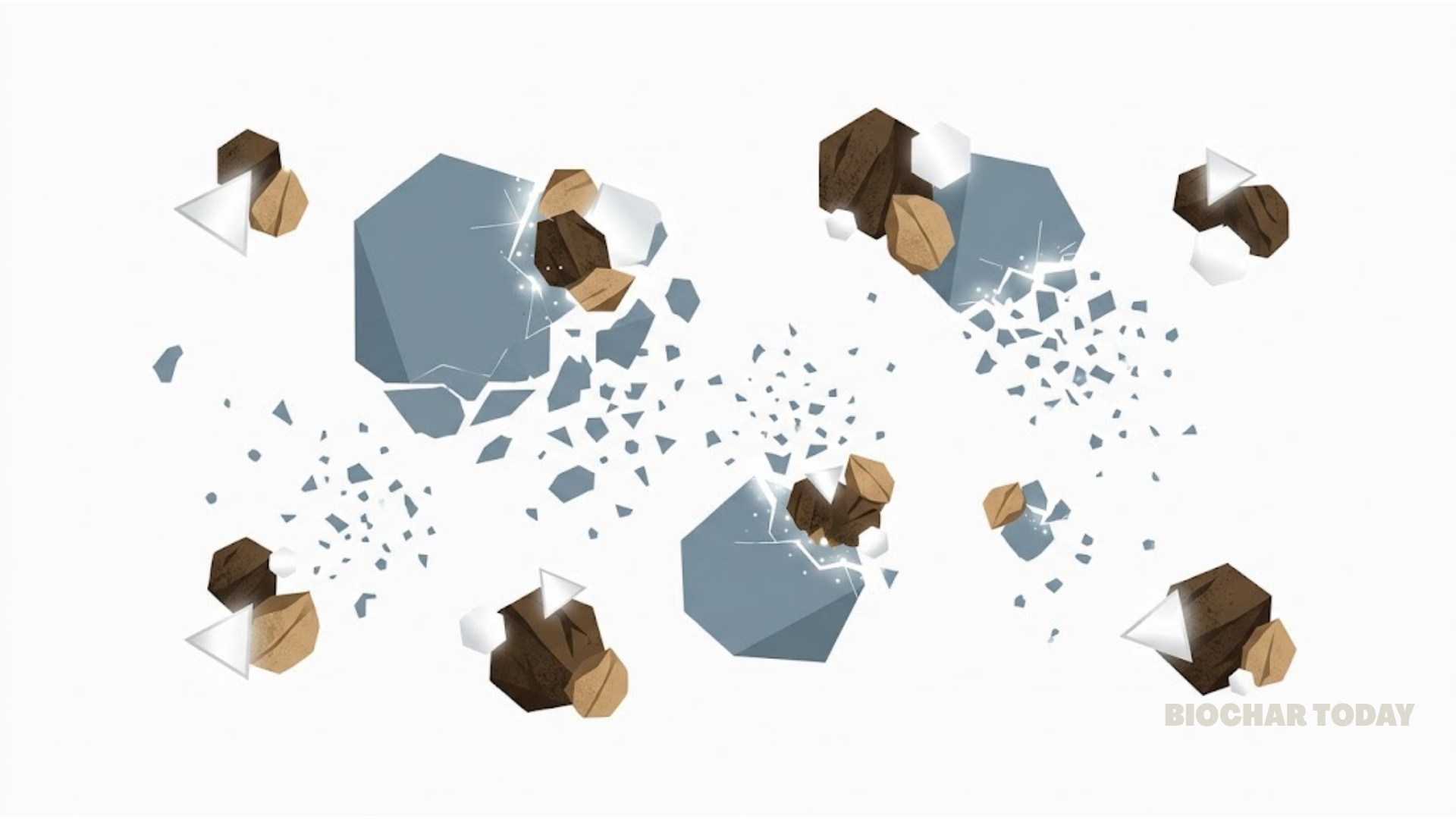
- Researchers created a new material from walnut shells and titanium dioxide that uses solar energy to speed up the destruction of these plastic fragments.
- The engineered composite breaks down persistent plastics into smaller, low-toxicity chemical pieces that eventually turn into water and carbon dioxide.
- A natural component that dissolves from the walnut shell material acts as a booster for the reaction rather than blocking out the necessary light.
- Detailed testing on seeds and small aquatic organisms showed that the chemical pieces left behind by this treatment are safe and do not harm plant growth.
The persistent accumulation of polyethylene microplastics stemming from agricultural mulch films constitutes a major hazard to global soil health and ecological stability. Because these plastics possess exceptionally high bond dissociation energies, they remain chemically inert and highly resistant to natural biodegradation in agricultural landscapes, leading to estimated environmental half-lives of up to four centuries. Conventional removal methods frequently fall short or introduce secondary pollution risks, necessitating the development of gentle, sustainable remediation strategies. To address this challenge, researchers published a study in the journal BiocharBiochar is a carbon-rich material created from biomass decomposition in low-oxygen conditions. It has important applications in environmental remediation, soil improvement, agriculture, carbon sequestration, energy storage, and sustainable materials, promoting efficiency and reducing waste in various contexts while addressing climate change challenges. More by authors Zuolong Li, Shihan Chen, Yue Sun, Yang Ding, Cheng Chen, and Jiehong He. The team engineered a sustainable waste-to-resource strategy by combining pyrolyzed agricultural biomassBiomass is a complex biological organic or non-organic solid product derived from living or recently living organism and available naturally. Various types of wastes such as animal manure, waste paper, sludge and many industrial wastes are also treated as biomass because like natural biomass these More waste with standard semiconductor photocatalysts to create a highly efficient, core-shell composite capable of accelerated plastic breakdown under visible light.
The performance of the optimized walnut shell biochar composite far outpaced pure titanium dioxide. Under simulated solar irradiation, the composite successfully managed to fragment large microplastic pieces down to a fraction of their original size in less than two days. This dramatic reduction in particle size represents a significant acceleration in photochemical degradation kinetics. This enhanced activity stems primarily from unique interfacial chemical bonds formed between the carbonized walnut shell and the titanium dioxide shell. This specific bonding configuration narrows the effective bandgap of the catalyst, allowing it to capture visible light far more effectively than traditional catalysts that only respond to ultraviolet radiation. Furthermore, the carbon network acts as an electronic mediator, rapidly pulling away energized electrons to prevent them from recombining uselessly, which leaves them free to drive chemical reactions on the plastic surface.
A unique component of the research involved evaluating the environmental chemistry of the dissolved organic matter that naturally leaches from the biochar during the liquid reaction. In many typical photocatalytic setups, dissolved organic compounds act as a shield that blocks incoming light from reaching the actual catalyst surface, thereby slowing down the target reaction. However, the dissolved matter originating from the walnut shell biochar behaved as a natural co-catalyst. It possessed a high electron-accepting capacity that actively amplified the generation of highly reactive oxygen molecules, specifically hydroxyl radicals. These hydroxyl radicals serve as the primary chemical drivers responsible for attacking the inert carbon chains of the microplastics. By shifting the chemical dynamics to increase radical production, the dissolved organic matter effectively neutralized its own light-shielding tendencies and yielded a net positive effect on the overall rate of plastic degradation.
The chemical transformation pathway was mapped from start to finish, revealing a sequential oxidation process that gradually chips away at the long-chain hydrocarbon backbones of the polyethylene. The reaction initiates with hydrogen abstraction along the plastic chains, followed by chain scission that splits the large polymers into smaller fragments. These fragments systematically convert into low-toxicity oxygenated chemical intermediates, such as alcohols, ketones, and esters, before ultimately undergoing terminal mineralization into harmless carbon dioxide and water. To ensure that this accelerated fragmentation does not inadvertently compromise the surrounding environment, the researchers subjected the resulting chemical products to rigorous ecotoxicological assessments. Computer modeling and direct biological testing on green algae, water fleas, and fish confirmed that the intermediates are completely benign. Real-world agricultural safety was also verified by exposing mung bean seeds to the post-reaction solutions; the treated microplastic fluids caused no inhibition to seed germination or root elongation, demonstrating excellent safety for agricultural reuse.
Source: Li, Z., Chen, S., Sun, Y., Ding, Y., Chen, C., & He, J. (2026). Synergetic polyethylene microplastic photodegradation over core-shell TiO2/biochar: unraveling the dual roles of interfacial bonding and biochar-derived DOM. Biochar, 8, 117.



Leave a Reply