
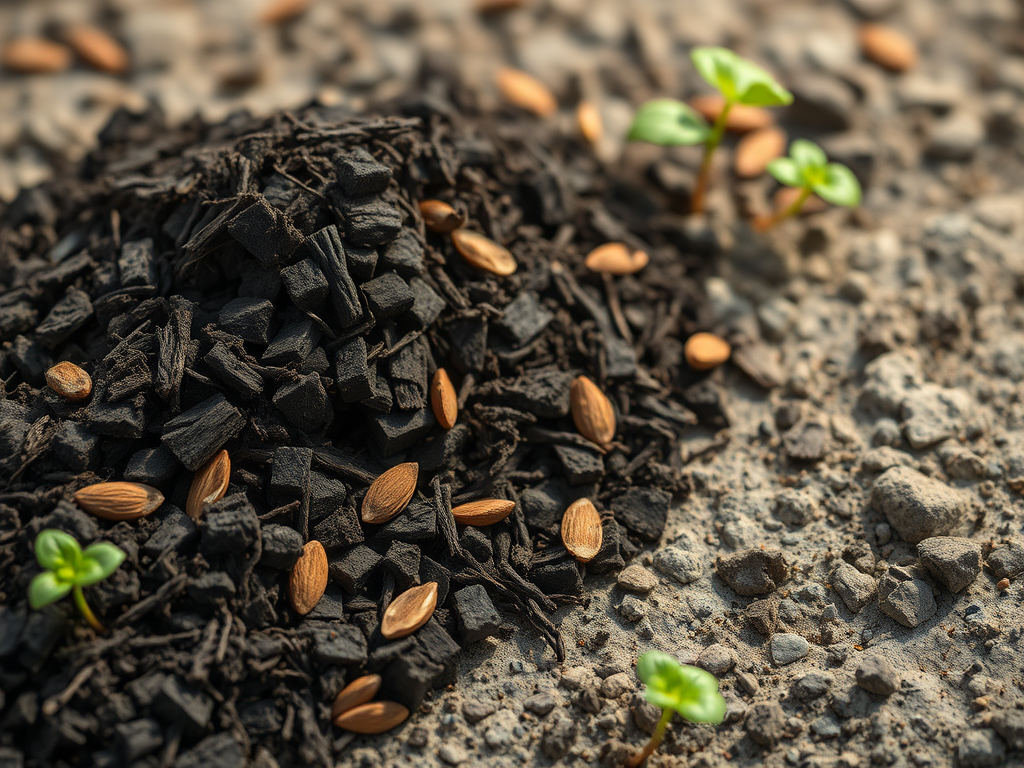
In a pivotal study published in the Journal of Water and Soil Conservation, researchers Parvin Kabiri, Alireza Hosseinpur, Hamidreza Motaghian, and Ramin Iranipour unveiled compelling evidence on the effectiveness of various biochars in remediating zinc-contaminated calcareous soil. Their investigation offers a beacon of hope for managing environmental pollution stemming from mining activities, where heavy metals like zinc (Zn) often accumulate to toxic levels in the soil. High concentrations of zinc pose a significant threat to plant growth, causing issues like reduced root development and leaf chlorosis, and can ultimately compromise food security and human health.
BiocharBiochar is a carbon-rich material created from biomass decomposition in low-oxygen conditions. It has important applications in environmental remediation, soil improvement, agriculture, carbon sequestration, energy storage, and sustainable materials, promoting efficiency and reducing waste in various contexts while addressing climate change challenges. More has emerged as a sustainable and cost-effective solution for environmental remediation. Its ability to adsorb and stabilize heavy metals makes it an attractive candidate for cleaning up contaminated soils. The key lies in biochar’s unique properties, such as its porous structure, high surface area, and alkaline pHpH is a measure of how acidic or alkaline a substance is. A pH of 7 is neutral, while lower pH values indicate acidity and higher values indicate alkalinity. Biochars are normally alkaline and can influence soil pH, often increasing it, which can be beneficial More, which allow it to bind with metal ions and reduce their mobility and availability in the soil.
To assess their efficacy, the research team compared biochars made from municipal waste compost, sewage sludge, sugarcane bagasse, rapeseed residues, almond hull, and walnut hull. These biochars were incorporated at a 2% weight-to-weight ratio into naturally contaminated calcareous soil, which already had a high total zinc content of 3497.5 milligrams per kilogram and a bioavailable zinc concentration of 141.3 milligrams per kilogram. The treated soil samples were then incubated for 120 days to observe the long-term effects on zinc bioavailability and desorption kinetics – essentially, how much zinc plants could potentially take up and how quickly zinc was released from the soil.
The results were remarkably clear: all tested biochars significantly reduced both the bioavailability and the cumulative release of zinc in the soil compared to the untreated control. However, biochars derived from walnut hulls and almond hulls proved to be the most effective. Specifically, walnut hull biochar led to a striking 41.2% reduction in zinc bioavailability, while almond hull biochar achieved a 36.9% reduction compared to the control soil. This substantial decrease in bioavailable zinc means less of the harmful metal is accessible for plants to absorb, thereby reducing its entry into the food chain.
The superior performance of walnut and almond hull biochars can be attributed to their enhanced physical and chemical properties. These biochars exhibited higher pH, electrical conductivity (EC), and, most notably, a significantly greater specific surface area compared to the other biochars and raw residues. For instance, walnut hull biochar boasted the highest specific surface area at an impressive 334.36 square meters per gram, along with a pH of 11.73 and an EC of 3.94 dS/m. A larger surface area provides more binding sites for zinc ions, while a higher pH can promote the precipitation and immobilization of heavy metals, effectively locking them in the soil.
Furthermore, the study examined the desorption kinetics, which describe the rate at which zinc is released from the soil particles into the soil solution. The lowest cumulative desorbed zinc was observed in soils treated with walnut hull biochar, at 1328.9 milligrams per kilogram. This indicates that walnut hull biochar was most effective at permanently stabilizing zinc within the soil matrix, preventing its harmful release and movement. The researchers concluded that the first-order, parabolic diffusion, and power function equations were most suitable for accurately describing zinc release rates in both treated and control soils.
These findings suggest that biochars, particularly those produced from walnut and almond hulls, offer a robust and environmentally sound strategy for the remediation of zinc-contaminated soils. Their ability to significantly reduce zinc bioavailability and minimize its release into the environment presents a viable pathway for improving soil health and safeguarding ecosystems. The researchers recommend that these two highly effective biochars be further tested at larger scales, such as farm levels, to confirm their efficacy in purifying agricultural soils and supporting sustainable land management practices.
SOURCE: Kabiri, P., Hosseinpur, A., Motaghian, H., & Iranipour, R. (2025). The Impact of Biochars on the Availability and Desorption Kinetics of Zinc in a Naturally Contaminated Calcareous Soil. Journal of Water and Soil Conservation, 32(1), 153-173.


![Eucalyptus Wood Waste-Derived Biochar Achieves a Ninety-Eight Percent Removal Efficiency for Benzo[ghi]perylene in Vehicle-Wash Wastewater](https://biochartoday.com/wp-content/uploads/2026/10/SCIENCE-BLOGS-2026-2026-10-19T160523.703.jpg)


Leave a Reply