
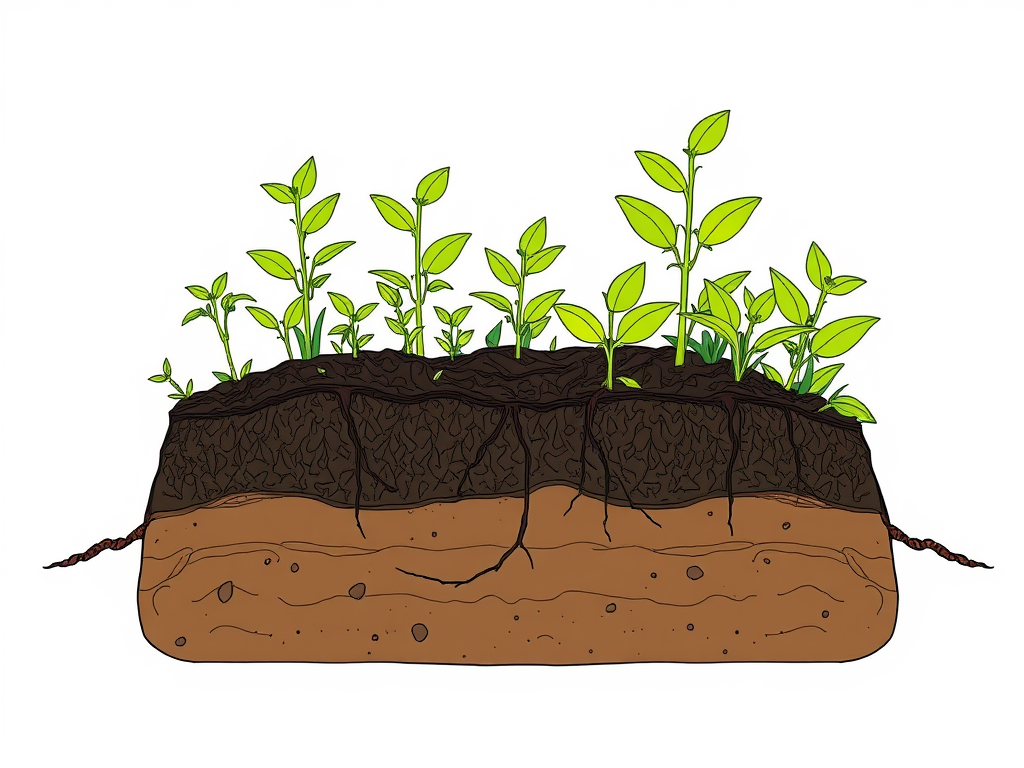
Copper mining in Michigan’s Upper Peninsula during the 19th and early 20th centuries left a legacy of severe environmental contamination. Mining waste, known as stamp sands, was indiscriminately dumped into Lake Superior and its tributaries, causing extensive harm to aquatic ecosystems and rendering vast land areas incapable of supporting vegetation. Traditional remediation efforts, such as establishing vegetative covers, have been largely unsuccessful due to the poor quality of these stamp sands, characterized by low organic matter, poor water-holding capacity, and high metal toxicity. A recent study by Sameer Neve, Dibyendu Sarkar, Zhiming Zhang, and Rupali Datta, published in BMC Chemistry, investigates the efficacy of vetiver (Chrysopogon zizanioides) root biocharBiochar is a carbon-rich material created from biomass decomposition in low-oxygen conditions. It has important applications in environmental remediation, soil improvement, agriculture, carbon sequestration, energy storage, and sustainable materials, promoting efficiency and reducing waste in various contexts while addressing climate change challenges. More as a sustainable soil amendmentA soil amendment is any material added to the soil to enhance its physical or chemical properties, improving its suitability for plant growth. Biochar is considered a soil amendment as it can improve soil structure, water retention, nutrient availability, and microbial activity. More to revitalize these copper-contaminated stamp sands.
The biochar used in this study was produced from spent vetiver roots, a waste product after essential oil extraction, aligning with circular economy principles. This approach offers a promising alternative to previous amendments like biosolids and compost, which can have drawbacks such as heavy metal accumulation or variable quality. Vetiver root biochar exhibits a high surface area of 308.2 m²/g, indicating a highly porous structure, and a basic pHpH is a measure of how acidic or alkaline a substance is. A pH of 7 is neutral, while lower pH values indicate acidity and higher values indicate alkalinity. Biochars are normally alkaline and can influence soil pH, often increasing it, which can be beneficial More of 10.98, making it suitable for neutralizing acidic soils.
The researchers incorporated vetiver root biochar into stamp sands at various concentrations (0%, 2.5%, 5%, 10%, 20% w/w) and incubated the mixtures for 60 days. Comprehensive soil analysis revealed significant improvements across several key parameters, with the 20% biochar amendment demonstrating the most pronounced impact. Soil pH, for instance, increased significantly from approximately 7.9 in control soils to up to 8.82 in soils amended with 20% biochar by day 60, creating a more favorable environment for microbial activity and plant growth. Electrical conductivity (EC) also increased with higher biochar amendments, reaching 348.33 µS/cm with 20% biochar by day 60, suggesting improved soil fertility.
Nutrient content saw substantial improvements as well. Total phosphorus content increased significantly with higher biochar amendments, reaching a maximum of 1.57 mg/g with 20% biochar by day 60. Total nitrogen content showed an eleven-fold increase to 21.18 mg/g with the 20% amendment by day 60. This is attributed to biochar’s high nutrient retention capacity, providing a stable matrix that slowly releases nutrients over time. Plant-available phosphorus also increased significantly, reaching 10.25 mg/g with 20% biochar by day 60, due to the biochar’s porous structure enhancing phosphorus solubilization.
Organic matter (OM) content, critical for soil structure and water retention, increased substantially, reaching 6.2% with 20% biochar by day 60. This is a direct result of the biochar’s high carbon content. Critically, the water-holding capacity (WHC) of the soil improved significantly, reaching 53.01% with the 20% biochar amendment by day 60. This enhancement is vital for sandy soils with poor natural water retention.
Furthermore, geochemical fractionation of the amended soil showed that copper (Cu) was predominantly found in the organic-bound phase (F5), and this fraction increased with higher biochar amendments. The water-soluble (F1) and exchangeable (F2) fractions were negligible, indicating minimal bioavailability of copper. This immobilization is crucial for the remediation of contaminated soils, as it reduces the potential toxicity and mobility of heavy metals. The mechanisms for copper removal include surface complexation by biochar’s functional groups, precipitation of copper as less soluble hydroxides and carbonate complexes due to increased soil pH, and cation exchange.
In conclusion, this study powerfully demonstrates that vetiver root biochar is an effective soil amendment for remediating copper-contaminated sandy soils. It offers substantial improvements in soil quality by enhancing nutrient content, organic matter, and water-holding capacity while effectively reducing copper bioavailability. These findings highlight the potential of vetiver root biochar to not only mitigate metal contamination but also promote sustainable soil health and facilitate vegetation growth in degraded lands, particularly Superfund sites affected by historic industrial activities. Future research should explore field-scale applications to examine long-term effects on soil ecosystems and plant productivity.
Source: Neve, S., Sarkar, D., Zhang, Z., & Datta, R. (2025). Sustainable management of copper-contaminated soils using vetiver root biochar. BMC Chemistry, 19(1), 146.




Leave a Reply