

Key Takeaways
- Converting urban wood waste, like tree trimmings and storm debris, into biocharBiochar is a carbon-rich material created from biomass decomposition in low-oxygen conditions. It has important applications in environmental remediation, soil improvement, agriculture, carbon sequestration, energy storage, and sustainable materials, promoting efficiency and reducing waste in various contexts while addressing climate change challenges. More through a process called pyrolysisPyrolysis is a thermochemical process that converts waste biomass into bio-char, bio-oil, and pyro-gas. It offers significant advantages in waste valorization, turning low-value materials into economically valuable resources. Its versatility allows for tailored products based on operational conditions, presenting itself as a cost-effective and efficient More is a sustainable solution for cities.
- Biochar helps the environment by locking carbon away for a long time, preventing it from turning into greenhouse gases like carbon dioxide and methane.
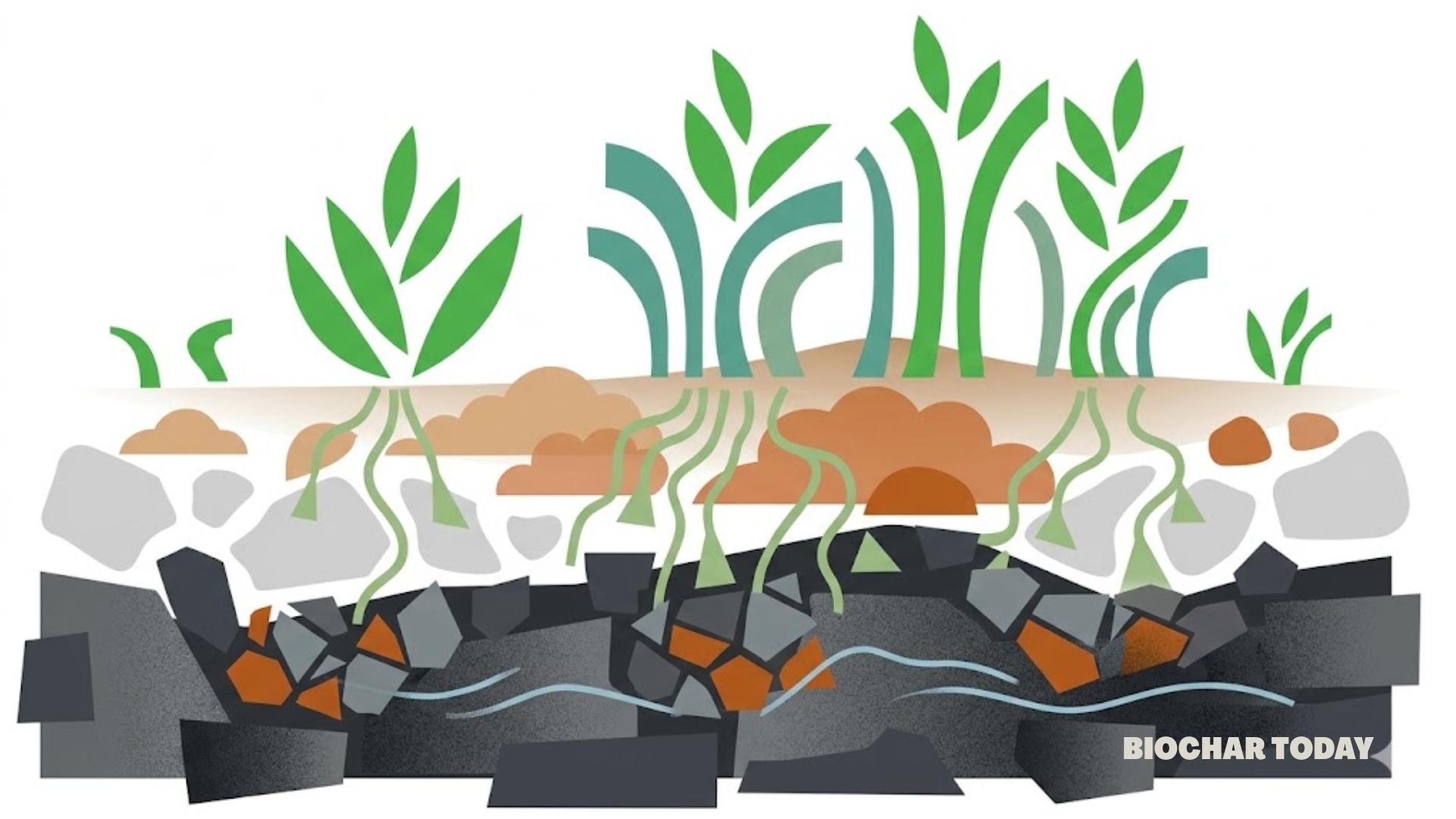
- Applying biochar to urban soils makes them healthier, helping trees and plants grow stronger, retaining more water, and improving resistance to drought.
- Biochar can be used in green infrastructure like green roofs and permeable pavements to reduce stormwater runoff and filter pollutants, offering a cost-effective alternative to activated carbonActivated carbon is a form of carbon that has been processed to create a vast network of tiny pores, increasing its surface area significantly. This extensive surface area makes activated carbon exceptionally effective at trapping and holding impurities, like a molecular sponge. It is commonly More.
- Pilot programs in cities like Boulder, CO, and Minneapolis, MN, show that this technology is viable, with systems potentially producing over 1,000 tons of biochar annually and generating verifiable carbon credits.b
A review article by Gamal El Afandi, Muhammad Irfan, Amira Moustafa, Salem Ibrahim, and Santosh Sapkota, published in the journal Urban Science, provides a comprehensive look at the carbon-negative potential of converting residual woody biomassBiomass is a complex biological organic or non-organic solid product derived from living or recently living organism and available naturally. Various types of wastes such as animal manure, waste paper, sludge and many industrial wastes are also treated as biomass because like natural biomass these More from urban vegetation into biochar for sustainable urban management in the United States. Rapid urbanization has created numerous environmental challenges, including the loss of natural green spaces, which increases energy consumption, pollution, and carbon emissions. Urban forests, however, are critical for mitigating these effects; studies indicate that urban trees across the continental US sequester roughly 22.8 million tons of carbon annually, which translates to a monetary value of approximately $460 million. They also store about 700 million tons of carbon, valued at around $14.3 billion. Biochar made from biomass through pyrolysis at temperatures typically between 300 and 700°C in a low-oxygen environment offers a stable, long-term way to sequester carbon and avoid the release of CO2 and CH4 that occurs during natural decomposition.
Biochar production is classified into three main types based on operational parameters. Slow pyrolysis has an extended duration, yielding about 35% biochar, 30% bio-oil, and 35% syngasSyngas, or synthesis gas, is a fuel gas mixture consisting primarily of hydrogen and carbon monoxide. It is produced during gasification and can be used as a fuel source or as a feedstock for producing other chemicals and fuels. More. Fast pyrolysis involves rapid heating and produces less biochar (15–25%) but more liquid bio-oil (60–75%). Flash pyrolysis rapidly heats biomass in seconds and can maximize yield up to 60% biochar or 70% bio-oil. The feedstockFeedstock refers to the raw organic material used to produce biochar. This can include a wide range of materials, such as wood chips, agricultural residues, and animal manure. More material and the pyrolysis temperature significantly influence the resulting biochar properties. For instance, biochar’s carbon content increases with temperature, measured at 58% at 300∘C and rising to 64% at 700∘C. Higher temperatures also increase the material’s surface area and porosityPorosity of biochar is a key factor in its effectiveness as a soil amendment and its ability to retain water and nutrients. Biochar’s porosity is influenced by feedstock type and pyrolysis temperature, and it plays a crucial role in microbial activity and overall soil health. Biochar More, enhancing its ability to adsorb pollutants.
The incorporation of biochar into urban environments offers multiple benefits, particularly for soil health and stormwater management. Urban soils are often compacted, contaminated, and nutrient-deficient. Biochar application, however, can increase tree biomass by an average of 41%, enhance soil structure, and increase water retention, which is critical during drought periods. In one controlled experiment, biochar-amended plots resulted in a remarkable 39% increase in plant biomass and water use efficiency under drought stress. Beyond urban green spaces, biochar-based solutions are proving effective for stormwater management. As urbanization increases impermeable surfaces, the risk of urban flooding rises. Biochar filtration is recognized as a best management practice for stormwater treatment, with Oregon State University research showing biochar media blends can achieve over 95% removal rates for dissolved and total copper and zinc. Furthermore, integrating biochar into green roof substrates can reduce pollutant loads; a comparative analysis found biochar substrate resulted in significantly lower total nitrogen and chemical oxygen demand levels—about half—compared to a commercial substrate. Biochar also has potential as a sustainable building insulator, with thermal conductivity comparable to gypsum board.
The conversion of urban wood waste, estimated to have a potential economic valuation of between $89 million and $786 million, represents a major sustainable opportunity. Pilot programs are underway in US cities to capitalize on this resource. For example, Boulder, Colorado, is piloting a community-scale system that could convert approximately 200 tons of biomass into 30 tons of biochar annually, potentially mitigating between 400 and 2053 metric tons of CO2 emissions annually. Similarly, a proposed unit in Minneapolis, Minnesota, aims to process 16 tons of green wood daily to create around 4 tons of biochar. Furthermore, mobile production systems like the CharBoss have been assessed and found to facilitate a net removal of approximately -2.70 metric tons of CO2 equivalent per ton of biochar produced, generating an impressive 2403.81 MT CO2 equivalent in marketable carbon removal certificates annually. These initiatives highlight the feasibility of diverting urban woody biomass from landfills to generate value-added products while significantly contributing to climate change mitigation efforts.
Source: El Afandi, G., Irfan, M., Moustafa, A., Ibrahim, S., & Sapkota, S. (2025). A Review on Carbon-Negative Woody Biomass Biochar System for Sustainable Urban Management in the United States of America. Urban Science, 9(6), 214.



Leave a Reply