
Key Takeaways
- BiocharBiochar is a carbon-rich material created from biomass decomposition in low-oxygen conditions. It has important applications in environmental remediation, soil improvement, agriculture, carbon sequestration, energy storage, and sustainable materials, promoting efficiency and reducing waste in various contexts while addressing climate change challenges. More made from brewery waste provides an effective and low-cost material to capture harmful bacteria in water filtration systems.
- Mixing biochar into sandy filtration media significantly reduces the underground movement and environmental spread of fecal pathogens.
- Higher biochar amendment rates successfully shift bacterial removal from simple physical straining to permanent cellular attachment.
- Laboratory transport columns demonstrate that a ten percent biochar mixture eliminates over 94 percent of targeted bacterial cells.
- This sustainable technique addresses major industrial waste disposal challenges while simultaneously protecting vital groundwater resources from contamination.
A recent study published in Biochar by Christos P. Giannopoulos, Christos A. Kolotouros, and Ioannis D. Manariotis investigates how engineered carbon amendments can upgrade standard sand filtration to prevent subsurface pathogen migration. Protecting groundwater from microbial contamination remains a critical global health priority, as waterborne pathogens frequently cause severe water-related illnesses and environmental risks. While sandy soils and conventional filters allow microbes to percolate downward into aquifers easily, introducing sustainable carbon materials into the filtration matrix offers a promising strategy to enhance bacterial retention. To test this approach, the researchers evaluated the physical fate and transport behaviors of indicator bacteria moving through saturated porous media containing specialized pyrolyzed residues.
The investigators utilized brewery industry byproducts, specifically malt spent rootlets, processed through slow pyrolysisPyrolysis is a thermochemical process that converts waste biomass into bio-char, bio-oil, and pyro-gas. It offers significant advantages in waste valorization, turning low-value materials into economically valuable resources. Its versatility allows for tailored products based on operational conditions, presenting itself as a cost-effective and efficient More at high temperatures to create a highly porous carbonaceous sorbent. This material features a substantial specific surface area and a complex internal microarchitecture filled with active binding domains. Through comprehensive batch sorption trials and continuous flow-through column experiments, the team examined how varying ionic strength conditions and structural configurations influence microbial capture. The findings revealed that bacterial inactivation follows non-linear patterns governed by population resistance, while adsorption kinetics and equilibrium capacities closely align with established mathematical models. Furthermore, raising solution ionic strength created electrostatic shielding effects that moderately hindered binding affinity, whereas lower ionic strength favored stronger microbial accumulation.
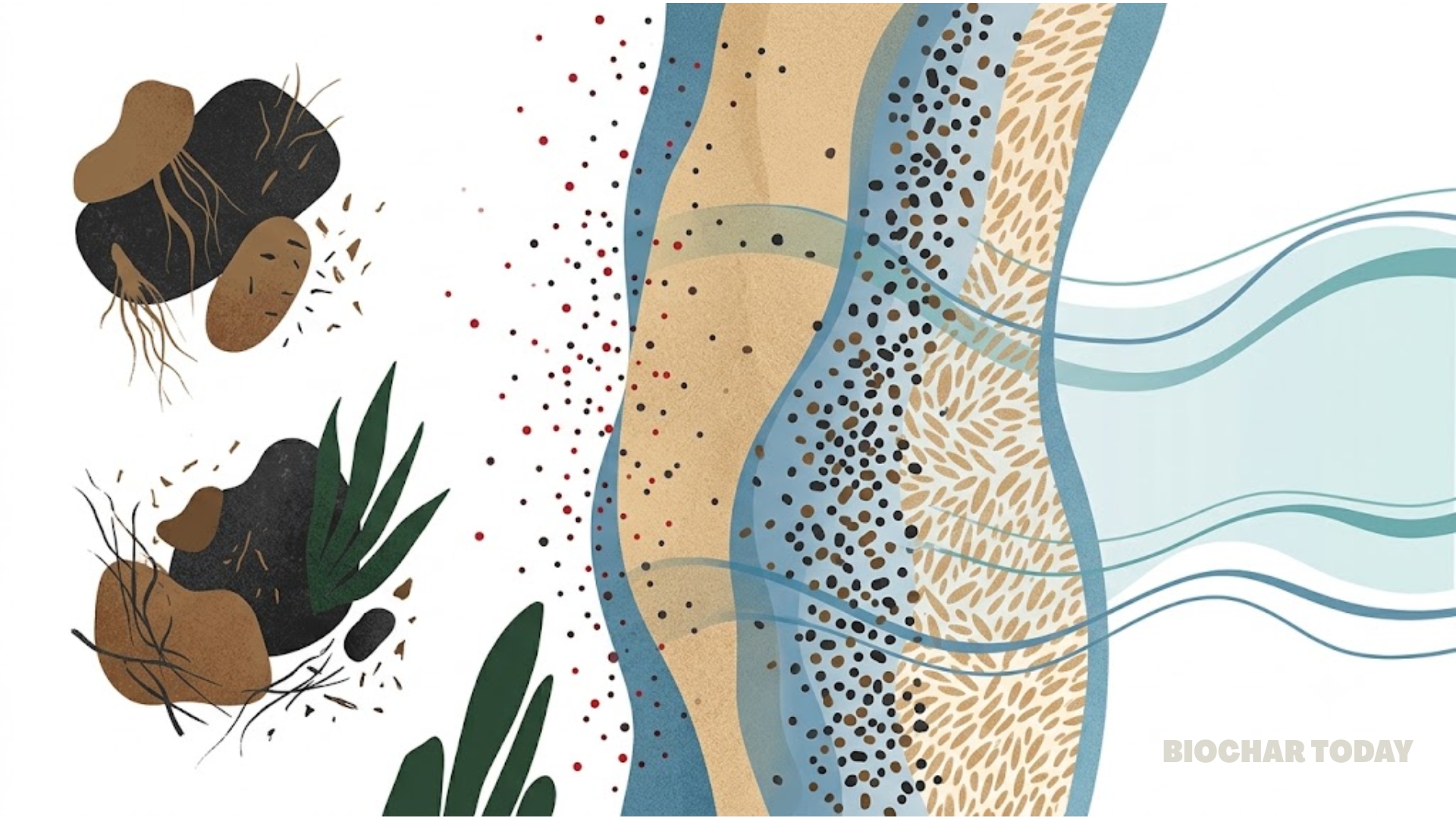
Flow-through column evaluations highlighted the dramatic performance differences achieved by blending the carbon material into standard quartz sand. Unamended sand filters captured only a small fraction of the incoming bacterial suspension, yielding low overall removal efficiency. Incorporating a ten percent weight ratio of the brewery-derived biochar drastically transformed the internal dynamics of the porous bed, elevating removal performance to 94.1 percent. Advanced biocolloid transport modeling indicated that this massive improvement stems from a fundamental transition in retention mechanics, shifting away from minor physical straining toward strong, irreversible cellular attachment. Because the treated biochar surfaces exhibit favorable physicochemical properties, trapped bacterial cells remain securely bound under continuous hydrodynamic flow without experiencing notable detachment.
These outcomes establish a compelling framework for valorizing agricultural and industrial waste streams into high-value environmental remediation tools. Transforming brewery byproducts into engineered filtration amendments solves dual objectives by mitigating pressing waste disposal hurdles and upgrading decentralized water treatment infrastructure. Although natural field conditions involve complex organic matrices and variable flow dynamics that warrant further long-term testing, the proven capacity of malt spent rootlets biochar to immobilize bacterial pathogens marks a vital step toward safer water supplies and more resilient ecological engineering.
Source: Giannopoulos, C. P., Kolotouros, C. A., & Manariotis, I. D. (2026). Sorption and transport of Escherichia coli CN-13 in saturated sand columns amended with biochar derived from malt spent rootlets. Biochar, 8, 130.



Leave a Reply