
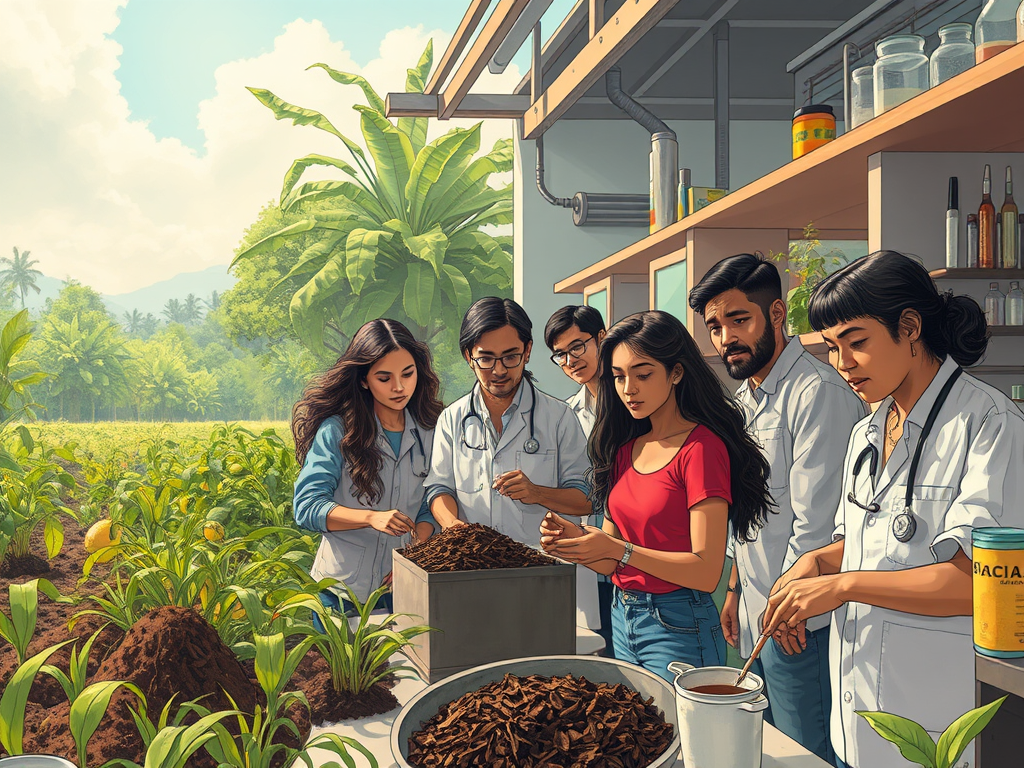
A team of researchers and students at the University of Sciences and Arts of Chiapas (Unicach) has developed an organic substrate to address the challenge of soil degradation and improve agricultural production in the region. This initiative leverages local plant materials to create a product that enhances soil health and nutrient uptake in local vegetable crops. The project is a collaboration between academics and students, serving to advance both agricultural research and the academic formation of future professionals.
The development of biocharBiochar is a carbon-rich material created from biomass decomposition in low-oxygen conditions. It has important applications in environmental remediation, soil improvement, agriculture, carbon sequestration, energy storage, and sustainable materials, promoting efficiency and reducing waste in various contexts while addressing climate change challenges. More in Chiapas aligns with a broader trend in Mexico, where there is a growing interest in using agricultural residues as a resource rather than a waste product. Mexico’s agricultural sector generates a significant amount of biomassBiomass is a complex biological organic or non-organic solid product derived from living or recently living organism and available naturally. Various types of wastes such as animal manure, waste paper, sludge and many industrial wastes are also treated as biomass because like natural biomass these More from crops such as coffee, sugarcane, and corn. Much of this waste is often left in fields or incinerated, contributing to greenhouse gas emissions and environmental issues. Instead, Professor Vicente Pérez Madrigal, a researcher involved in the project, explained that the biomass could be converted into biochar through pyrolysisPyrolysis is a thermochemical process that converts waste biomass into bio-char, bio-oil, and pyro-gas. It offers significant advantages in waste valorization, turning low-value materials into economically valuable resources. Its versatility allows for tailored products based on operational conditions, presenting itself as a cost-effective and efficient More (burning in the absence of oxygen).
The studies are being conducted using both simple, at-home methods and more controlled laboratory environments. The team is focusing on common regional materials such as sawdust and coffee husks. The research has shown that different source materials yield biochar with varying porosities, making it essential to identify which material is best suited for each type of plant. This local-scale research is key to demonstrating the viability of biochar production and application for small- and medium-sized farms across Mexico, where a considerable amount of biomass is available as a feedstockFeedstock refers to the raw organic material used to produce biochar. This can include a wide range of materials, such as wood chips, agricultural residues, and animal manure. More for conversion. The involvement of students is a key component of this project, with two theses already underway in this field—one at the master’s level in Agroforestry Sciences and another for a bachelor’s in Agroforestry Engineering. This project provides practical experience and strengthens the research capabilities of the participating students.
SOURCE: Desarrollan sustrato para mejorar fertilización



Leave a Reply