
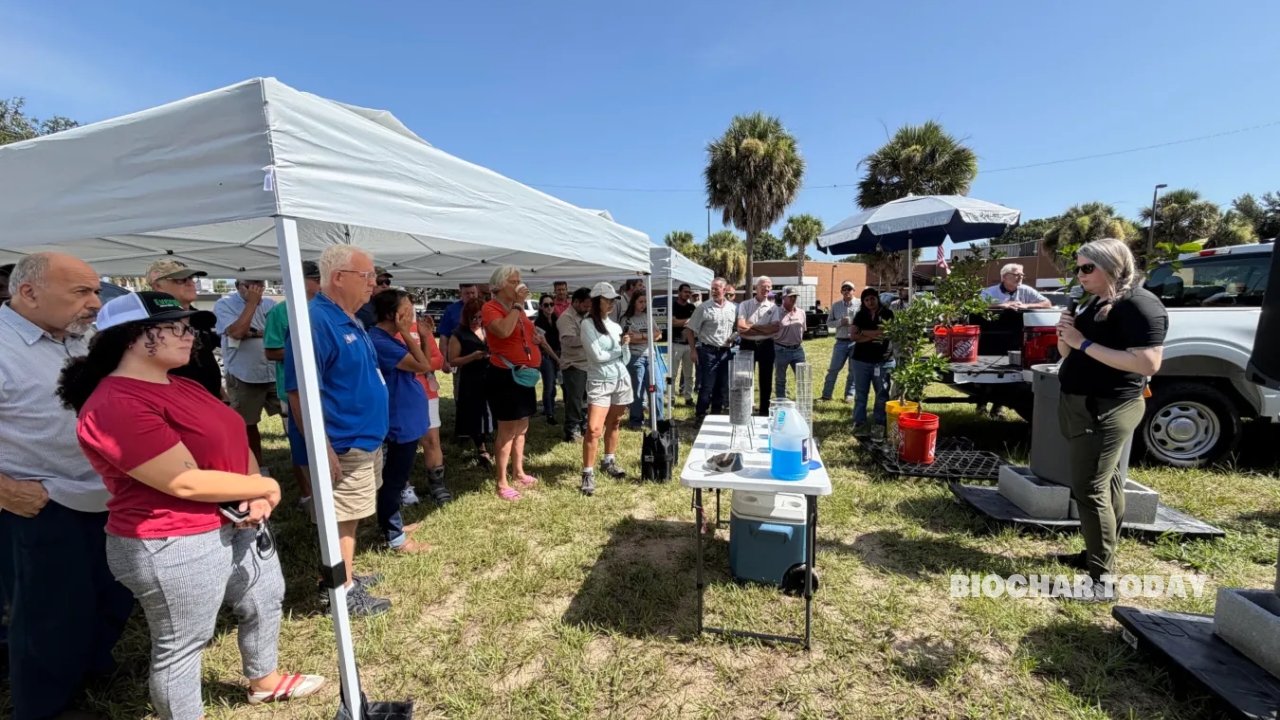
Researchers at the University of Florida Institute of Food and Agricultural Sciences Citrus Research and Education Center (UF/IFAS CREC) in the United States have highlighted the efficacy of integrating biocharBiochar is a carbon-rich material created from biomass decomposition in low-oxygen conditions. It has important applications in environmental remediation, soil improvement, agriculture, carbon sequestration, energy storage, and sustainable materials, promoting efficiency and reducing waste in various contexts while addressing climate change challenges. More and compost to rehabilitate soil health in commercial citrus production. The research emphasizes leveraging the U.S. Department of Agriculture Natural Resources Conservation Service (USDA NRCS) Conservation Practice Standard 336 to facilitate grower adoption. By pairing biochar with compost, growers can access funding and technical frameworks to deploy soil carbon amendments that enhance soil function and long-term crop resilience across the region.
Citrus production in Florida faces severe agronomic headwinds, driven by sandy soils that naturally lack organic matter and possess weak water- and nutrient-holding capacities. This structural soil deficit is severely exacerbated by Huanglongbing (HLB), or citrus greening disease, which compromises the root systems of citrus trees. Damaged root architecture restricts the trees’ ability to efficiently take up essential water and nutrients from the soil, leading to heightened physiological stress, lower resource-use efficiency, and reduced yields.
To address these root-zone constraints, UF/IFAS CREC evaluated co-applications of compost and biochar as complementary soil carbon amendments. Compost supplies immediate organic matter, nutrients, and beneficial microbial populations to support nutrient cycling. Meanwhile, biochar provides a stable carbon framework that elevates cation exchange capacity, improves soil structure, and retains moisture within the active root zone. The commercial adoption of this practice is further accelerated by USDA NRCS Conservation Practice Standard 336, which offers structured support for applying approved carbon-based amendments, including biochar-compost blends.
The implementation of biochar-compost blends yields measurable improvements in both soil hydraulics and overall crop performance. Field research demonstrates enhanced soil water retention alongside significant reductions in nutrient leachingLeaching is the process where nutrients are dissolved and carried away from the soil by water. This can lead to nutrient depletion and environmental pollution. Biochar can help reduce leaching by improving nutrient retention in the soil. More. Consequently, treated citrus trees exhibit elevated photosynthetic performance, superior water-use efficiency, and reduced drought and oxidative stress. At harvest, these root-zone improvements translate directly into enhanced fruit set, improved fruit retention, and increased fruit growth, demonstrating that targeted soil restoration can sustain productivity under HLB pressure.


Leave a Reply