

Key Takeaways
- Hydrogen is a clean fuel source, and this study offers a new, efficient way to produce it from plant waste (biomassBiomass is a complex biological organic or non-organic solid product derived from living or recently living organism and available naturally. Various types of wastes such as animal manure, waste paper, sludge and many industrial wastes are also treated as biomass because like natural biomass these More), like corn straw.
- A novel two-stage catalytic system was developed to overcome challenges in H2 production, specifically low yield and carbon buildup on catalysts.
- The two-stage system uses biocharBiochar is a carbon-rich material created from biomass decomposition in low-oxygen conditions. It has important applications in environmental remediation, soil improvement, agriculture, carbon sequestration, energy storage, and sustainable materials, promoting efficiency and reducing waste in various contexts while addressing climate change challenges. More as a “pre-catalyst” to clean up the raw vapor before it hits the main catalyst.
- This setup achieved a high H2 yield of 48.87 vol% and significantly reduced harmful carbon deposits on the catalyst, which normally cause it to stop working quickly.
- This approach offers a strategy for converting biomass into a valuable energy product, making the process more economically viable than previous one-stage methods.
Biomass, such as agricultural waste like corn straw, holds immense potential as a sustainable fuel source. Transforming this resource into clean gas fuels, particularly hydrogen (H2), is a key technical goal, often achieved through pyrolysisPyrolysis is a thermochemical process that converts waste biomass into bio-char, bio-oil, and pyro-gas. It offers significant advantages in waste valorization, turning low-value materials into economically valuable resources. Its versatility allows for tailored products based on operational conditions, presenting itself as a cost-effective and efficient More catalysis. However, this process faces two main hurdles: achieving a high yield of H2-rich gas and mitigating the rapid accumulation of carbon deposits, or “coke,” on the catalyst’s surface, which leads to deactivation. To address these challenges, Zhang et al. published their research in the journal Biochar, detailing a novel two-stage catalytic system designed to boost H2 production and enhance catalytic stability. The first step in their study involved optimizing a conventional one-stage catalysis system using metal-support catalysts, which are typically Ni-based due to their cost-effectiveness and ability to cleave carbon bonds. They determined the optimal conditions to be a catalytic temperature of 800°C, a biomass:catalyst ratio of 1:2, and Al2O3 as the catalyst carrier. They then tested various metal combinations (Ni, Ni-Co, Ni-Fe, Ni-Mo, and Ni-Ce) supported on the carrier. Of these, the Ni−Ce(NE) catalyst demonstrated the highest H2 yield of 45.24 vol% in the gas product. This superior performance was attributed to the redox cycle between Ce3+ and Ce4+, which provided active oxygen species to consume carbon deposits and promote the oxidation of coke, thus enhancing anti-coking performance and tar-cracking efficiency.
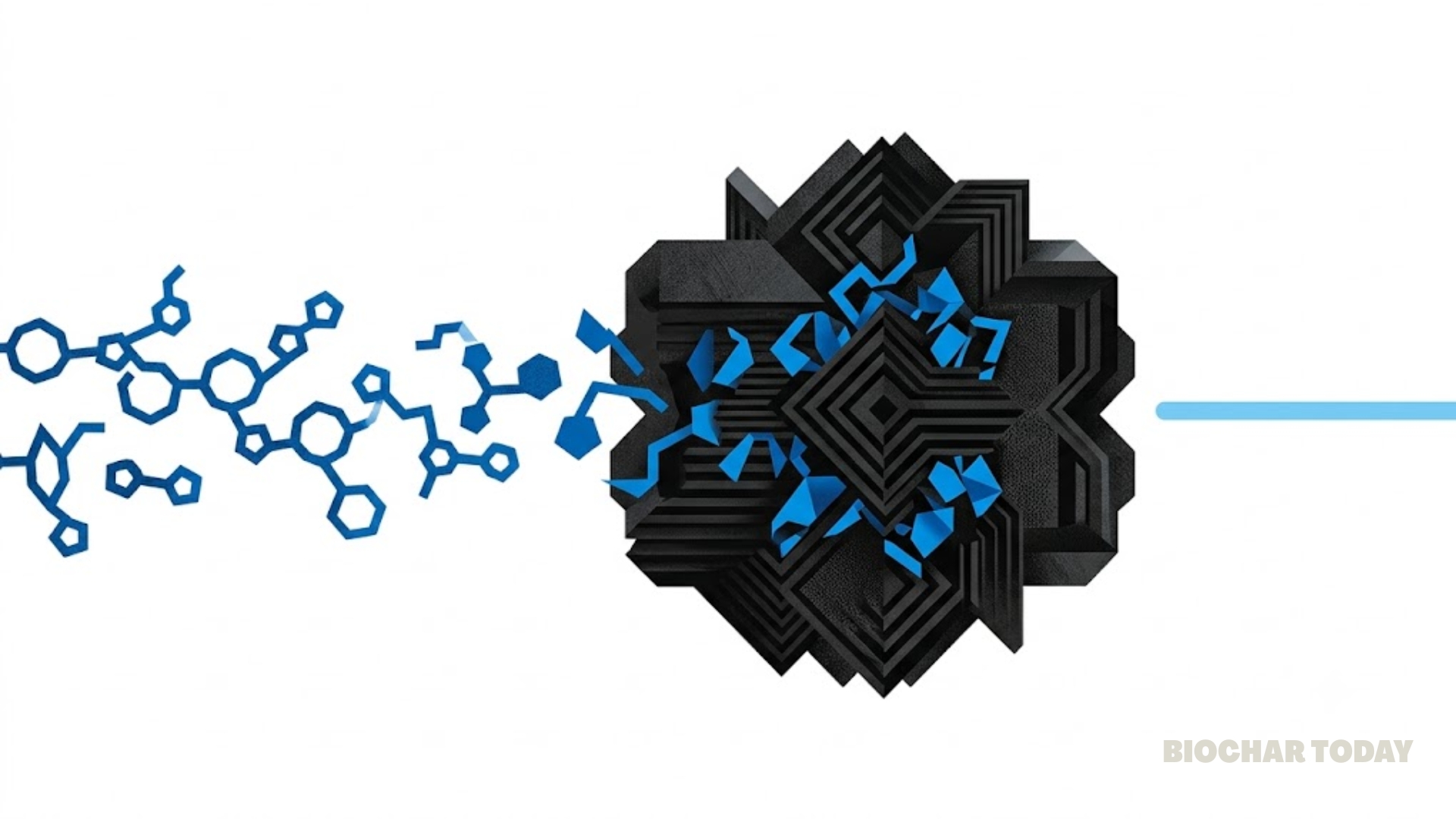
To further enhance performance, the researchers introduced biochar (B), a product of pyrolysis itself, as a pre-catalytic layer placed upstream of the metal-support catalyst, creating the novel two-stage catalytic system. Biochar has a porous structure and rich surface functional groups, making it suitable for acting as a catalyst for tar cracking and reforming. In the first stage (pre-catalysis), the biochar effectively cracked and selectively adsorbed the large, macromolecular compounds (primary tar) generated during initial biomass pyrolysis. This primary step converted the large, sticky tar molecules into smaller gaseous fragments and intermediates, significantly reducing the burden of heavy compounds that would otherwise quickly deactivate the main catalyst in the second stage.
The results confirmed the successful synergistic effect of the two-stage process. When the Ni-based catalyst (N) was combined with the biochar pre-catalyst, the H2 yield rose significantly from 41.24 vol% (one-stage) to 48.87 vol% (two-stage). This increase was due to the biochar promoting better gas flow, activating volatiles via its surface functional groups, and facilitating the free-radical reforming of tar into H2 and CO precursors that aided the downstream reaction. Overall, the two-stage system (with biochar) led to an increase in total gas yield (up to 71.39 wt% for NF) and a corresponding decrease in tar yield.
Critically, the biochar layer dramatically inhibited carbon deposition on the subsequent metal catalyst. This was confirmed by Temperature-Programmed Oxidation (TPO) analysis, which showed a reduced amount of carbon accumulation on the spent catalysts compared to the one-stage process. Furthermore, Raman spectroscopy showed that the carbon deposits that did form were more graphitized (indicated by a decrease in the ID/IG ratio from 1.229-1.282 to 1.208-1.256) , implying a more stable, less reactive structure that is less likely to poison the active sites.
A techno-economic assessment highlighted that the pre-catalytic step is economically essential. While one-stage catalysis incurred a loss of 2.72 Y⋅kg−1 due to high catalyst costs and low product yield, the two-stage scenario resulted in an additional income of 0.31 Y⋅kg−1 compared to conventional pyrolysis. This improvement is primarily due to the biochar’s role in reducing catalyst deactivation and increasing the combustible fraction of the gas products, ensuring a more stable long-term operation. This study, therefore, presents a successful and novel staged catalytic strategy of “biochar adsorption activation–catalyst reforming” for the efficient and economically feasible conversion of biomass to clean hydrogen energy.
Source: Zhang, X., Zhao, L., Yao, Z., Jia, J., Sun, Y., & Huo, L. (2025). Enhanced hydrogen production and carbon suppression via a two-stage catalytic system of biochar pre-catalysis and Ni-based catalysts during biomass pyrolysis. Biochar, 7(1), 120.



Leave a Reply