
Key Takeaways
- Tree rings from the nineteen sixties contain a unique chemical marker from historical nuclear tests that can track carbon in the ground.
- Scientists can turn these special tree rings into a natural tracker to measure how long biocharBiochar is a carbon-rich material created from biomass decomposition in low-oxygen conditions. It has important applications in environmental remediation, soil improvement, agriculture, carbon sequestration, energy storage, and sustainable materials, promoting efficiency and reducing waste in various contexts while addressing climate change challenges. More stays stable in soil.
- This natural tracking method proves that only a tiny fraction of biochar breaks down into carbon dioxide over a full year.
- The new technique works much better than older methods for studying wood-based biochar without needing expensive laboratory isotope labeling.
- Understanding how biochar holds carbon helps researchers improve natural climate solutions for global warming.
In a recent publication in the journal Radiocarbon, researcher Haichao Li and his team explore an innovative approach to solving one of the most persistent puzzles in environmental science. For decades, scientists have struggled to measure accurately how long biochar remains stable when buried in the earth. Traditional methods required expensive and complex laboratory isotope labeling or relied on natural abundance variations that only worked under narrow environmental conditions. By turning to historical atmospheric records preserved inside nature, the research team unlocked a completely new way to track carbon stability without altering the feedstockFeedstock refers to the raw organic material used to produce biochar. This can include a wide range of materials, such as wood chips, agricultural residues, and animal manure. More artificially. This clever technique opens up fresh possibilities for studying carbon dynamics across diverse agricultural and forest soils without the heavy financial burdens previously associated with specialized isotope tracking facilities.
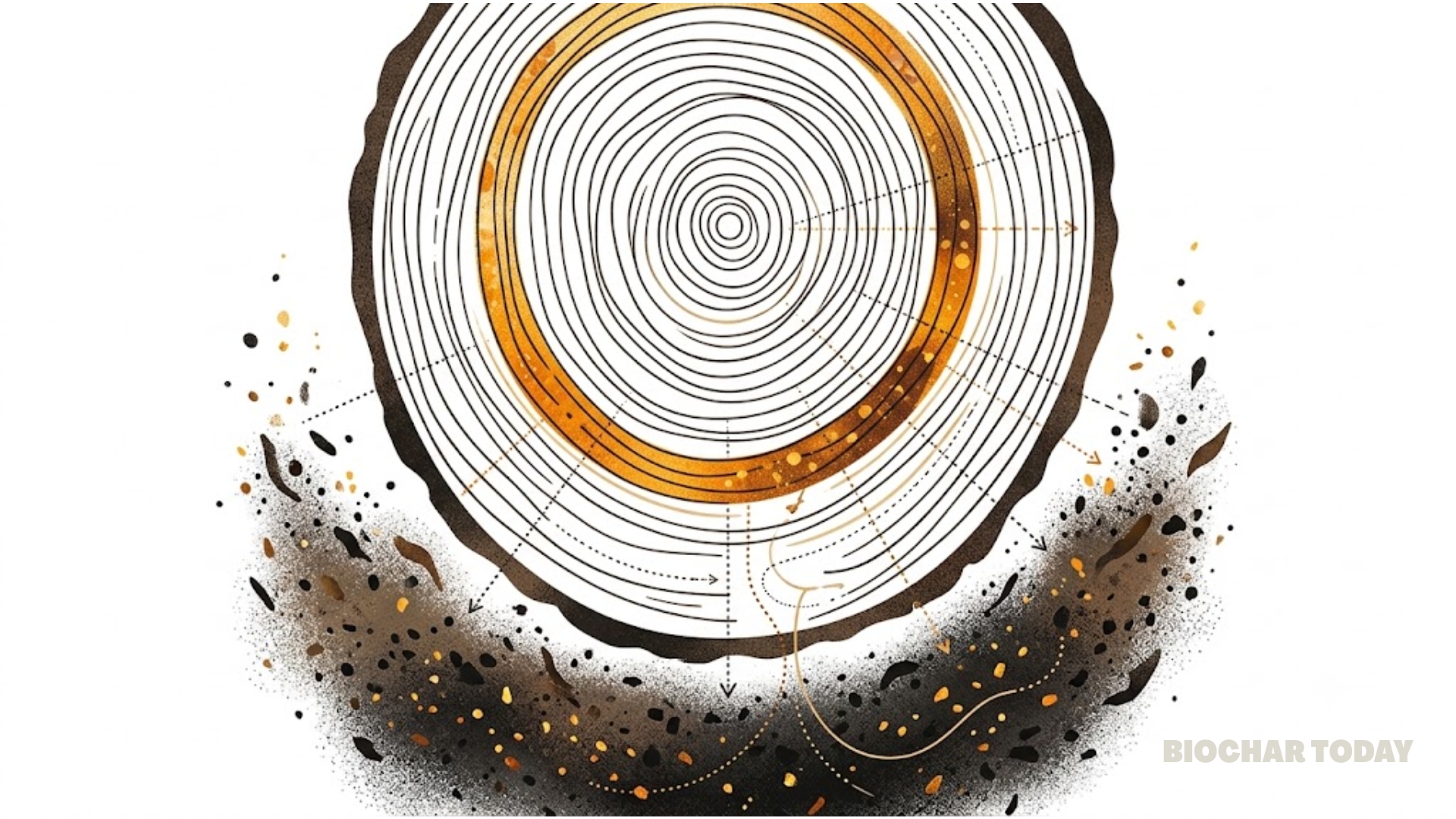
During the height of atmospheric nuclear weapons testing in the nineteen sixties, a massive spike of radioactive carbon accumulated in the global atmosphere and became permanently locked inside the growing rings of trees. The authors recognized that these specific tree rings act as a natural time capsule filled with a distinct chemical signature. By harvesting wood exclusively from the nineteen sixty-four to nineteen sixty-seven growth rings, the researchers successfully produced natural carbon-enriched biochar. This unique material carries an elevated isotopic abundance that distinguishes it effortlessly from ordinary soil organic matter once mixed into the ground. Because mature trees absorbed this atmospheric signal evenly during their growth years, the resulting biochar provides a remarkably uniform tracer for monitoring decomposition rates over extended periods.
To test the effectiveness of this natural tracking tool, the team conducted a meticulous year-long soil incubation experiment under controlled laboratory conditions. They monitored carbon dioxide emissions released continuously from soil mixed with two types of biochar produced at different maximum temperatures. Because the isotopic signature of the tree-ring biochar was distinctly higher than normal soil carbon, the researchers could accurately separate the carbon dioxide originating from the biochar from the carbon dioxide released by native soil microbes. The findings revealed that between eight and eleven percent of the respired carbon came from the biochar during the initial two weeks of adjustment, a fraction that steadily decreased to lower levels as the microbial activity stabilized over time.
The overarching finding of the experiment demonstrates exceptional long-term stability for both tested biochar types. After a full year of continuous microbial decomposition, only zero point thirty-two percent of the biochar produced at lower temperatures and zero point thirty-five percent of the biochar produced at higher temperatures had mineralized into the air. These remarkably low mineralization figures confirm that the vast majority of the carbon remains securely locked away in the soil rather than escaping back into the atmosphere as greenhouse gases. Furthermore, the study carefully measured how the biochar amendment influenced the breakdown of native soil organic matter, documenting minimal negative priming effects over the course of the twelve-month observation period.
Compared to traditional techniques, this bomb-carbon tracing method offers superior sensitivity and practical advantages for large-scale research. Standard natural abundance methods require massive isotopic differences between plant types, whereas the tree-ring method can successfully detect biochar contributions as low as four percent in total emissions. Moreover, because the wood feedstock is sourced from mature forest trees rather than young laboratory seedlings, the resulting biochar closely mirrors commercial products used in real-world agricultural and environmental remediation projects. This major methodological breakthrough provides scientists and policymakers with a dependable, highly accurate tool to evaluate carbon sequestration initiatives and verify climate change mitigation efforts worldwide.
Source: Li, H., Cederlund, H., Azzi, E. S., Sundberg, C., & Karltun, E. (2026). Bomb 14C for tracing biochar mineralization in soil. Radiocarbon, 68(4), 1146-1154.


Leave a Reply