
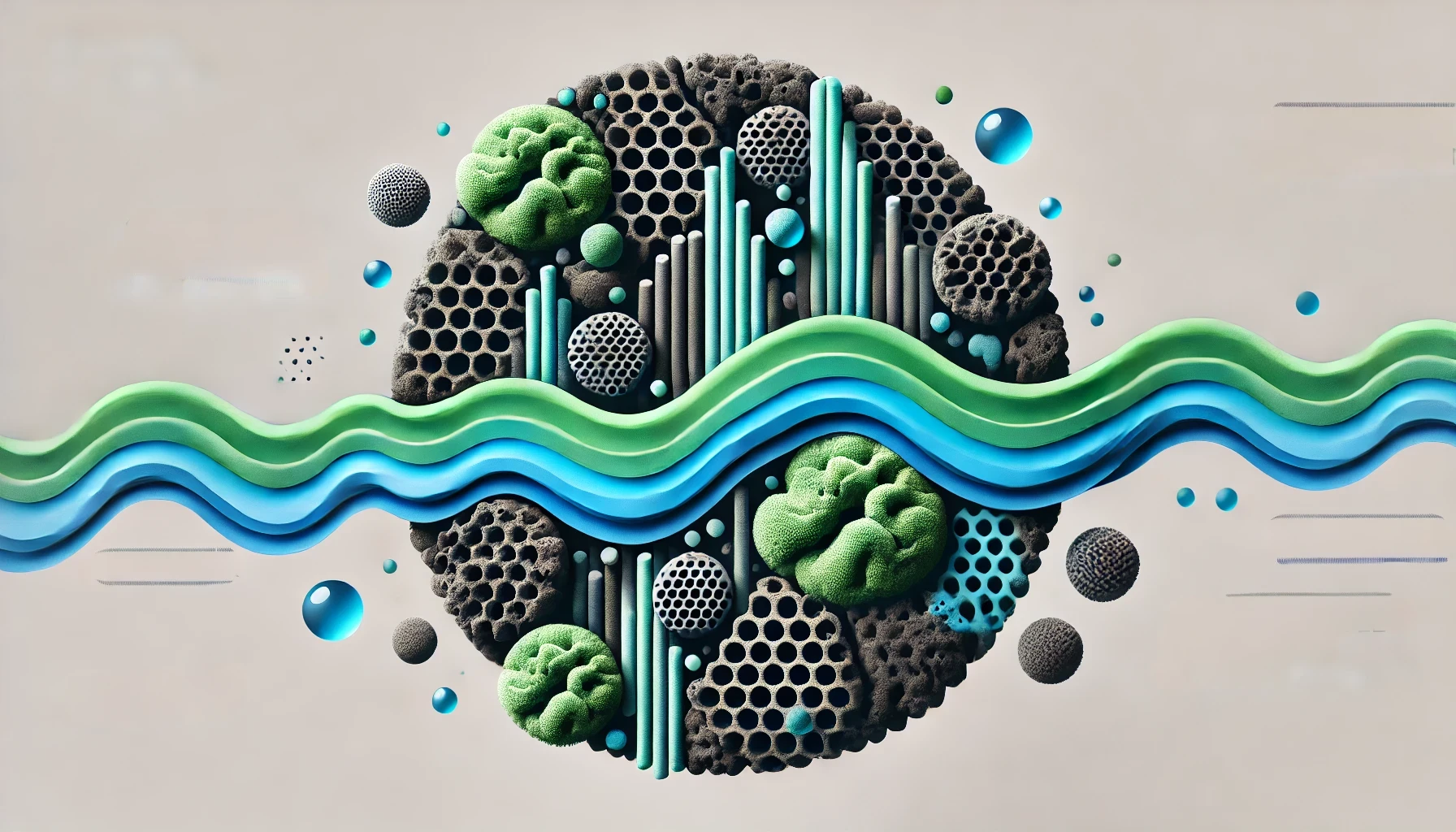
Madzin, et al (2025) Optimising spent mushroom compost biocharBiochar is a carbon-rich material created from biomass decomposition in low-oxygen conditions. It has important applications in environmental remediation, soil improvement, agriculture, carbon sequestration, energy storage, and sustainable materials, promoting efficiency and reducing waste in various contexts while addressing climate change challenges. More for heavy metal removal: Mechanisms and kinetics in mine water treatment. Journal of Water Process Engineering. https://doi.org/10.1016/j.jwpe.2024.106829
Spent mushroom compost (SMC), a byproduct of the mushroom industry, offers a sustainable solution to address heavy metal contamination in abandoned mine water. A recent study demonstrates how biochar produced from SMC can effectively remove toxic metals like copper (Cu), manganese (Mn), iron (Fe), and lead (Pb), which are hazardous to ecosystems and human health.
SMC is converted to biochar through pyrolysisPyrolysis is a thermochemical process that converts waste biomass into bio-char, bio-oil, and pyro-gas. It offers significant advantages in waste valorization, turning low-value materials into economically valuable resources. Its versatility allows for tailored products based on operational conditions, presenting itself as a cost-effective and efficient More, a process of heating biomassBiomass is a complex biological organic or non-organic solid product derived from living or recently living organism and available naturally. Various types of wastes such as animal manure, waste paper, sludge and many industrial wastes are also treated as biomass because like natural biomass these More in limited oxygen. The study explored three temperatures—300°C, 500°C, and 700°C—to determine the optimal conditions for heavy metal adsorption. Biochar produced at 500°C showed superior performance, achieving a 97% removal efficiency for metals, while also being more cost-effective and energy-efficient than higher temperature biochar.
The adsorption process is influenced by factors such as pHpH is a measure of how acidic or alkaline a substance is. A pH of 7 is neutral, while lower pH values indicate acidity and higher values indicate alkalinity. Biochars are normally alkaline and can influence soil pH, often increasing it, which can be beneficial More and metal concentration. The biochar’s microporous structure and functional groups enable mechanisms like cation exchange and electrostatic attraction, ensuring efficient metal binding. Batch studies confirmed the biochar’s performance aligns well with established kinetic and isotherm models, validating its reliability.
Economically, SMC biochar is a game-changer, costing significantly less than conventional activated carbonActivated carbon is a form of carbon that has been processed to create a vast network of tiny pores, increasing its surface area significantly. This extensive surface area makes activated carbon exceptionally effective at trapping and holding impurities, like a molecular sponge. It is commonly More while offering similar or superior efficiency. Its reusability—retaining over 85% adsorption efficiency after multiple cycles—further enhances its feasibility for large-scale water treatment applications.
This innovation aligns with global sustainability goals, providing a scalable, eco-friendly method to repurpose agricultural waste while tackling water contamination. By integrating low-cost production, effective heavy metal removal, and potential for reusability, SMC biochar emerges as a sustainable solution for regions affected by mining.

Leave a Reply