
Researchers in South Korea have successfully demonstrated an ultra-fast thermochemical conversion process that transforms wet spent coffee grounds into high-grade solid fuel. The collaborative study, led by the Korea Institute of Geoscience and Mineral Resources (KIGAM) and GodTech Co., Ltd., introduces a methodology that processes organic waste in ninety seconds. This technology completely bypasses the traditional, energy-intensive drying phases that typically stall biomassBiomass is a complex biological organic or non-organic solid product derived from living or recently living organism and available naturally. Various types of wastes such as animal manure, waste paper, sludge and many industrial wastes are also treated as biomass because like natural biomass these More recycling projects. The resulting material exhibits high energy density and structural porosityPorosity of biochar is a key factor in its effectiveness as a soil amendment and its ability to retain water and nutrients. Biochar’s porosity is influenced by feedstock type and pyrolysis temperature, and it plays a crucial role in microbial activity and overall soil health. Biochar More, presenting a viable pathway for fast-acting municipal waste management and advanced industrial applications.
Managing spent coffee grounds presents a severe global disposal challenge, as millions of tons of this heavy, moisture-laden waste enter landfills annually where they decompose into potent methane gas. Traditional recycling methods, such as hydrothermal carbonization and torrefaction, face significant economic and physical barriers due to the high water content of the feedstockFeedstock refers to the raw organic material used to produce biochar. This can include a wide range of materials, such as wood chips, agricultural residues, and animal manure. More. Conventional processing requires extensive pre-drying or prolonged heating cycles lasting up to several hours. These requirements consume more energy than the recovered fuel ultimately delivers, making widespread commercial adoption cost-prohibitive.
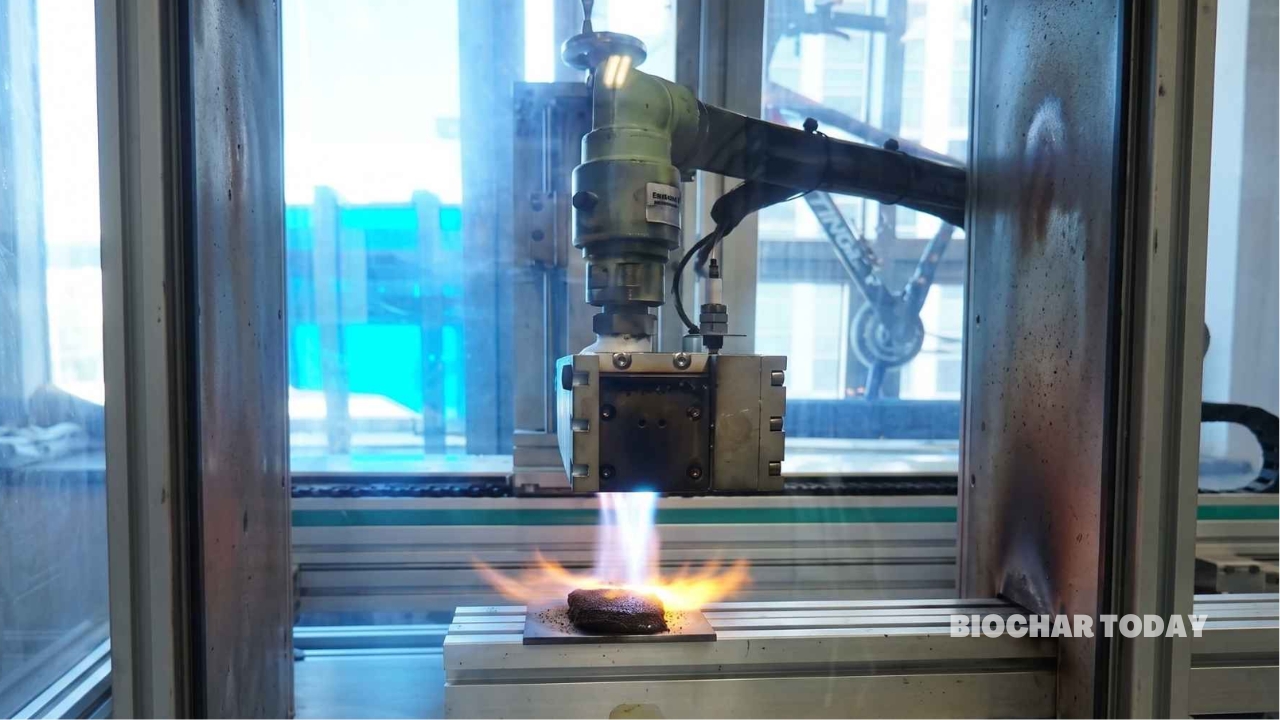
To resolve this operational bottleneck, the engineering team utilized atmospheric-pressure flame plasma pyrolysisPyrolysis is a thermochemical process that converts waste biomass into bio-char, bio-oil, and pyro-gas. It offers significant advantages in waste valorization, turning low-value materials into economically valuable resources. Its versatility allows for tailored products based on operational conditions, presenting itself as a cost-effective and efficient More to weaponize the moisture trapped within the biomass. By exposing untreated grounds containing over fifty percent moisture to a liquefied petroleum gas and compressed air flame at eight hundred to nine hundred degrees Celsius, the system induces a rapid thermochemical reaction. The intense thermal energy flash-vaporizes internal water molecules instantaneously. This moisture flash triggers localized microscopic explosions that fracture the particles internally, establishing an ultra-fast carbonization pathway without requiring vacuum chambers or complex chemical pretreatments.
The experimental outcomes confirm complete biomass conversion within ninety seconds, yielding a highly stable material with a heating value of twenty-nine megajoules per kilogram, which matches commercial anthracite coal. This rapid conversion achieves an eighty-three percent mass reduction while tripling fixed carbon content and entirely eliminating sulfur components to prevent harmful emissions during subsequent combustion. Furthermore, the localized micro-explosions increase the specific surface area more than seventy-five-fold, creating a highly porous material suitable for advanced water filtration and industrial adsorption.



Leave a Reply