
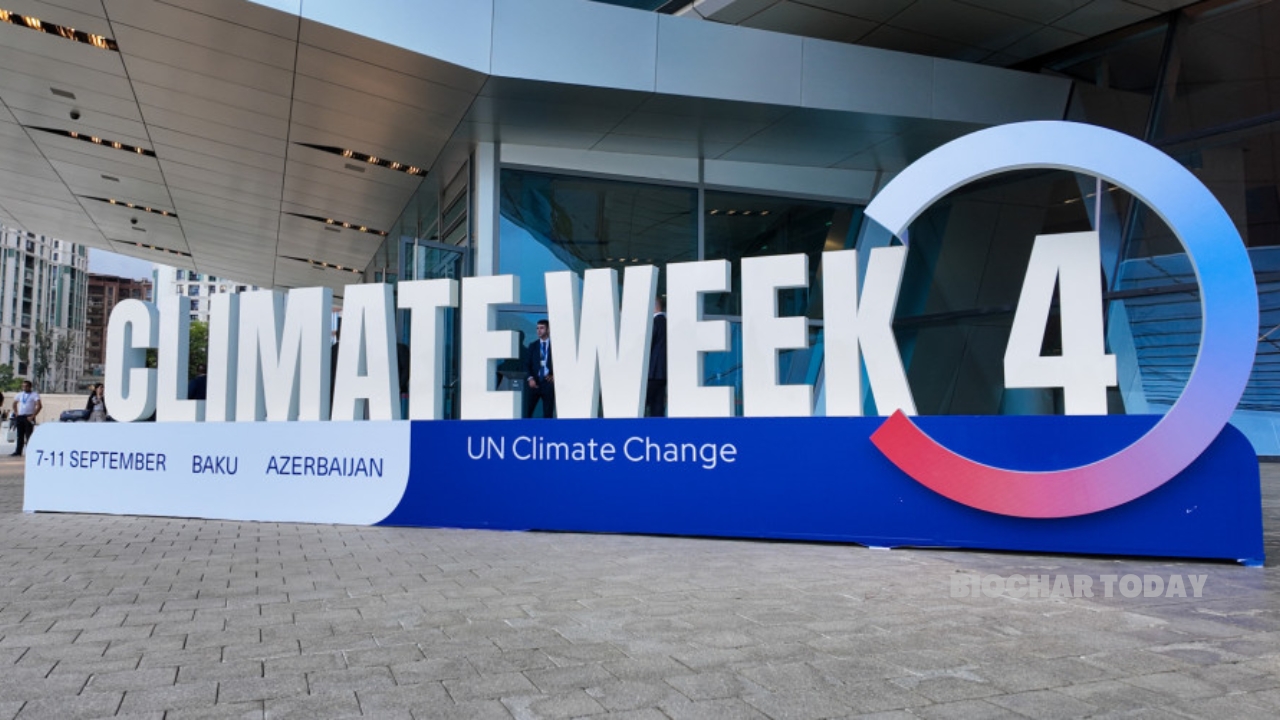
The United Nations Framework Convention on Climate Change reported on the progression of global climate implementation efforts discussed during UN Climate Week sessions moving from Yeosu, Republic of Korea, to Baku, Azerbaijan. The proceedings highlighted actionable, real-economy solutions designed to translate climate pledges into operational national strategies. Among the featured initiatives, the Government of Pakistan presented its National BiocharBiochar is a carbon-rich material created from biomass decomposition in low-oxygen conditions. It has important applications in environmental remediation, soil improvement, agriculture, carbon sequestration, energy storage, and sustainable materials, promoting efficiency and reducing waste in various contexts while addressing climate change challenges. More Accelerator Programme. This initiative focuses on converting agricultural residue into biochar to drive environmental and economic progress across its domestic agricultural sector.
Intensive agricultural systems frequently face challenges related to high volumes of unmanaged crop waste, elevated greenhouse gas emissions from biomassBiomass is a complex biological organic or non-organic solid product derived from living or recently living organism and available naturally. Various types of wastes such as animal manure, waste paper, sludge and many industrial wastes are also treated as biomass because like natural biomass these More burning, and deteriorating soil health. Furthermore, rural communities in developing economies often lack sustainable waste-management infrastructure and diversified income streams. These factors contribute to land degradation, reduced agricultural resilience, and missed economic opportunities within rural populations.
To address these compounding agricultural and economic challenges, the Government of Pakistan established the National Biochar Accelerator Programme. The framework focuses on processing loose agricultural waste into biochar using thermal conversion technologies. By intercepting biomass that would otherwise decompose or be burned in fields, the program creates a standardized pathway for rural communities to process organic waste locally and integrate the resulting material back into agricultural systems.
The program delivers measurable environmental and socio-economic outcomes. The application of biochar improves overall soil health, enhances nutrient retention, and reduces direct agricultural emissions. Economically, the initiative opens new revenue streams for rural populations by transforming low-value agricultural waste into a functional soil amendmentA soil amendment is any material added to the soil to enhance its physical or chemical properties, improving its suitability for plant growth. Biochar is considered a soil amendment as it can improve soil structure, water retention, nutrient availability, and microbial activity. More. By linking environmental remediation with rural economic development, the initiative provides a scalable model for climate action within the agricultural sector.



Leave a Reply