
Key Takeaways
- Agricultural by-products like empty fruit bunches pose a composting challenge due to their highly rigid, recalcitrant lignin content.
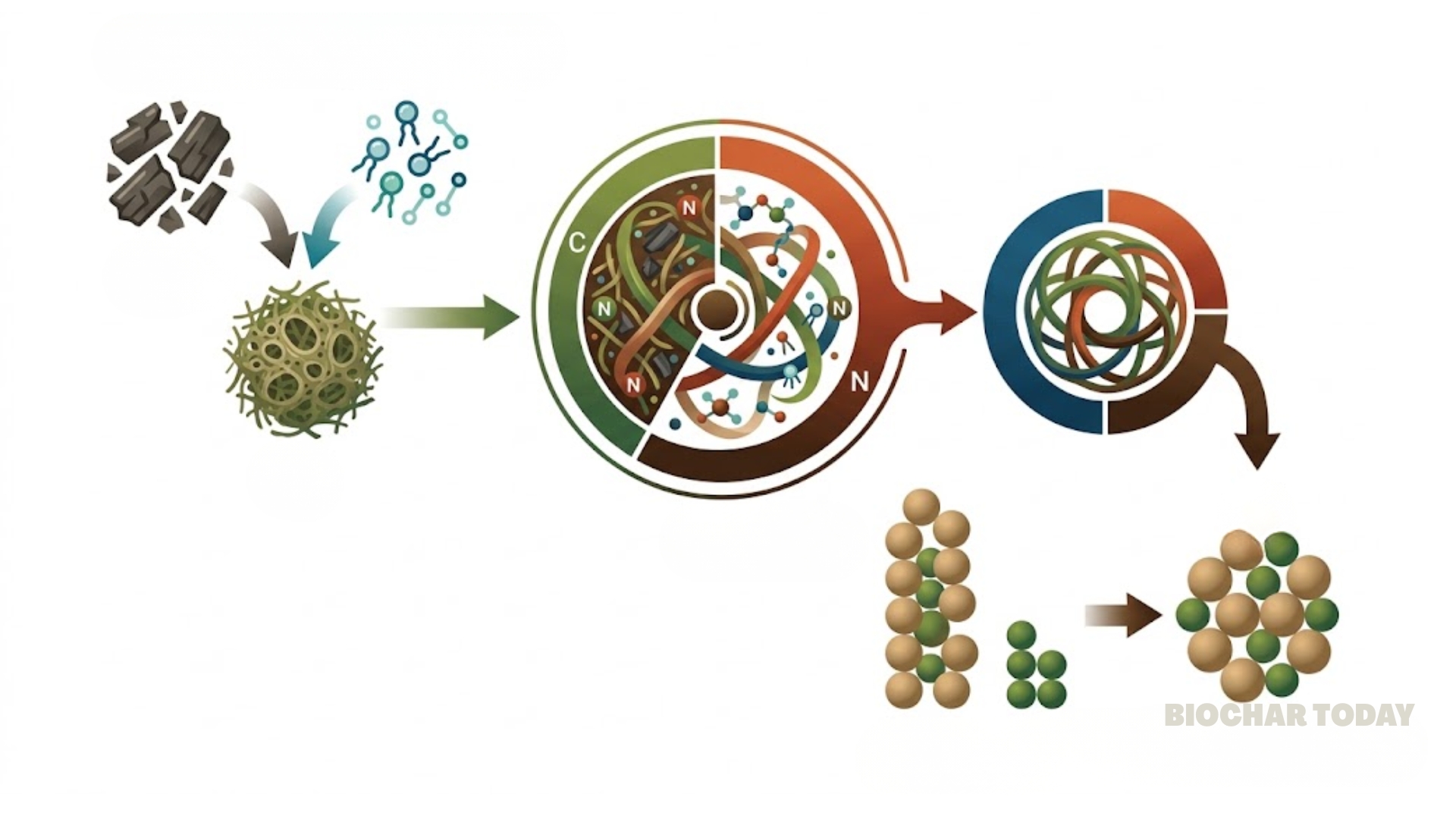
- Integrating a porous biocharBiochar is a carbon-rich material created from biomass decomposition in low-oxygen conditions. It has important applications in environmental remediation, soil improvement, agriculture, carbon sequestration, energy storage, and sustainable materials, promoting efficiency and reducing waste in various contexts while addressing climate change challenges. More framework improves pile aeration and offers a protected habitat for microbial colonization.
- Applying a non-ionic surfactant lowers surface tension, enhancing microbial enzyme accessibility to hydrophobic fibers.
- Combining biochar and surfactants reduces the carbon-to-nitrogen ratio from 22.19 down to 6.95 after 42 days.
- Quantitative spectroscopy confirms this synergy yields a 40% reduction in cellulose peaks and a 35% decrease in lignin peaks.
In a recent study published in the Kuwait Journal of Science, researchers Nursyafi Amila Hilmy and Rosnani Alkarimiah evaluated methods to enhance the biological decomposition of empty fruit bunches (EFB). EFB is a massive by-product of the palm oil industrial sector, rich in cellulosic materials that are structurally robust but highly resistant to natural decomposition. Lignin, a complex organic polymer that constitutes approximately 21.2% of the EFB composition, maintains the extreme rigidity and durability of the fibers. This high lignin content creates severe challenges for standard biomassBiomass is a complex biological organic or non-organic solid product derived from living or recently living organism and available naturally. Various types of wastes such as animal manure, waste paper, sludge and many industrial wastes are also treated as biomass because like natural biomass these More utilization, as conventional microbial or enzymatic activities cannot easily break it down. Typically, co-composting shredded EFB with palm oil mill effluent (POME) requires a lengthy management period of 60 to 70 days. While standard maturity metrics like the carbon-to-nitrogen ($C/N$) ratio provide basic progress information, they offer limited insight into underlying structural changes. To bypass these physical limitations, pre-treatment strategies involving surface-active agents and physical matrices are required to break down the lignin barrier and optimize waste management efficiency.
To address these performance gaps, the authors conducted an experimental batch composting process at Universiti Sains Malaysia using a controlled 10-liter insulated rotary drum reactor. The organic matrix consisted of fresh EFB manually shredded into 1-centimeter pieces and combined with POME sludge. To maximize the decomposition velocity, the researchers introduced a novel dual-additive strategy combining biochar and a surfactant. The biochar, produced via slow pyrolysisPyrolysis is a thermochemical process that converts waste biomass into bio-char, bio-oil, and pyro-gas. It offers significant advantages in waste valorization, turning low-value materials into economically valuable resources. Its versatility allows for tailored products based on operational conditions, presenting itself as a cost-effective and efficient More at 500–600°C, was utilized to provide a highly porous physical scaffold. Simultaneously, Tween 80—a commercially available non-ionic surfactant—was added to lower the surface tension of the aqueous sludge phase and increase the wetting of the hydrophobic EFB fibers. The batch was operated under a controlled thermophilic temperature setting of 50°C for a total duration of 42 days, with a regular daily turning frequency of 15 minutes to facilitate oxygen exposure and stabilize metabolic gas release. The structural and chemical transitions of the organic matrix were continuously monitored using Fourier transform infrared (FTIR) spectroscopy and quantitative scanning electron microscopy-energy dispersive X-ray (SEM-EDX) analysis.
The experimental results revealed that the combined application of biochar and the surfactant establishes a powerful physical and chemical synergy that dramatically optimizes organic degradation. During the 42-day thermophilic phase, the surfactant successfully bypassed the physical barriers of the lignocellulosic matrix, allowing extracellular microbial enzymes to easily penetrate the crystalline cellulose and hemicellulose structures. Concurrently, the highly porous framework of the biochar served as a crucial structural support, shielding the dense composting microbiota from environmental stress and maintaining ideal pile aeration. This combined action resulted in a sharp reduction in the $C/N$ ratio, which dropped precipitously from an initial 22.19 down to a highly mature 6.95 by the final week. This mineralization efficiency proved superior to traditional composting treatments lacking the surfactant. Additionally, the intense acidogenesis triggered by this rapid initial decomposition initially competed with the inherent alkalinity of the biochar framework. However, subsequent microbial consumption of short-chain organic acids drove a universal stabilization pathway, transitioning the matrix from a baseline pHpH is a measure of how acidic or alkaline a substance is. A pH of 7 is neutral, while lower pH values indicate acidity and higher values indicate alkalinity. Biochars are normally alkaline and can influence soil pH, often increasing it, which can be beneficial More of 6.15 to an alkaline profile of 10.88.
Quantitative structural analysis using FTIR spectroscopy explicitly confirmed this advanced stage of molecular stabilization. The treatment group showed a 40% intensity reduction in aliphatic C-H stretching bands ($2928\text{ cm}^{-1}$ and $2850\text{ cm}^{-1}$) associated with cellulose degradation, compared to a mere 15% reduction observed in the control group. Furthermore, the spectra revealed a 35% decrease in recalcitrant lignin peaks ($1600\text{ cm}^{-1}$) coupled with a 25% amplification of peaks associated with stable humic acids (1400–1500 $\text{cm}^{-1}$). Wavenumber migrations in the carboxylic and alcoholic regions further justified the shift from a raw heterogeneous waste mixture into a mature, complex humified state. Physical justification was provided by SEM imaging, which illustrated extensive surface rupture, shape fracturing, and fiber pitting in the biochar-surfactant group, whereas the control fibers maintained a smooth, persistent structure. Quantitative EDX analysis supported this physical degradation, recording a superior carbon-to-oxygen ($C/O$) elemental stabilization ratio of 1.17 due to efficient carbon oxidation into gas. The authors concluded that the synergistic integration of biochar and Tween 80 provides a validated, high-value framework for accelerating industrial palm oil waste management and achieving circular economy goals.
Source: Hilmy, N. A., & Alkarimiah, R. (2026). Enhancing composting efficiency of empty fruit bunches using biochar and surfactants: An FTIR-based analysis. Kuwait Journal of Science, 53(2), 100612.



Leave a Reply