
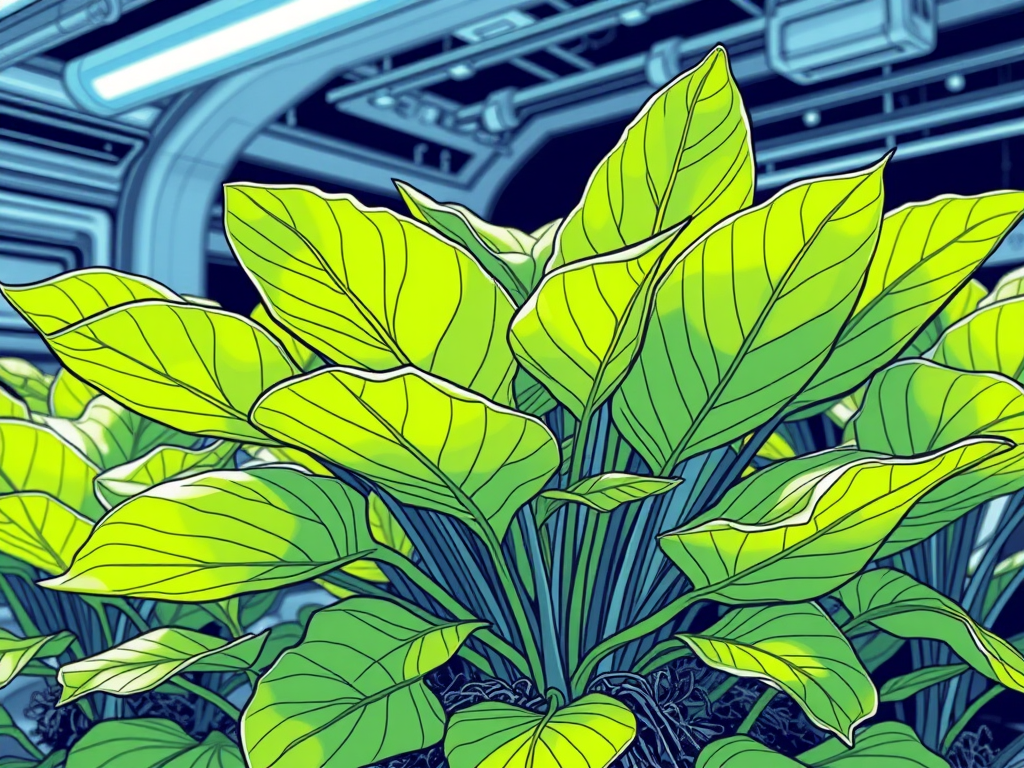
As humanity sets its sights on extended space missions and potential extraterrestrial habitation, the ability to cultivate plants beyond Earth becomes paramount for bioregenerative life support systems. A recent study published in npj Microgravity by Charles Wang Wai Ng and Yu Chen Wang investigates the efficacy of soil conditioning with biocharBiochar is a carbon-rich material created from biomass decomposition in low-oxygen conditions. It has important applications in environmental remediation, soil improvement, agriculture, carbon sequestration, energy storage, and sustainable materials, promoting efficiency and reducing waste in various contexts while addressing climate change challenges. More and hydrochar to enhance plant growth and production under simulated microgravity conditions. This research sheds light on how these soil amendments can help overcome the significant environmental challenges plants face in space, such as nutrient deficiency, limited water, and altered gravity.
The study focused on Malabar Spinach, a commonly grown vegetable, cultivated for 18 days under two gravity conditions: normal Earth gravity (1g) and simulated microgravity using a Random Positioning Machine (RPM). Peanut shell biochar and wood hydrochar were applied at a 3% dosage by mass to the soil. The researchers meticulously measured plant morphology, physiological properties, and productivity to evaluate plant development under these varied conditions. The findings revealed that microgravity significantly inhibited plant growth. Over an 18-day period, microgravity reduced the fresh biomassBiomass is a complex biological organic or non-organic solid product derived from living or recently living organism and available naturally. Various types of wastes such as animal manure, waste paper, sludge and many industrial wastes are also treated as biomass because like natural biomass these More accumulation of Malabar Spinach by up to 71%. This reduction was primarily attributed to inhibited leaf and root growth, which in turn decreased light interception and nutrient uptake. For instance, leaf area enlargement was inhibited by up to 30% by day 16 in microgravity, irrespective of soil condition. Similarly, root surface area was reduced under microgravity, particularly in control and biochar-treated groups at shallower depths (10-30 mm), with reductions of 26% and 29% respectively at 10-20 mm depth. However, the application of soil conditioners notably mitigated some of these adverse effects. Biochar proved more effective than hydrochar in enhancing overall plant production in microgravity.
In the presence of biochar, microgravity surprisingly enhanced the biosynthesis of chlorophyll a and carotenoids by up to 36%. Chlorophyll b also saw a 44% increase with biochar treatment under microgravity. These pigments are crucial for photosynthesis and plant protection against excessive radiation. In terms of biomass, biochar treatment enhanced Malabar Spinach biomass accumulation by a remarkable 344% compared to the control soil condition under microgravity, while hydrochar provided a 65% enhancement. This indicates biochar’s superior ability to promote biomass even in challenging microgravity environments. Nutrient uptake was also significantly influenced by the soil conditioners.
Under biochar treatment, potassium (K) content in the leaves increased by an impressive 174%, and hydrochar treatment resulted in a 55% increase. Microgravity further boosted plant K uptake by 22% with biochar and 25% with hydrochar. Phosphorus (P) content in leaves also significantly increased by 38-52% with soil conditioners, with microgravity further improving P levels by 31% under hydrochar treatment. Calcium (Ca) concentrations in leaves increased by up to 73% with biochar and 26% with hydrochar, though microgravity did not significantly affect Ca concentration. Interestingly, while microgravity generally reduced water use efficiency (WUE) by 65-68% , biochar significantly increased WUE by 278% compared to control soil in microgravity, attributed to its promotion of plant productivity and a slight reduction in transpiration. Hydrochar also increased WUE by up to 67%.
Furthermore, the study addressed the accumulation of heavy metals, which is a critical concern for food safety in space. Microgravity significantly enhanced plant cadmium (Cd) accumulation by up to 114%, regardless of soil conditions. However, under microgravity, hydrochar reduced plant Cd accumulation by 36% (p<0.05) and biochar by 9%. This suggests that biochar and hydrochar can help immobilize heavy metals in the soil, reducing their bioavailability and uptake by plants. Overall, these findings strongly indicate that biochar and hydrochar are promising soil conditioners for enhancing plant development in low-gravity conditions. Specifically, peanut shell biochar’s effectiveness in boosting plant growth, chlorophyll synthesis, and nutrient uptake, while also contributing to heavy metal immobilization, makes it a valuable candidate for future bioregenerative life support systems in space exploration.
Source: Ng, C. W. W., & Wang, Y. C. (2025). Soil conditioning for enhancing plant growth using biochar and hydrochar under microgravity. npj Microgravity, 11(31).




Leave a Reply