
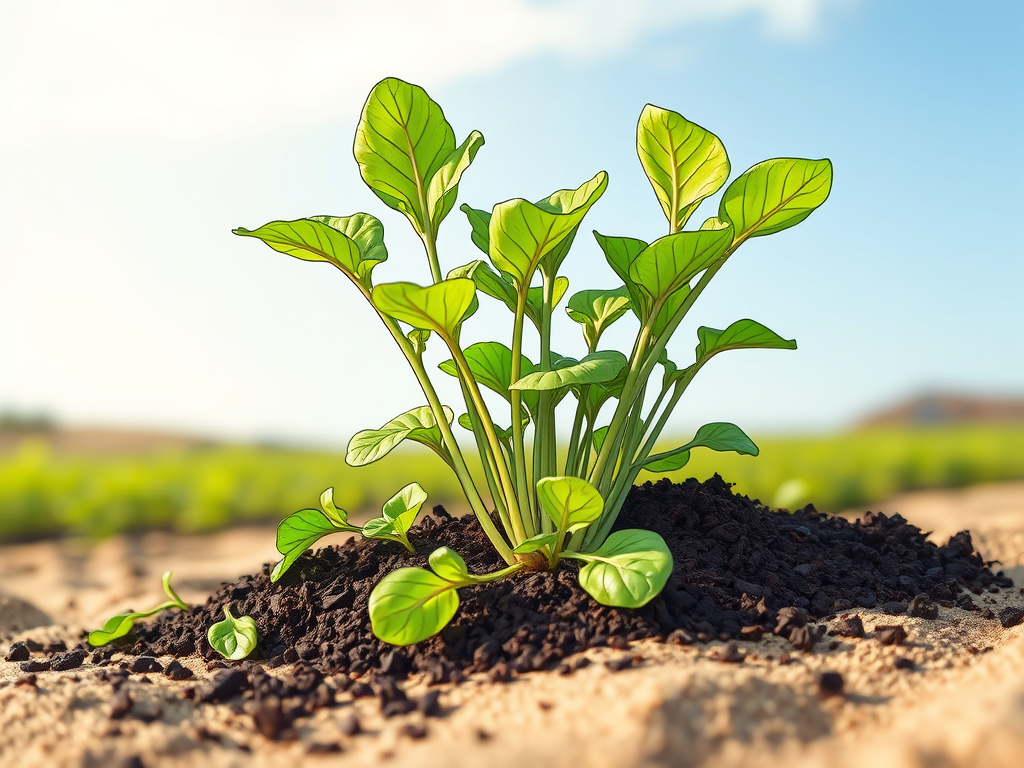
To meet rising food demands, innovative agricultural solutions are essential, particularly for salt-affected soils irrigated with saline water. In Scientific Reports, ELsaman et al., explored the use of biocharBiochar is a carbon-rich material created from biomass decomposition in low-oxygen conditions. It has important applications in environmental remediation, soil improvement, agriculture, carbon sequestration, energy storage, and sustainable materials, promoting efficiency and reducing waste in various contexts while addressing climate change challenges. More to improve soil quality and arugula growth under saline conditions. The study focused on four different types of biochar—banana leaves, rice straw, sorghum stalks, and wood chips—applied at varying rates to saline soil.
The research demonstrated that biochar significantly enhances soil quality. For instance, applying 3% wood chips biochar increased total available nitrogen by 41%, while 5% rice straw biochar boosted available potassium by an impressive 849%. Additionally, 5% banana leaves biochar led to the highest increase in cation exchange capacity, at 58%.
Biochar application also markedly improved arugula growth. Notably, the highest fresh biomassBiomass is a complex biological organic or non-organic solid product derived from living or recently living organism and available naturally. Various types of wastes such as animal manure, waste paper, sludge and many industrial wastes are also treated as biomass because like natural biomass these More of arugula was observed with the 3% sorghum stalks biochar treatment. This treatment also optimized nitrogen and phosphorus uptake by the plants.
The study concluded that 3% sorghum stalks biochar is particularly effective for rehabilitating saline soil and promoting sustainable arugula production. This application enhances nutrient uptake, productivity, and arugula growth under saline conditions, improving plant tolerance to salt stress. Furthermore, using 3% sorghum stalks biochar is more cost-effective than a 5% dose.
SOURCE: ELsaman, N. K., Amin, A. E. A. Z., Abd El-Razek, M., & Roshdy, N. M. K. (2025). Comparative effects of different types and doses of biochar on soil quality indicators and arugula growth under saline conditions. Scientific Reports, 15(1), 10046.




Leave a Reply