
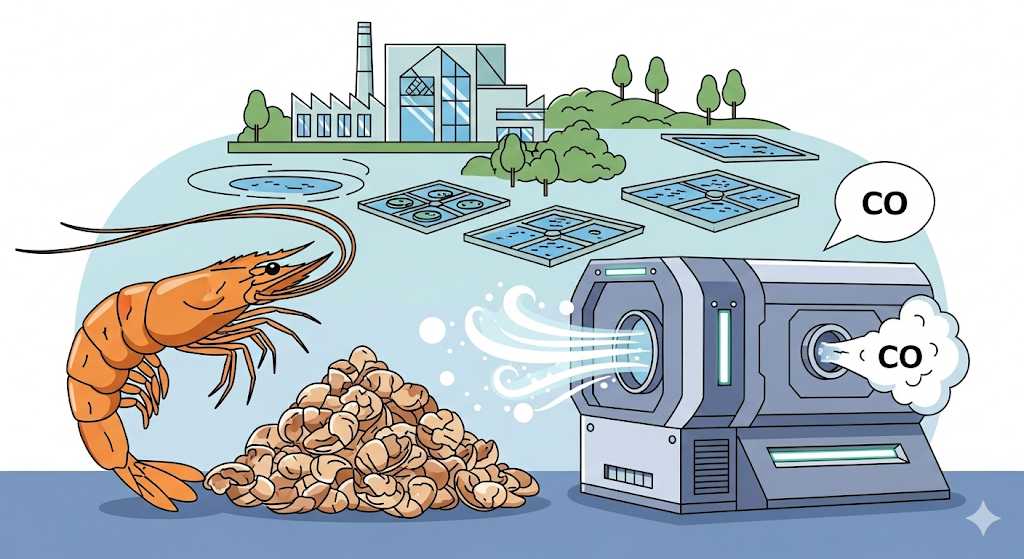
A recent breakthrough from the University of Sharjah is set to change the way the seafood industry handles its waste, offering a potent new tool in the fight against climate change. Researchers have developed an innovative process to transform discarded shrimp shells, heads, and intestinal tracts into a valuable activated carbonActivated carbon is a form of carbon that has been processed to create a vast network of tiny pores, increasing its surface area significantly. This extensive surface area makes activated carbon exceptionally effective at trapping and holding impurities, like a molecular sponge. It is commonly More product with high-performance CO₂ adsorption capabilities.
The study, led by Dr. Haif Al-Jomard and published in the journal Nanoscale, outlines a novel “waste-to-carbon” technology. The process involves pyrolyzing the shrimp waste—a form of thermal decomposition that produces biochar—which is then followed by a series of acid treatments, chemical activation, and ball milling. This process creates a porous activated carbon material that is not only highly efficient at capturing carbon dioxide but also demonstrates long-term stability for repeated use in industrial applications.
With the seafood industry generating millions of tons of waste annually, this method provides a dual-pronged solution. It addresses the significant environmental challenge of disposing of this waste while simultaneously contributing to global efforts to reduce greenhouse gas emissions. Professor Chaouki Ghenai, a co-author of the study, highlighted the economic benefits, noting that the approach is a “cost-effective route” to producing activated carbon, turning a problematic waste stream into a valuable and environmentally friendly resource.
Beyond carbon capture, the activated carbon derived from shrimp waste has potential applications in various sectors, including air and water purification, solvent recovery, and gold extraction. This research is a compelling example of the circular economy in action, where waste is not simply discarded but is instead valorized into a new, highly efficient resource. The findings validate a scalable and sustainable strategy for the valorization of seafood waste and lay a foundation for future innovations in sustainable carbon capture technologies.



Leave a Reply