
Galitskaya, P.Y., Selivanovskaya, S.Y., Karamova, K.O. et al. Transformation of BiocharBiochar is a carbon-rich material created from biomass decomposition in low-oxygen conditions. It has important applications in environmental remediation, soil improvement, agriculture, carbon sequestration, energy storage, and sustainable materials, promoting efficiency and reducing waste in various contexts while addressing climate change challenges. More from Plant BiomassBiomass is a complex biological organic or non-organic solid product derived from living or recently living organism and available naturally. Various types of wastes such as animal manure, waste paper, sludge and many industrial wastes are also treated as biomass because like natural biomass these More in Gray Forest Soil: Evaluation by Isotopic Labeling Method.Eurasian Soil Sc.57, 1579–1589 (2024). https://doi.org/10.1134/S1064229324601598
Recent research has explored the transformation of biochar derived from corn biomass in gray forest soil using isotopic labeling methods. Biochar, produced through pyrolysisPyrolysis is a thermochemical process that converts waste biomass into bio-char, bio-oil, and pyro-gas. It offers significant advantages in waste valorization, turning low-value materials into economically valuable resources. Its versatility allows for tailored products based on operational conditions, presenting itself as a cost-effective and efficient More, is known for its potential as a soil amendmentA soil amendment is any material added to the soil to enhance its physical or chemical properties, improving its suitability for plant growth. Biochar is considered a soil amendment as it can improve soil structure, water retention, nutrient availability, and microbial activity. More and carbon sequestration agent. However, the mechanisms of its decomposition in soil—whether primarily biotic or abiotic—are still debated.
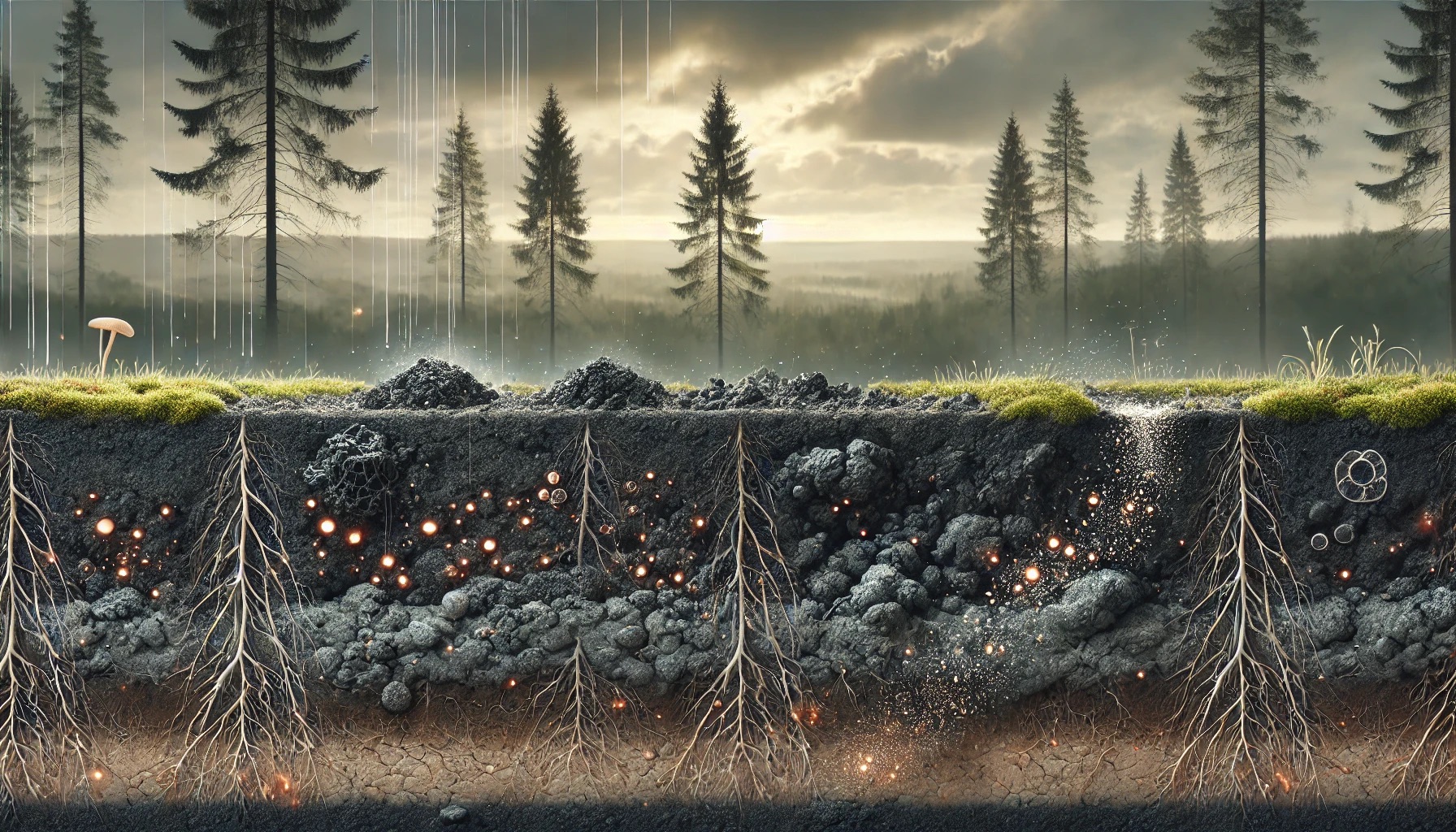
This study aimed to trace biochar’s decomposition, particularly its migration within the soil and its breakdown by microbial activity. Biochar was introduced into the topsoil of experimental columns, and conditions mimicking Central Russian rainfall were simulated for 90 days. The results indicated that biochar particles remained in the upper soil layer without migrating deeper, suggesting that it does not easily move within the soil profile.
The presence of biochar significantly increased microbial respiration, releasing more carbon dioxide (CO2) compared to control samples. Microbial decomposition, verified through CO2 measurements containing isotopically labeled carbon, indicated that microorganisms play a vital role in biochar degradation. Despite this microbial activity, only a small portion of the biochar underwent decomposition, leaving most of it intact.
These findings suggest that biochar provides a stable carbon source in soil, suitable for long-term carbon sequestration, with minimal annual application required. Its slow decomposition rate also implies that biochar can be a lasting soil improver without significantly disrupting soil microbial communities. Further long-term studies are needed to optimize its use in agriculture.


Leave a Reply