
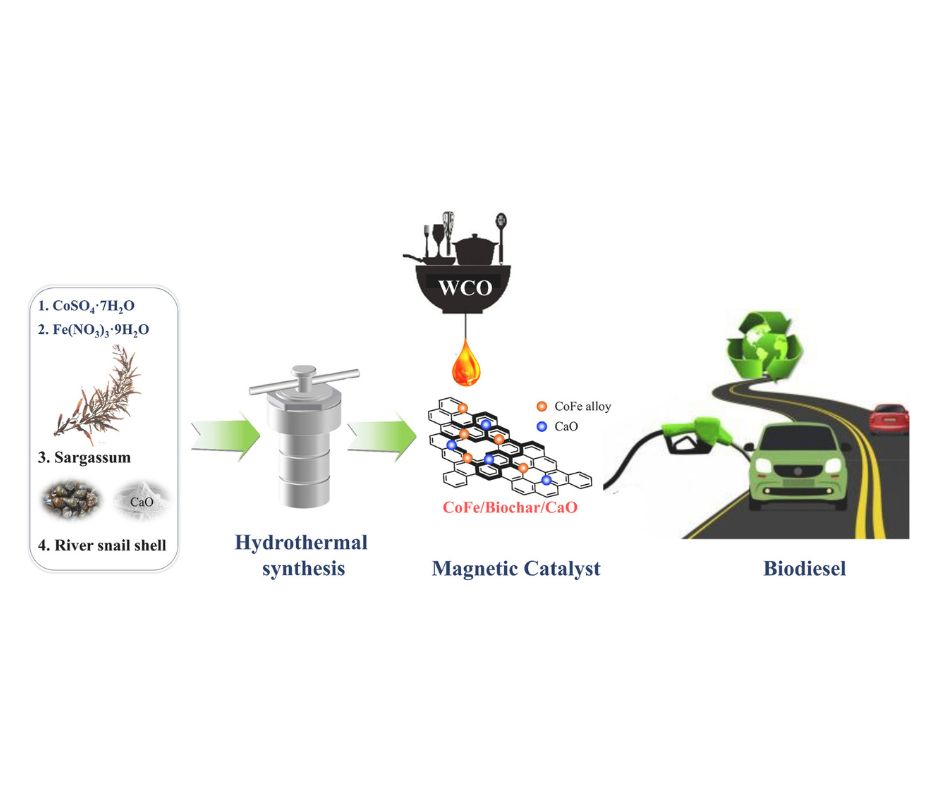
ARTICLE SUMMARY: Xia et al. (2024) Application of waste derived magnetic acid-base bifunctional CoFe/biochar/CaO as an efficient catalyst for biodiesel production from waste cooking oil. Chemosphere, Vol 350. https://doi.org/10.1016/j.chemosphere.2023.141104
Traditionally, Ca-based catalysts have powered the conversion of waste cooking oil (WCO) into biodiesel. However, limitations like loss of active components, poor acid resistance, and difficult recovery hampered their widespread use. This research unveils a novel solution: a green and recyclable magnetic acid-base catalyst derived from readily available waste materials like sargassum and river snail shells.
This innovative catalyst, dubbed CoFe/biochar/CaO, boasts several advantages:
- Multifunctional: Its CoFe alloy core provides both magnetic properties for easy separation and active acid sites for efficient WCO conversion.
- Nanoscale magic: Calcium and other metals are finely dispersed on the biocharBiochar is a carbon-rich material created from biomass decomposition in low-oxygen conditions. It has important applications in environmental remediation, soil improvement, agriculture, carbon sequestration, energy storage, and sustainable materials, promoting efficiency and reducing waste in various contexts while addressing climate change challenges. More surface, enhancing catalytic activity and stability.
- High performance: The catalyst delivers an impressive 99.21% biodiesel yield, remaining active even after five cycles.
- Optimized process: Using advanced mathematical modeling, optimal reaction conditions were identified,pushing the predicted yield even higher to 98.29%.
- Waste-to-wealth: This approach leverages waste materials, minimizing environmental impact and promoting sustainability.
Furthermore, the produced biodiesel meets stringent quality standards, paving the way for its real-world application. This research paves the way for a greener, more efficient future for biodiesel production, utilizing readily available waste and minimizing environmental impact. By harnessing the power of magnetic waste-derived catalysts, we can transform sustainable development into a reality, one liter of biodiesel at a time.






Leave a Reply