
Haleký, et al (2024) Biofiltration of n-butyl acetate with three packing material mixtures, with and without biocharBiochar is a carbon-rich material created from biomass decomposition in low-oxygen conditions. It has important applications in environmental remediation, soil improvement, agriculture, carbon sequestration, energy storage, and sustainable materials, promoting efficiency and reducing waste in various contexts while addressing climate change challenges. More. Toxic/Hazardous Substances and Environmental Engineering. https://doi.org/10.1080/10934529.2024.2332127
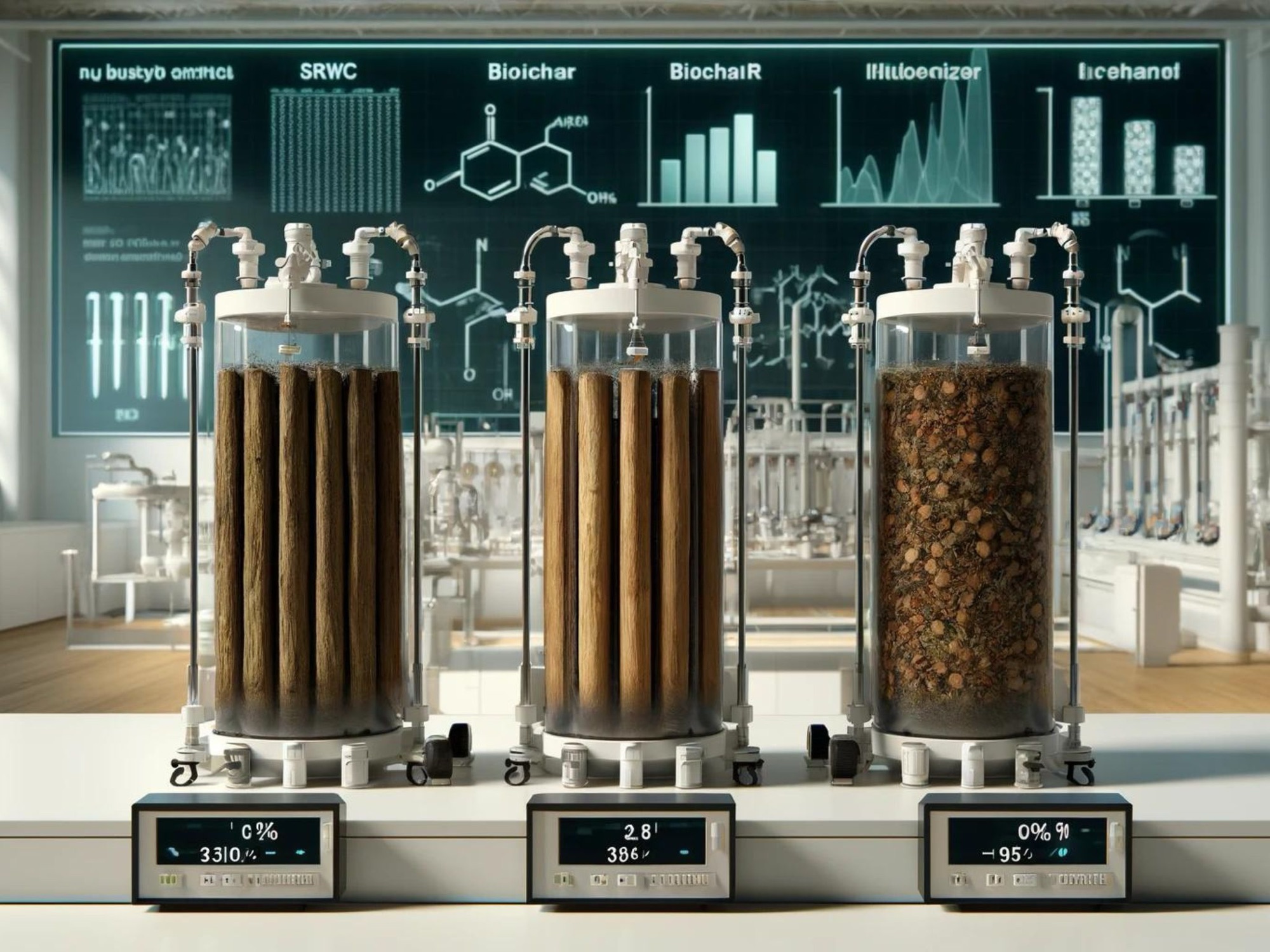
In recent exploratory studies, two economical packing materials were assessed for their efficiency in removing n-butyl acetate through lab-scale biofilters. These materials included waste spruce root wood chips and biochar derived as a byproduct from wood gasificationGasification is a high-temperature, thermochemical process that converts carbon-based materials into a gaseous fuel called syngas and solid by-products. It takes place in an oxygen-deficient environment at temperatures typically above 750°C. Unlike combustion, which fully burns material to produce heat and carbon dioxide (CO2), gasification More processes. The research primarily focused on three biofilters; one packed solely with spruce root wood chips (SRWC), another supplemented with 10% biochar (SRWC-B), and a third featuring 10% nitrogen-fertilizer-impregnated biochar (SRWC-IB).
The findings revealed that the addition of biochar improved the maximum elimination capacities from 206 ± 27 g m^(-3) h^(-1) for the SRWC, to 275 ± 21 g m^(-3) h^(-1) for the SRWC-B, and up to 294 ± 20 g m^(-3) h^(-1) for the SRWC-IB setup. All configurations maintained removal efficiencies above 95% at moderate pollutant loads, demonstrating their potential for stable and effective performance over time.
Despite its high initial adsorption capacity of 208 ± 6 mg_toluene g^(-1), the biochar exhibited a significant reduction (approximately 70%) in efficacy after 300 days of operation. In contrast, the impregnated biochar not only retained but significantly increased its capacity to 149 ± 7 mg_toluene g^(-1) from an initial 17 ± 5 mg_toluene g^(-1), marking a substantial improvement over the unimpregnated form.
Microscopic and colony-forming unit (CFU) analyses indicated a robust colonization of the packing materials by a diverse microbial community and various grazing fauna, which are critical for long-term operational stability. The biofilters also maintained an acceptable pressure drop (up to 1020 Pa m^(-1)), indicating minimal airflow resistance through the system.
Economically, while the impregnated biochar had a higher upfront cost (123 €/m^3 compared to 14 €/m^3 for regular biochar), its application in the SRWC-IB configuration could potentially reduce overall investment costs by about 9% due to the efficiencies gained from reduced biofilter volume requirements. This study not only underscores the potential of using waste and byproduct materials in environmental management strategies but also highlights the enhancements possible through minor modifications in biofilter compositions.




Leave a Reply