
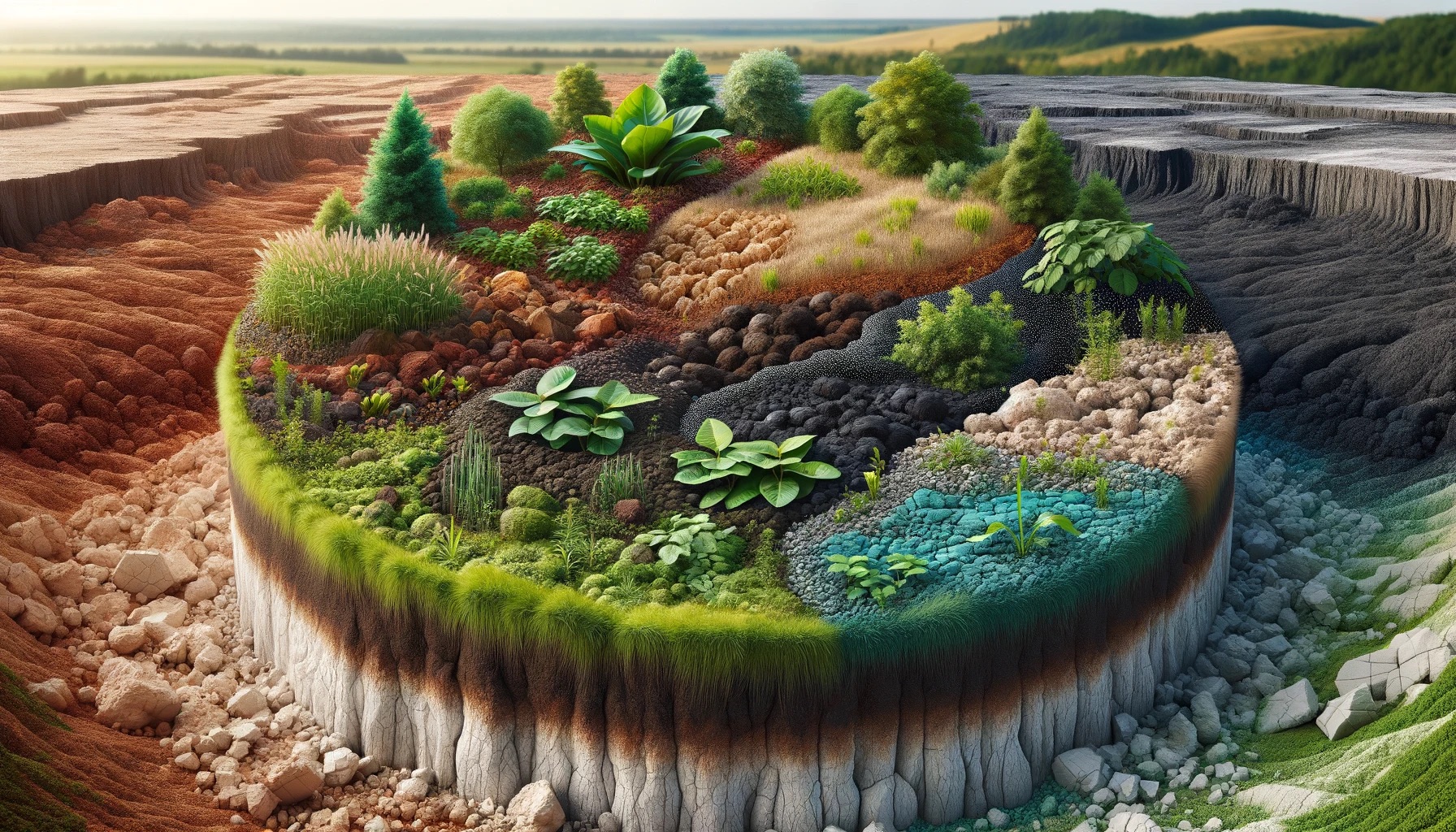
Sakin, et al (2024) BiocharBiochar is a carbon-rich material created from biomass decomposition in low-oxygen conditions. It has important applications in environmental remediation, soil improvement, agriculture, carbon sequestration, energy storage, and sustainable materials, promoting efficiency and reducing waste in various contexts while addressing climate change challenges. More applications and enzyme activity, carbon dioxide emission, and carbon sequestration in a calcareous soil. https://doi.org/10.1080/01904167.2024.2354215
Biochar, a carbon-rich byproduct of biomassBiomass is a complex biological organic or non-organic solid product derived from living or recently living organism and available naturally. Various types of wastes such as animal manure, waste paper, sludge and many industrial wastes are also treated as biomass because like natural biomass these More pyrolysisPyrolysis is a thermochemical process that converts waste biomass into bio-char, bio-oil, and pyro-gas. It offers significant advantages in waste valorization, turning low-value materials into economically valuable resources. Its versatility allows for tailored products based on operational conditions, presenting itself as a cost-effective and efficient More, is gaining attention as a tool for carbon sequestration and soil enhancement. A recent study explored the effects of various biochar types (AS, TS, PP, CS) on soil respiration and carbon-cycle enzyme activities in calcareous soil.
The research involved applying biochar at different rates (0.5%, 1.0%, and 1.5%) to assess changes in soil organic carbon (SOC) and microbial biomass carbon (MBC). Notably, the TS treatment led to the highest increase in SOC, while AS showed only a slight improvement. Conversely, AS treatment resulted in the highest MBC content, with TS showing the lowest.
CO2 emissions varied significantly across treatments. TS biochar produced the highest CO2-C emissions, whereas PP biochar, with its high recalcitrant carbon content, resulted in the lowest emissions. This was attributed to a positive priming effect that stabilized biochar mineralization, thereby enhancing soil quality.
Enzyme activities also differed among treatments. The CS treatment exhibited the highest β-galactosidase activity, while AS showed the lowest. Similarly, β-glycosidase activity was highest with PP biochar and lowest with AS.
The findings suggest that TS biochar is effective for increasing SOC, while PP biochar is beneficial for reducing CO2-C emissions. Additionally, TS, PP, and CS biochars are recommended for boosting soil enzyme activities, which are crucial for carbon sequestration and soil health.
Overall, the study highlights the potential of biochar to enhance soil biochemical cycles and improve carbon sequestration in arid soils, providing valuable insights for sustainable soil management practices.


Leave a Reply