
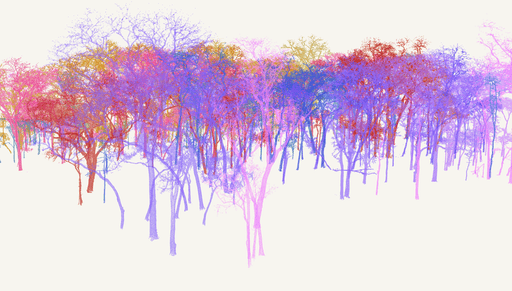

Demol, M., Aguilar-Amuchastegui, N., Bernotaite, G. et al. Multi-scale lidar measurements suggest miombo woodlands contain substantially more carbon than thought. Commun Earth Environ 5, 366 (2024). https://doi.org/10.1038/s43247-024-01448-x
Miombo woodlands, the dry tropical forests that span across southern Africa, are crucial to the livelihoods of millions of people, providing plant-based materials, fertile soils for agriculture, and grazing lands. These ecosystems also hold significant cultural and spiritual value, support substantial biodiversity, and play a vital role in climate and water resource regulation. However, due to human activities, the cover of these woodlands has been decreasing, from approximately 2.7 million km² in 1980 to 1.9 million km² in 2020. Monitoring the changes in these woodlands is essential due to their importance and dynamic nature.
A critical aspect of this monitoring is accurately quantifying the aboveground biomassBiomass is a complex biological organic or non-organic solid product derived from living or recently living organism and available naturally. Various types of wastes such as animal manure, waste paper, sludge and many industrial wastes are also treated as biomass because like natural biomass these More (AGB) and carbon stored in these woodlands. Uncertainties in these measurements can lead to misinformed policies and misallocation of resources. For example, carbon markets, such as the Reducing Emissions from Deforestation and Degradation (REDD+) program, rely on accurate carbon stock estimates to incentivize the protection of these woodlands. Additionally, international climate agreements, such as the Paris Agreement, depend on precise forest carbon accounting.
Traditionally, the quantification of forest AGB stocks combines remotely sensed estimates of forest area with emissions factors (EF) that represent expected AGB per unit area. These EFs are typically derived from in-situ measurements or taken from literature sources like the Intergovernmental Panel on Climate Change (IPCC) defaults. While this method is relatively straightforward, it has limitations. It may not capture variations within forest types, might use EFs that are not representative of the specific forest, and often fails to detect changes beyond the binary forest/non-forest transition.
A significant source of uncertainty in these measurements arises from the methods used to collect in-situ data from forest plots. Allometric models, which estimate tree biomass based on measurable variables like stem diameter and tree height, are commonly used. However, these models are calibrated with data from a limited number of harvested trees, which must represent the variability of the entire region or taxa where the model is applied.
To address these challenges, researchers assembled a comprehensive terrestrial and airborne lidar dataset covering 50,000 hectares of intact and degraded miombo woodlands. They generated AGB estimates with low uncertainty by directly measuring forest structure in three dimensions. The results revealed that the miombo woodlands store significantly more carbon than previously estimated using conventional methods.
Specifically, the study found that the AGB in the miombo woodlands was between 1.5 and 2.2 times higher than previous estimates. This discrepancy is largely due to the underestimation of large trees by traditional allometric models. Extrapolating these findings across Africa’s miombo woodlands suggests that their carbon stock may need an upward revision of approximately 3.7 petagrams of carbon. This implies that the current carbon sequestration and emissions potential of these woodlands is underestimated, which could affect incentives for their protection and restoration.
These findings highlight the importance of using advanced measurement techniques, such as lidar, to improve the accuracy and precision of forest biomass estimates. Accurate measurements are crucial for effective climate change mitigation strategies, forest management policies, and the allocation of resources for conservation efforts. As the miombo woodlands continue to face threats from human activities, such precise monitoring becomes even more critical to safeguarding these vital ecosystems.
-
aboveground biomass, allometric models, biodiversity, carbon markets, carbon sequestration, carbon storage, climate regulation, deforestation, ecosystem services, environmental policy, forest conservation, forest monitoring, forest structure, IPCC, lidar measurements, Miombo woodlands, REDD+, Remote Sensing, southern Africa, sustainable management




Leave a Reply