
Journal of Environmental Chemical Engineering Volume 12, Issue 1, February 2024, 111840
Authors: Lalmalsawmdawngliani, C. Lalhriatpuia, Diwakar Tiwari
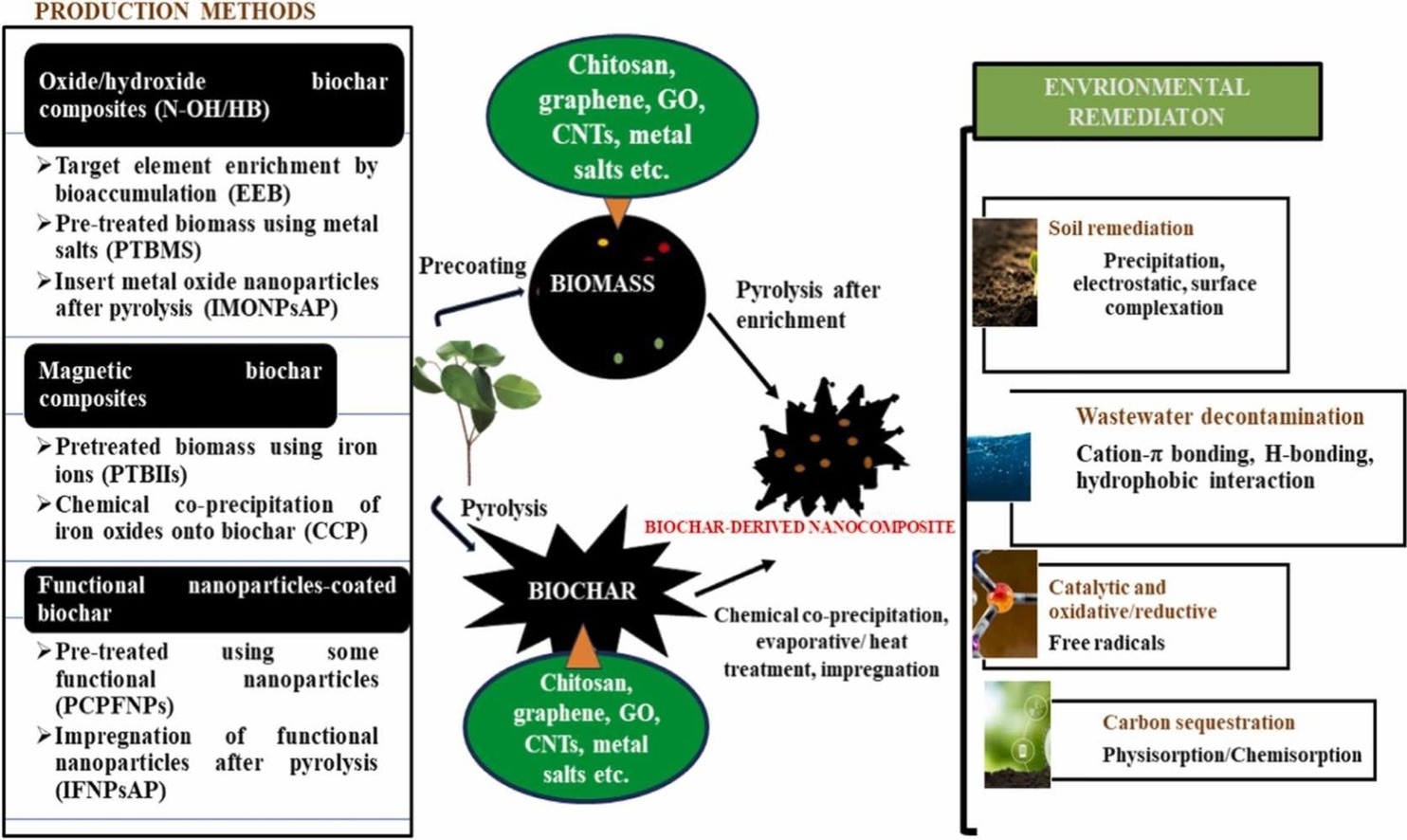
BiocharBiochar is a carbon-rich material created from biomass decomposition in low-oxygen conditions. It has important applications in environmental remediation, soil improvement, agriculture, carbon sequestration, energy storage, and sustainable materials, promoting efficiency and reducing waste in various contexts while addressing climate change challenges. More is emerging as a powerful tool for environmental remediation. This article explores a particularly promising application: biochar-derived nanocomposites. These innovative materials combine biochar with nanoparticles of metal oxides or hydroxides, creating a potent adsorbent for various pollutants.
The large surface area and porous structure of these nanocomposites make them highly effective at capturing contaminants like heavy metals, organic and inorganic pollutants, and even CO2. The article delves into the various methods of producing these nanocomposites, highlighting their potential for treating polluted water and soil.
However, scaling up the production of biochar-derived nanocomposites remains a challenge. The authors emphasize the need for further research to optimize their synthesis and reduce costs. This will be crucial for making this technology widely accessible and truly impactful in environmental cleanup efforts.
Despite the challenges, biochar-derived nanocomposites hold immense promise for a cleaner future. Their ability to tackle diverse pollutants makes them a versatile weapon in our fight against environmental contamination. As research progresses and production hurdles are overcome, these innovative materials could become a mainstay in environmental remediation strategies.
SOURCE: https://www.sciencedirect.com/science/article/abs/pii/S2213343723025794



Leave a Reply