
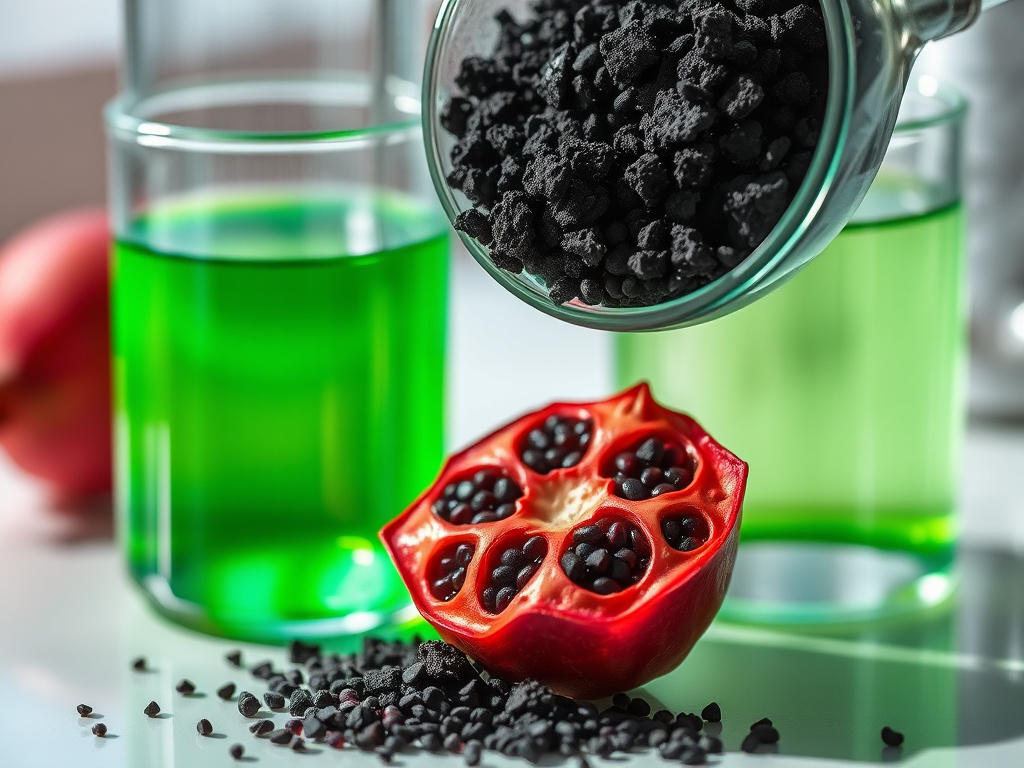
Malachite green (MG) dye is a persistent and bioaccumulative pollutant widely used in industries such as textiles and aquaculture. Its presence in wastewater poses serious threats to human health, including carcinogenic and mutagenic effects, and to aquatic life by blocking sunlight and reducing water oxygenation. A study by Zainab Haider Mussa, Ahmed Falah Imran, and colleagues, published in Results in Surfaces and Interfaces, investigated a low-cost, environmentally friendly solution for this problem: activated biocharBiochar is a carbon-rich material created from biomass decomposition in low-oxygen conditions. It has important applications in environmental remediation, soil improvement, agriculture, carbon sequestration, energy storage, and sustainable materials, promoting efficiency and reducing waste in various contexts while addressing climate change challenges. More produced from pomegranate peels. This research aimed to develop an efficient treatment technology to detoxify wastewater contaminated with malachite green dye.
The adsorbent, referred to as pomegranate peel activated carbonActivated carbon is a form of carbon that has been processed to create a vast network of tiny pores, increasing its surface area significantly. This extensive surface area makes activated carbon exceptionally effective at trapping and holding impurities, like a molecular sponge. It is commonly More (PPAC), was prepared from pomegranate peels, which are a readily available and carbon-rich byproduct of the pomegranate juice industry. The peels, making up a significant portion of the fruit, were subjected to a preparation process that included physical and chemical activation. The study found that the prepared PPAC had an amorphous structure, which is generally more effective than crystalline structures for adsorbing various pollutants. Its specific surface area was measured at 46.363 m²/g, an important property that contributes to a higher number of active sites for adsorption.
The researchers conducted batch adsorption experiments to evaluate the material’s performance under various conditions, including initial dye concentration, pHpH is a measure of how acidic or alkaline a substance is. A pH of 7 is neutral, while lower pH values indicate acidity and higher values indicate alkalinity. Biochars are normally alkaline and can influence soil pH, often increasing it, which can be beneficial More, contact time, and adsorbent dose. The findings revealed that the highest removal efficiency and adsorption capacity were achieved at a pH of 11. Under these optimal conditions, the PPAC demonstrated a remarkable dye removal efficiency of 99.85% and an adsorption capacity of 362.6 mg/g. A key observation was that increasing the pH of the solution enhanced the removal of malachite green, as the cationic dye molecules were more readily absorbed at higher alkalinity where competitive forces were absent. The study also showed that while a higher adsorbent dose increased overall removal efficiency, the adsorption capacity per gram of the adsorbent decreased due to the availability of more unoccupied sites.
To understand the nature of the adsorption process, the researchers performed kinetic and isotherm studies. The data were found to be best described by the pseudo-second-order kinetic model, indicating that chemisorption was the rate-controlling step of the adsorption process. This suggests that the adsorption was driven by strong chemical interactions between the dye molecules and the adsorbent’s surface. Furthermore, the Freundlich isotherm model provided the most accurate fit for the experimental data, suggesting that the PPAC surface was heterogeneous and that multilayer adsorption occurred. Thermodynamic analysis demonstrated that the adsorption was both spontaneous and endothermic, indicating that the process was energetically favorable and that higher temperatures promoted increased adsorption.
The study also investigated the reusability and selectivity of the adsorbent. The researchers tested the regeneration of the PPAC using various chemical eluents, with acetic acid proving to be the most effective. The adsorbent maintained an adsorption efficiency between 98% and 91% over the first two regeneration cycles before experiencing a decline in subsequent cycles. In a selectivity test, the PPAC was evaluated for its ability to remove other dyes, including methylene blue, crystal violet, and safranin. The results showed that the adsorbent was highly effective for a range of dyes, with removal rates between 89% and 94% for most, confirming its potential beyond just malachite green. The conclusion is that this method offers a viable option for decolorizing textile effluents, leveraging an abundant waste product to provide an effective, sustainable, and low-cost solution for wastewater treatment.
Source: Mussa, Z.H., Imran, A.F., Al-Ameer, L.R., Al-Saedi, H.F.S., Deyab, I.F., A-Qaim, F.F., & Kamyab, H. (2025). Utilizing Pomegranate Peel Biochar for Effective Malachite Green Adsorption. Results in Surfaces and Interfaces.



Leave a Reply