
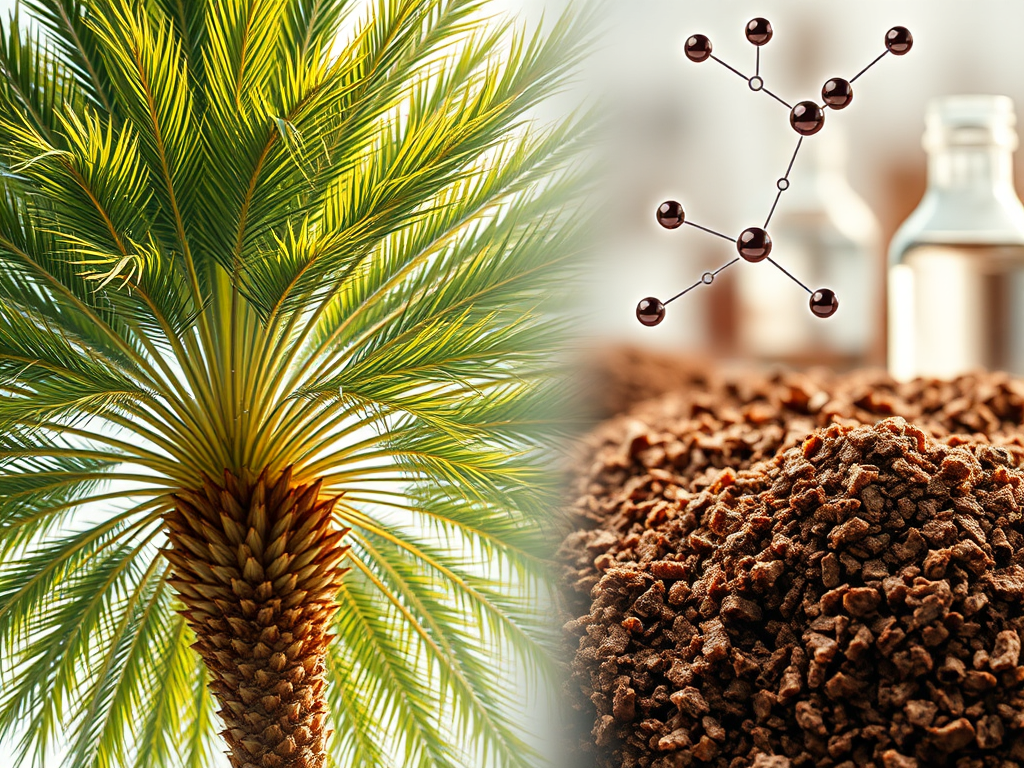
What if agricultural waste could clean water and boost crops? A recent innovation turns discarded date palm fronds into a high-tech biocharBiochar is a carbon-rich material created from biomass decomposition in low-oxygen conditions. It has important applications in environmental remediation, soil improvement, agriculture, carbon sequestration, energy storage, and sustainable materials, promoting efficiency and reducing waste in various contexts while addressing climate change challenges. More capable of recovering phosphorus from wastewater. With its enhanced design, this biochar not only addresses pollution but also holds the promise of becoming a sustainable slow-release fertilizer, revolutionizing agriculture and waste management in one bold step.
In a recent study, researchers developed a magnesium/aluminum-modified biochar (Mg/Al-DPF-B) derived from date palm fronds to recover phosphorus (P) from wastewater efficiently. This engineered biochar stands out due to its enhanced structural and chemical properties, achieved by loading its surface with magnesium and aluminum nanoparticles. The team explored its phosphorus adsorption capabilities using column experiments under varying conditions such as P concentrations, flow rates, and biochar mass. Results revealed that increasing the biochar mass led to the highest adsorption capacity. When scaled up, the biochar could treat 116 cubic meters of wastewater daily, recovering over 0.5 kilograms of phosphorus. What’s next? The study envisions turning the P-loaded biochar into a slow-release fertilizer for agriculture, with future research examining nutrient release and crop uptake. This breakthrough underscores the dual benefits of waste management and resource recovery, paving the way for greener, more sustainable agricultural practices.
Biochar Today thinks that transforming date palm residues into a high-performing biochar, this study offers a practical solution to recover phosphorus while supporting a circular economy in agriculture. While the scalability potential is promising, the reliance on precise conditions (e.g., flow rates, P concentration) raises questions about consistency across diverse wastewater systems. Moreover, the long-term performance of P-loaded biochar as a slow-release fertilizer needs rigorous testing, especially concerning potential heavy metal leachingLeaching is the process where nutrients are dissolved and carried away from the soil by water. This can lead to nutrient depletion and environmental pollution. Biochar can help reduce leaching by improving nutrient retention in the soil. More into soil.
Jellali, Salah, et al. 2024. Phosphorus recovery from aqueous solutions by a Mg/Al-modified biochar from date palm wastes in column mode: adsorption characteristics and scale-up design parameters assessment.” BiomassBiomass is a complex biological organic or non-organic solid product derived from living or recently living organism and available naturally. Various types of wastes such as animal manure, waste paper, sludge and many industrial wastes are also treated as biomass because like natural biomass these More Conversion and Biorefinery . https:// doi. org/ 10. 1007/ s13399- 024- 06435-y.




Leave a Reply