
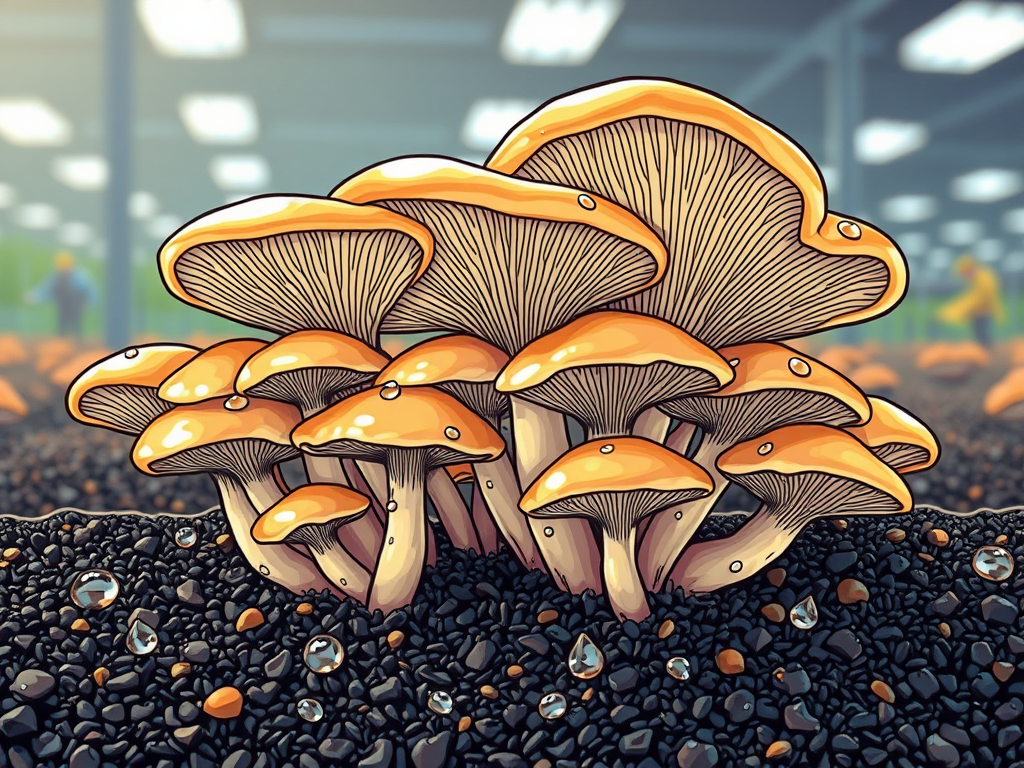
In a recent study published inScientific Reports, researchers Wei Hu and Lanming Gou, along with their colleagues, have developed an effective strategy to address the environmental challenge of disposing of spent mushroom substrate (SMS). The edible fungi industry generates a significant amount of SMS, which traditionally ends up in landfills or piles, occupying land and causing environmental pollution through decomposition. The study explores an innovative approach: converting SMS into biocharBiochar is a carbon-rich material created from biomass decomposition in low-oxygen conditions. It has important applications in environmental remediation, soil improvement, agriculture, carbon sequestration, energy storage, and sustainable materials, promoting efficiency and reducing waste in various contexts while addressing climate change challenges. More, a carbon-rich, porous material. While biochar improves mushroom cultivation, its properties can limit its effectiveness. To address this, the researchers chemically modified the SMS biochar with phosphoric acid, creating an acid-modified mushroom substrate (AMMS).
The acid modification process significantly improves the biochar’s physical and chemical properties. Analysis revealed that acid modification increased the biochar’s surface area and micropore volume. The surface area of the mushroom substrate with biochar increased exponentially compared to treatments without biochar. For example, the surface area of the B3 and PB3 treatments were 29 times and 33 times that of the control group (CK), respectively. The average surface area of the AMMS treatments was also significantly higher than that of the unmodified biochar treatments (BMS). A larger surface area and more pores provide more attachment points for mushroom mycelia and improve ventilation, which are crucial for mushroom growth and quality.
Furthermore, Fourier transform infrared spectroscopy (FTIR) analysis showed that acid modification enhanced the hydrophilicity and adsorption capacity of the biochar. The treatment introduced or increased oxygen-containing functional groups like carboxyl and hydroxyl groups on the biochar’s surface. This change makes the biochar surface more polar and improves its ability to hold and slowly release nutrients. This is significant because a substrate’s hydrophilicity affects the even distribution of water and nutrients, which in turn influences the growth of mushroom mycelium. The research found that the electrical conductivity (EC) of the AMMS treatments was about 30% higher on average than that of the BMS treatments, indicating an increased availability of water-soluble nutrients.
These enhanced properties translated directly into better mushroom growth and yield. The mycelial growth rate was dramatically higher in treatments with biochar compared to the control group. The mycelium bags were filled in 12-13 days with AMMS, which was nearly 2-3 days faster than the BMS treatments. The highest-performing AMMS treatments (PB1 and PB2) showed the best mycelium growth and the highest yield among all substrates. These treatments resulted in a 13-16% yield increase compared to the unmodified biochar treatments (B1 and B2). The first mushroom harvest time was also advanced by an average of 2.5 days for the PB1 and PB2 treatments compared to B1 and B2.
The study also addressed food safety concerns. Tests confirmed that all treatments with biochar had no food security risks. The analysis of contaminants and metabolites in the mushrooms showed that the levels were within the national safety standards. This confirms that the acid-modified biochar derived from spent mushroom substrate is not only an effective and economically viable additive for mushroom cultivation but also a safe one. This approach provides a practical strategy for resource utilization and supports the optimization of oyster mushroom cultivation practices.
Source: Hu, W., Gou, L., Hu, L., Wang, S., Liang, T., & Zhou, N. (2025). Effect of acid modification of Biochar derived from spent mushroom substrate on the production of oyster mushroom (Pleurotus ostreatus). Scientific Reports, 15(30955).


Leave a Reply