
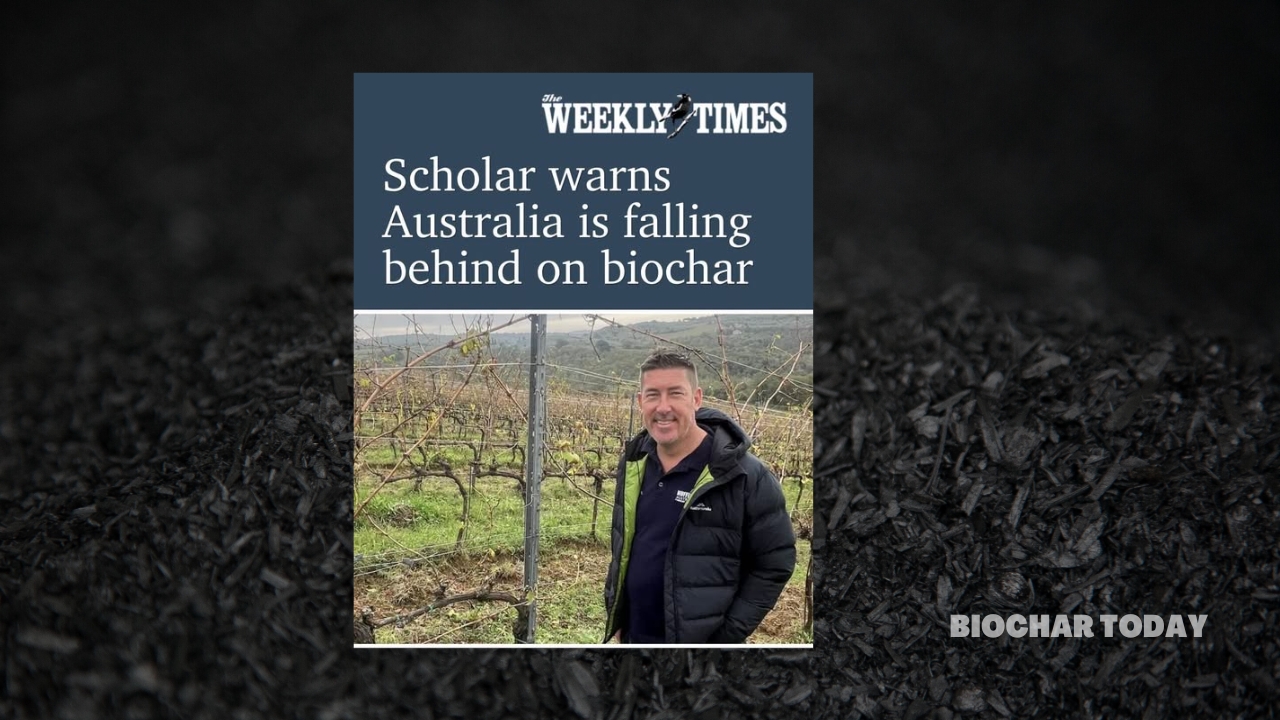
A comprehensive industry report released by Nuffield Australia researcher Paul McGorman highlights that Australia risks falling behind in the rapidly expanding global biocharBiochar is a carbon-rich material created from biomass decomposition in low-oxygen conditions. It has important applications in environmental remediation, soil improvement, agriculture, carbon sequestration, energy storage, and sustainable materials, promoting efficiency and reducing waste in various contexts while addressing climate change challenges. More market due to a lack of coordinated domestic incentives. Supported by the Grains Research and Development Corporation (GRDC), the study evaluates how international investments, particularly Denmark’s multi-billion-dollar commitment to biochar as a core net-zero pillar, are shifting agricultural dynamics. McGorman emphasizes that while international competitors are heavily backing the sector to lock in long-term advantages, Australian producers risk losing competitive ground if they do not establish scalable frameworks.
The major challenge addressed in the report revolves around the structural and financial barriers confronting Australian primary producers who wish to adopt or produce biochar. Local operations face high capital infrastructure costs, strict requirements for consistent feedstockFeedstock refers to the raw organic material used to produce biochar. This can include a wide range of materials, such as wood chips, agricultural residues, and animal manure. More quality, and complex hurdles in navigating carbon credit certification pathways. Furthermore, the absence of an integrated federal framework or dedicated financial incentives—unlike the active programs operating across Europe and the United States—leaves early adopters isolated and prevents the local sector from scaling efficiently.
To resolve these commercial constraints, the report details three practical, farmer-led business production models tailored specifically to Australian conditions: medium-scale centralized systems, small-scale mobile units, and medium-scale cooperative frameworks. Centralized plants processing between 3,000 and 9,000 tonnes of biomassBiomass is a complex biological organic or non-organic solid product derived from living or recently living organism and available naturally. Various types of wastes such as animal manure, waste paper, sludge and many industrial wastes are also treated as biomass because like natural biomass these More annually achieve financial resilience by stacking three independent revenue streams: physical product sales, localized energy capture, and certified carbon credits. Meanwhile, the cooperative model allows multiple producers to share capital infrastructure expenses, pool feedstock reserves, and return the finished soil amendmentA soil amendment is any material added to the soil to enhance its physical or chemical properties, improving its suitability for plant growth. Biochar is considered a soil amendment as it can improve soil structure, water retention, nutrient availability, and microbial activity. More to member farms within a circular economy framework.
The documented outcomes from these structured systems demonstrate substantial economic and agricultural advantages for early adopters. Financial modeling indicates that a properly optimized medium-scale facility producing 1,000 tonnes of biochar per year can secure over AU$550,000 annually from carbon credits alone, in addition to standard energy and product revenues. On the agronomic side, a South Australian dairy trial feeding 150 grams of biochar per cow daily generated an annual net profit increase of approximately AU$72,000 through enhanced feed conversion and milk yields. Consequently, the report calls for government and industry leaders to integrate biochar into Australia’s formal carbon credit frameworks to secure these economic returns nationally.





Leave a Reply