
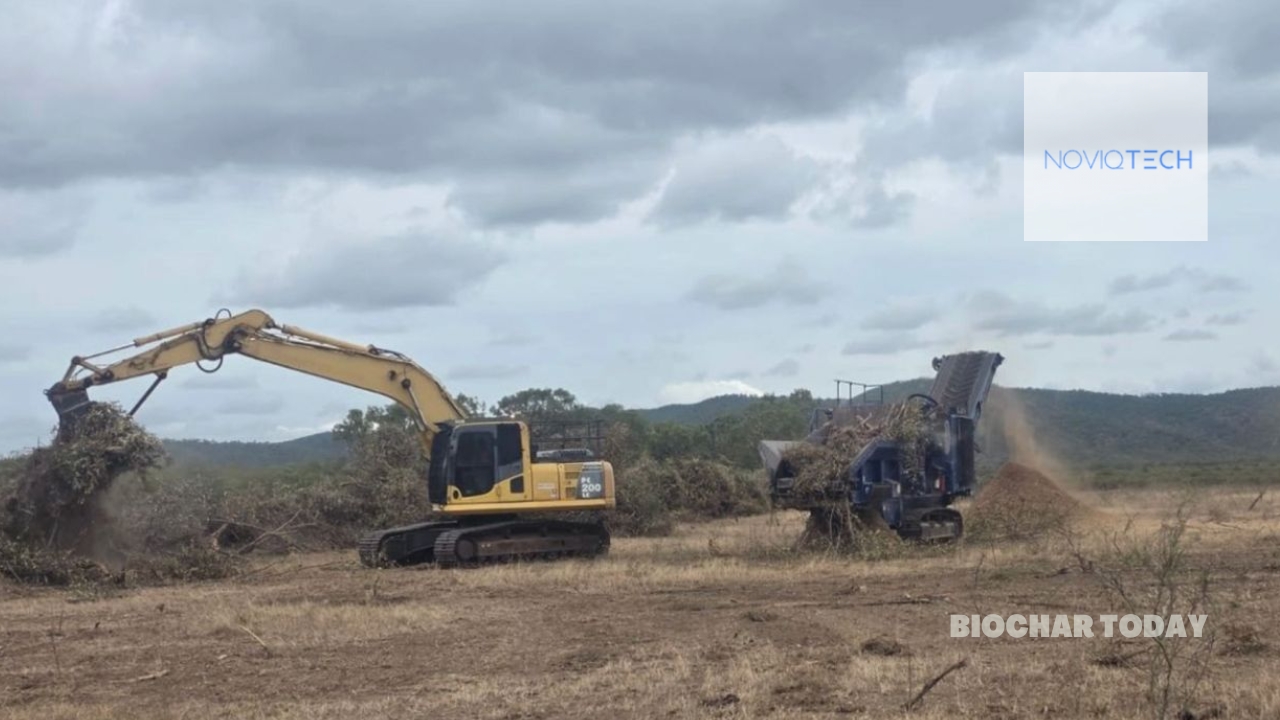
NoviqTech Limited, an Australian digital technology and carbon tracking company, has announced that its subsidiary, Coralia, has commenced field and pyrolysisPyrolysis is a thermochemical process that converts waste biomass into bio-char, bio-oil, and pyro-gas. It offers significant advantages in waste valorization, turning low-value materials into economically valuable resources. Its versatility allows for tailored products based on operational conditions, presenting itself as a cost-effective and efficient More trials for its flagship Great Barrier Reef BiocharBiochar is a carbon-rich material created from biomass decomposition in low-oxygen conditions. It has important applications in environmental remediation, soil improvement, agriculture, carbon sequestration, energy storage, and sustainable materials, promoting efficiency and reducing waste in various contexts while addressing climate change challenges. More Project. Located in North Queensland, Australia, the project focuses on harvesting and chipping invasive Chinese Apple trees from designated trial zones characterized by varying infestation densities. The processed biomassBiomass is a complex biological organic or non-organic solid product derived from living or recently living organism and available naturally. Various types of wastes such as animal manure, waste paper, sludge and many industrial wastes are also treated as biomass because like natural biomass these More will be transported to Toowoomba, Queensland, where technology provider Pyrocal will execute conversion trials across multiple operating temperatures. This full-scale field-to-biochar initiative aims to establish a verified value chain while evaluating carbon removal pathways under established voluntary market frameworks.
The major challenge addressed by this initiative is the ecological and economic degradation caused by invasive woody weeds within critical catchment areas. Proliferating across Queensland, species like the Chinese Apple tree displace native vegetation, impair biodiversity, and compromise local agricultural productivity, thereby threatening the broader Great Barrier Reef ecosystem. Concurrently, developing a high-integrity carbon removal framework utilizing these invasive species requires overcoming complex logistics, managing high moisture and contamination levels in wild feedstocks, and ensuring rigorous data collection to meet international methodology standards.
To solve these compounding ecological and operational issues, Coralia has integrated mechanical harvesting with advanced thermal processing and rigorous digital auditing. The project uses aerial surveys, ground observations, and stakeholder feedback to harvest representative feedstockFeedstock refers to the raw organic material used to produce biochar. This can include a wide range of materials, such as wood chips, agricultural residues, and animal manure. More across distinct low, medium, and high infestation zones. The collected biomass is chipped and subjected to controlled pyrolysis at Pyrocal’s specialized facility, where comprehensive stack testing and biochar analysis are performed. Furthermore, Coralia is systematically gathering life cycle assessment inputs and chain-of-custody documentation to satisfy the strict certification criteria outlined by the Puro.earth tracking methodology.
The initial outcomes of the trial will establish data-driven benchmarks for biomass harvesting productivity, logistics economics, and product distribution. Operational data compiled through June will support an upcoming preliminary assessment submission to Puro.earth, positioning the venture for formal certification. Beyond carbon credit generation, the resultant biochar is slated for agricultural applications and low-carbon concrete research at Swinburne University of Technology. Ultimately, the project demonstrates a scalable mechanism that converts an environmental liability into a stable carbon sink, validating a model that simultaneous delivers land restoration and high-integrity carbon removal.



Leave a Reply