
Key Takeaways
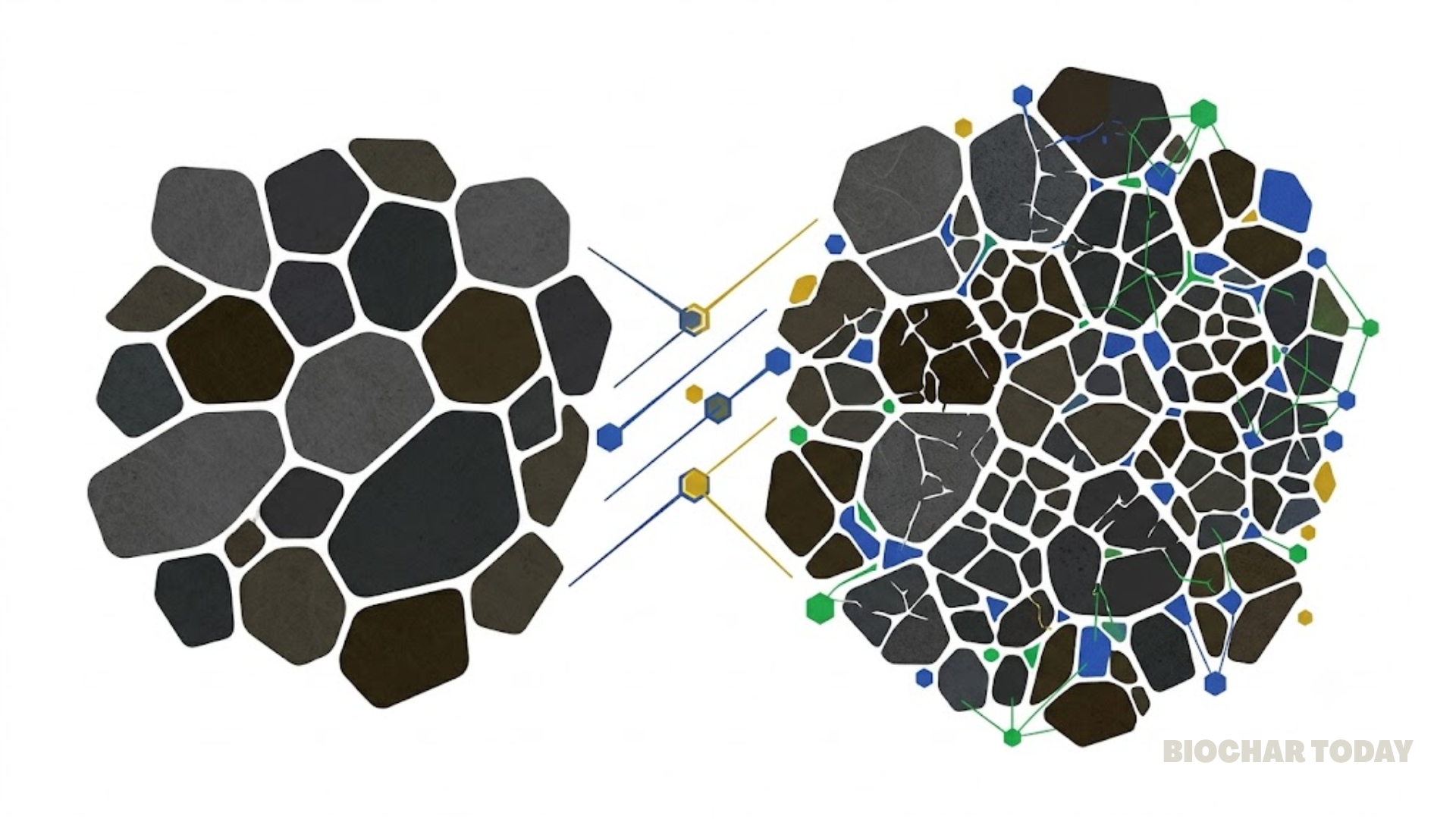
- Nitric acid treatment boosts Marvel grass biocharBiochar is a carbon-rich material created from biomass decomposition in low-oxygen conditions. It has important applications in environmental remediation, soil improvement, agriculture, carbon sequestration, energy storage, and sustainable materials, promoting efficiency and reducing waste in various contexts while addressing climate change challenges. More surface area nearly threefold from 28 to 79 square meters per gram.
- Chemical modification expands total pore volume from 0.025 to 0.065 cubic centimeters per gram while maintaining the core pore size.
- Thermogravimetric testing reveals that pyrolysisPyrolysis is a thermochemical process that converts waste biomass into bio-char, bio-oil, and pyro-gas. It offers significant advantages in waste valorization, turning low-value materials into economically valuable resources. Its versatility allows for tailored products based on operational conditions, presenting itself as a cost-effective and efficient More kinetics are primarily driven by two-dimensional and three-dimensional diffusion models.
- Raw Marvel grass contains high organic content with 38.63 percent carbon and 6.22 percent hydrogen.
- Thermal degradation is endothermic, yielding an average activation energy of 141.57 kilojoules per mole.
A research team at Assiut University conducted a detailed investigation into the thermal degradation kinetics of Marvel grass (Dichanthium annulatum), a perennial grass widely distributed across Egypt and Africa, to evaluate its potential as a renewable biomassBiomass is a complex biological organic or non-organic solid product derived from living or recently living organism and available naturally. Various types of wastes such as animal manure, waste paper, sludge and many industrial wastes are also treated as biomass because like natural biomass these More source for biochar production. Elemental analysis showed that the raw grass possesses 38.63 percent carbon, 53.25 percent oxygen, and 6.22 percent hydrogen, confirming a high lignocellulosic content ideal for thermochemical processing. Non-isothermal thermogravimetric testing performed across heating rates of 10, 20, and 30 degrees Celsius per minute demonstrated that primary devolatilization occurs between 200 and 400 degrees Celsius, representing the primary breakdown of hemicellulose and cellulose.
Isoconversional kinetic modeling revealed that the thermal decomposition of Marvel grass follows a complex, multi-step process with varying activation energies. Model-free methods yielded an average activation energy of 141.57 kilojoules per mole. Master plot analysis further identified that the reaction mechanism is initially governed by two-dimensional diffusion between conversion levels of 0.10 and 0.60, before transitioning into three-dimensional diffusion under the Jander model from 0.60 to 0.90 conversion. Thermodynamic evaluation confirmed the endothermic nature of the pyrolysis process, showing an average enthalpy change of 136.39 kilojoules per mole and a positive Gibbs free energy change averaging 136.74 kilojoules per mole.
To enhance the functional performance of the derived biochar, the material was synthesized at 400 degrees Celsius and subjected to chemical modification using nitric acid and ammonia. Nitrogen adsorption-desorption analysis showed that this modification significantly enhanced the textural properties of the material without destroying its structural framework. The specific surface area expanded from 28 square meters per gram in pristine biochar to 79 square meters per gram in the modified biochar. Concurrently, the total pore volume increased from 0.025 to 0.065 cubic centimeters per gram, while the average pore radius remained stable at 17 to 18 angstroms. Fourier transform infrared spectroscopy confirmed the addition of oxygenated surface functional groups, demonstrating that acid treatment removes residual tar and creates highly accessible active sites for soil remediation and nutrient retention.
Source: Gad El-hak, A. S. M., Abdel-Shakour, M., Algamal, A. G., Amin, A. E. E. A. Z., & Mahfouz, R. M. (2026). Thermodynamic and kinetic analysis of Marvel grass pyrolysis and characterization of the derived biochar. Assiut University Journal of Multidisciplinary Scientific Research (AUNJMSR), 55(3), 751–779.





Leave a Reply