
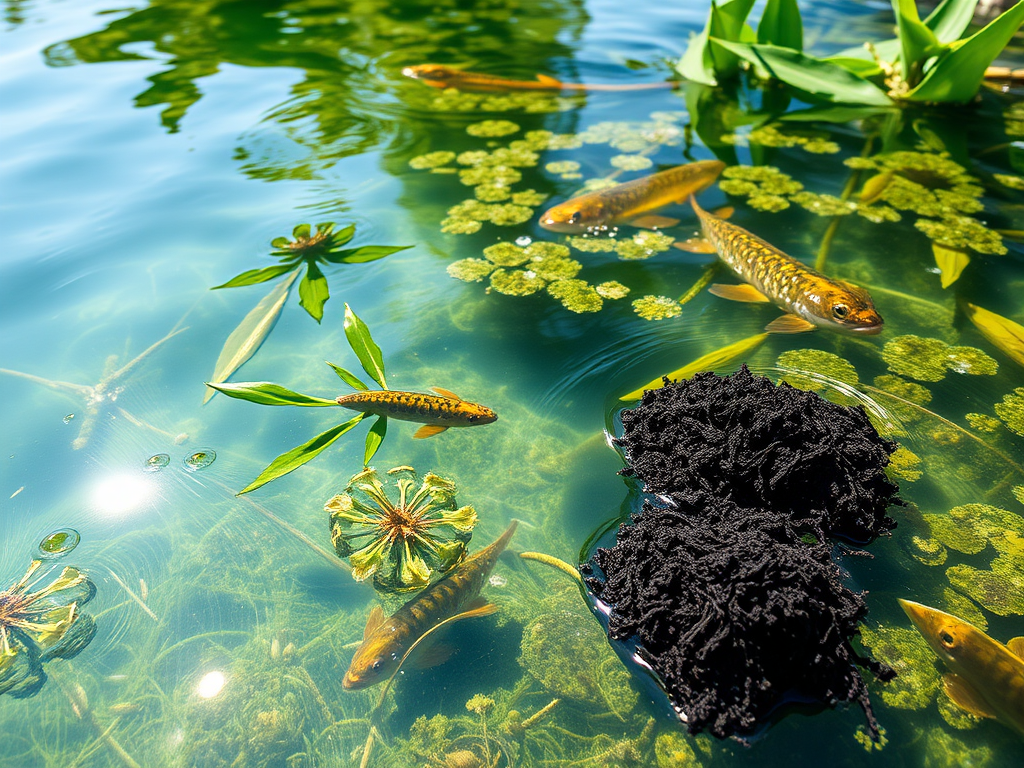
When you picture environmental pollution, you might first think of smog choking a city or plastic littering an ocean. But one of the most insidious and widespread forms of pollution is often invisible: excess phosphorus and nitrogen in waterways. These nutrients, which are essential for plant growth, can cause massive algal blooms when they accumulate in lakes, rivers, and coastal areas. These blooms block sunlight, consume vast amounts of oxygen as they decay, and create “dead zones” where aquatic life cannot survive. Finding an effective and sustainable way to remove phosphorus from water is a critical challenge. In a new study published in the journal Scientific Reports, a research team led by Lihui Zhang and colleagues presents an elegant solution: a highly efficient biocharBiochar is a carbon-rich material created from biomass decomposition in low-oxygen conditions. It has important applications in environmental remediation, soil improvement, agriculture, carbon sequestration, energy storage, and sustainable materials, promoting efficiency and reducing waste in various contexts while addressing climate change challenges. More derived from an unlikely source—the bark of plane trees.
The problem with many traditional methods for removing phosphorus is that they are either expensive, energy-intensive, or simply not very effective at removing inorganic forms like phosphate. While biochar—a charcoal-like substance made from organic materials—has long been recognized as a powerful adsorbent for many pollutants, it has historically shown a less-than-satisfactory performance against inorganic phosphorus. To overcome this limitation, the researchers developed a modified biochar by preparing a composite with Zinc-Aluminum layered double hydroxide, or ZnAl-LDH. This innovative approach enhances the biochar’s ability to “grab” and hold onto phosphate molecules, making it a powerful tool for water purification.
The results of the study were highly promising, demonstrating just how effective this new material is. The team’s most compelling finding was the sheer efficiency of the composite. Using a minimal amount of the adsorbent, specifically a mere 10 milligrams, they were able to achieve an impressive 93% adsorption rate for phosphate from a 25 mL solution. This high level of performance with such a small quantity of material is a significant breakthrough. It reveals that the modified biochar doesn’t just work, but it does so with a level of effectiveness that could make it a viable, cost-effective solution for large-scale water treatment.
Beyond its high removal efficiency, the study also uncovered the underlying mechanism of the biochar’s success. According to the research, the material works through a process called mono-molecular layer adsorption, which essentially means phosphate molecules form a single, uniform layer on the biochar’s surface. This process is driven by a combination of chemical interactions, including surface complexation, ligand exchange, and a powerful “interlayer anion exchange,” where the biochar’s structure allows it to swap its own ions for those of the incoming phosphate. This detailed understanding of the mechanism is crucial for optimizing the material and developing even more effective versions in the future.
Perhaps the most exciting finding, however, is the potential for resource recovery. In addition to cleaning the water, the researchers demonstrated that the absorbed phosphate isn’t lost. They were able to recover nearly 60% of the phosphate from the saturated biochar by soaking it in a sodium carbonate solution. This is a game-changing result. Phosphorus is a finite and non-renewable resource that is essential for agriculture, and its price is constantly rising. The ability to not only remove it from polluted waterways but also to recover and potentially reuse it as a fertilizer creates a compelling closed-loop system. This could help mitigate the environmental damage caused by phosphorus pollution while simultaneously addressing the growing challenge of nutrient scarcity in global food production.
This research highlights the incredible potential of combining sustainable materials with clever chemical modifications. While the initial study focuses on laboratory-scale results, the findings offer a clear path forward for developing a practical, two-pronged solution to water pollution and resource depletion. This innovative biochar could one day be used in filters for municipal wastewater treatment plants, agricultural runoff systems, or even in household water purifiers, providing a sustainable and effective way to protect our aquatic ecosystems and recover a valuable natural resource.
Source: Zhang, L., Zhang, C., Zhang, C., Li, W., Zhou, Y., Wang, Y., & Du, G. (2025). Preparation of plane trees’ bark biochar/ZnAl-LDH and its adsorption performance for phosphate and recovery. Scientific Reports, 15(1), 32105.




Leave a Reply