
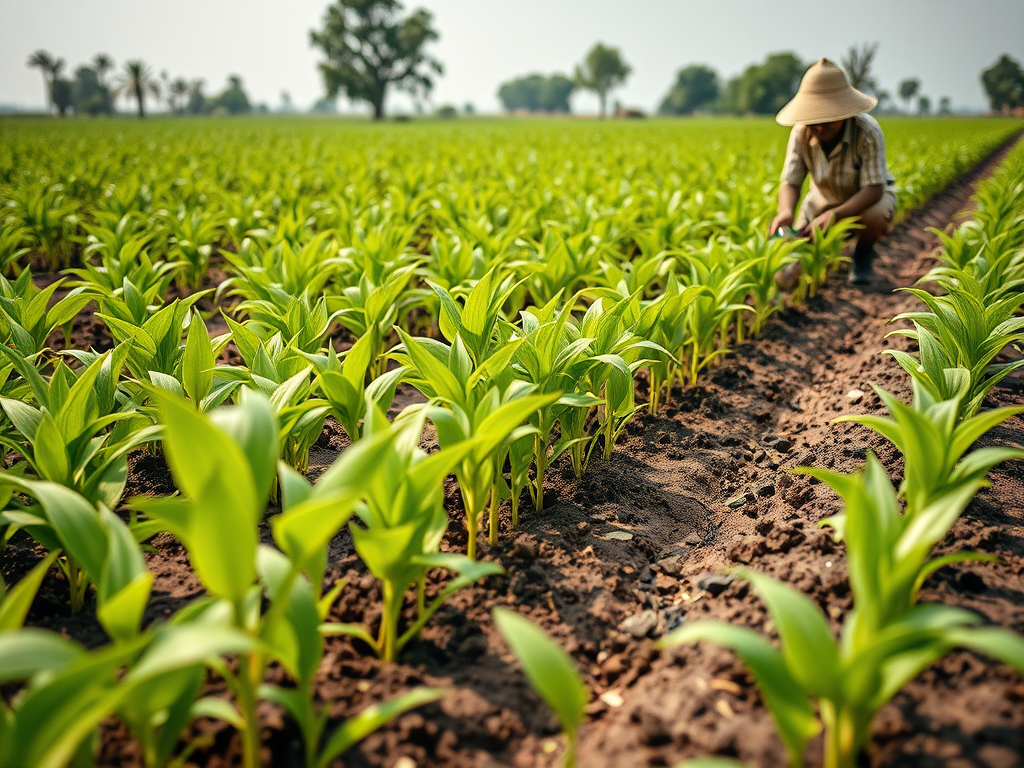
In a world grappling with climate change, farming faces a critical challenge: feeding a growing population while reducing its environmental footprint. Conventional agriculture, while highly productive, relies on high energy inputs and is a significant contributor to greenhouse gas (GHG) emissions. A recent study conducted by Gagan Gaurav, “Assessment of Carbon Dynamics, Economic Viability, Energy Efficiency, and Greenhouse Gas Emissions Under Alternative Farming Systems in Moong (Vigna radiata) Cultivation,” investigated how different farming methods for moong, a protein-rich pulse crop, stack up in terms of sustainability. The research, conducted by Gagan, evaluated natural, organic, biochar-based, regenerative, and conventional farming systems to see which offered the best balance of productivity, profitability, and environmental health.
The study found a major trade-off between productivity and sustainability. Conventional farming delivered the highest moong grain yield at 11.0 quintals per hectare, but at a steep cost. This system had the highest total energy input (9,546 MJ/ha) and the highest total GHG emissions (2,510 kg CO2-eq/ha). In contrast, low-input systems like natural and organic farming showed significant reductions in their environmental impact. Natural farming had the lowest GHG emissions, a mere 760 kg CO2-eq/ha, a 69% reduction compared to conventional farming. Organic farming followed closely with 861 kg CO2-eq/ha, and regenerative farming had 1,604 kg CO2-eq/ha.
However, the standout performer was biochar-based farming. While its total emissions were higher than natural and organic systems, at 1,770 kg CO2-eq/ha, this still represented a 29% reduction from the conventional approach. More importantly, the system excelled at sequestering carbon in the soil. Biochar-based farming had a net carbon sequestration of 236.21 g C m−2 over the 60-day crop cycle, a significant achievement from adding stable carbon that resists microbial decomposition. This puts it in a sweet spot, balancing competitive yields with long-term climate benefits.
Beyond environmental metrics, the study also analyzed economic viability and energy efficiency. Natural farming, despite its lowest yield, had the highest benefit-cost ratio (2.24) because it had the lowest total cost of cultivation at ₹22,500/ha. Biochar-based and regenerative farming also showed strong benefit-cost ratios of 2.21 and 2.18, respectively, highlighting their economic efficiency. Conventional farming, on the other hand, had the lowest benefit-cost ratio (2.06) due to its high input costs, which eroded profitability despite its high yields.
The energy analysis mirrored these findings. Natural farming was the most energy-efficient, with an energy use efficiency (EUE) of 2.90, indicating it produced the most output per unit of energy invested. Biochar-based farming was a close second with a 2.86 EUE, while conventional farming had the lowest at 2.39. This shows that while conventional farming can maximize short-term output, it is not the most resource-efficient system. Biochar-based and regenerative farming systems offer a balanced approach, providing high net energy returns and superior EUE by reducing reliance on energy-intensive synthetic inputs.
The study’s conclusions are clear: the future of sustainable agriculture lies in optimizing, not maximizing, productivity. Biochar-based and regenerative farming systems provide a promising pathway by enhancing soil health, sequestering carbon, and improving economic and energy efficiency without a severe drop in yield. These findings offer a scientific basis for policymakers and farmers to transition toward more climate-resilient and environmentally sustainable practices.
Source: Gagan. (2025). Thesis: Assessment of Carbon Dynamics, Economic Viability, Energy Efficiency, and Greenhouse Gas Emissions Under Alternative Farming Systems in Moong (Vigna radiata) Cultivation. International Rice Research Institute South Asia Regional Centre.




Leave a Reply