
Key Takeaways
- Common waste materials like walnut shells and crop residues can be transformed into advanced water filters.
- Modifying raw biocharBiochar is a carbon-rich material created from biomass decomposition in low-oxygen conditions. It has important applications in environmental remediation, soil improvement, agriculture, carbon sequestration, energy storage, and sustainable materials, promoting efficiency and reducing waste in various contexts while addressing climate change challenges. More with iron or zinc allows it to capture hard-to-remove pollutants like microplastics.
- These specialized filters successfully clean out pharmaceutical leftovers and industrial toxins from water supplies.
- The new materials can be easily collected and reused after treating dirty water.
- Engineers must balance the high performance of these filters with clean manufacturing to prevent secondary pollution.
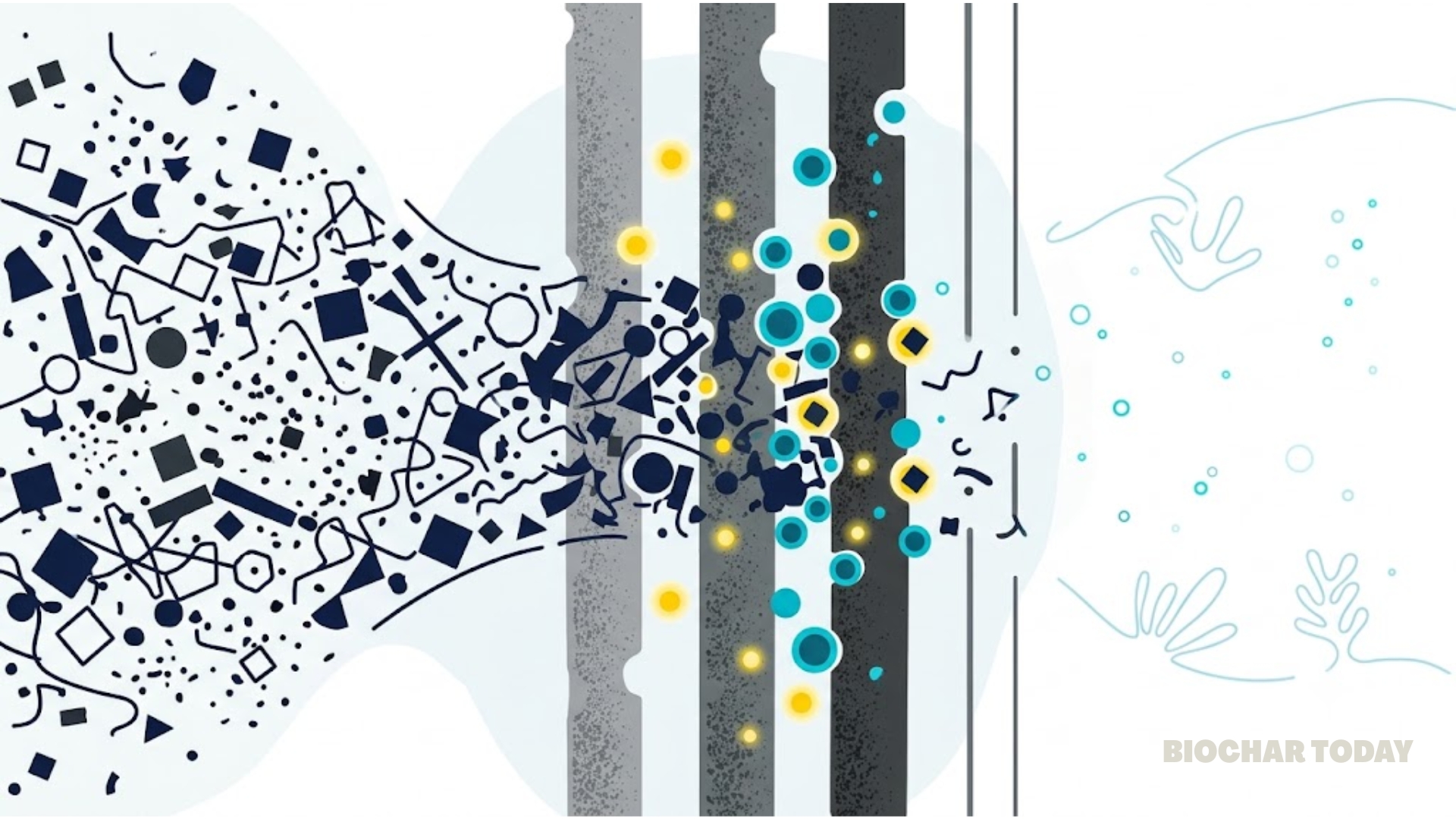
Wastewater purification remains a critical global challenge as municipal, agricultural, and industrial activities continuously discharge millions of cubic meters of polluted water into the environment. In the journal Sustainable Carbon Materials, researchers Cui Wang, Qichen Hou, Xinjun Zhang, and Bo Bai reviewed the latest breakthroughs in engineered biochar composites designed to target both conventional and emerging pollutants. While raw biochar offers an ecofriendly, porous foundation for water filtration, its natural state provides limited adsorption capacity and lacks the target selectivity needed to trap complex chemical compounds. To overcome these performance ceilings, material scientists are developing advanced composite engineering methods that integrate iron oxides, metal hydroxides, and functional nanoparticles into the raw carbon matrix. These modifications dramatically boost internal specific surface areas and enrich surface chemical reactivity, creating versatile materials capable of simultaneous physical trapping and catalytic degradation.
The evaluation highlights the exceptional capability of these advanced carbon materials to neutralize highly persistent threats, such as industrial dyes, heavy metals, and agricultural runoff. Traditional wastewater facilities frequently fail to remove complex organic dyes due to their high visibility and molecular stability, yet carbon composites achieve clear visual decolorization rates exceeding ninety-five percent within a few hours of treatment. Heavy metals like lead, copper, and chromium present another severe ecological hazard because they continuously accumulate inside living organisms through the food chain. By loading nano-scale materials or zero-valent iron onto the carbon matrix, these engineered composites provide high-density binding spots that lock up toxic heavy metal ions through direct chemical bonding and surface precipitation. Furthermore, when treating excess nutrients like phosphorus and nitrogen that cause toxic algal blooms in lakes, modified biochars completely overcome natural electrostatic repulsion to achieve a phosphorus removal efficiency of nearly ninety-nine percent.
Beyond conventional pollutants, the manuscript centers on the removal of highly toxic emerging contaminants, such as antibiotic residues, microplastics, and perfluorinated compounds, which resist natural environmental breakdown. Antibiotics entering the water cycle from medical and veterinary waste promote the spread of drug-resistant bacteria, but combining biochar with light-sensitive semiconductors creates powerful catalytic systems that break down ninety-seven percent of tetracycline within forty minutes under visible light. Similarly, per- and polyfluoroalkyl substances, widely feared for their extreme structural stability, are effectively captured through a combination of electrical attraction and hydrophobic interactions. The composites also show exceptional performance when clearing out microplastics, which are tiny plastic fragments smaller than five millimeters that contaminate marine life and drinking water. By applying iron and zinc modifications to the carbon surface, the resulting filters successfully capture up to ninety-nine percent of suspended microplastics while maintaining high structural performance across diverse acidic and neutral water conditions.
Despite these impressive purification metrics, the authors emphasize that enhancing material performance frequently introduces complex environmental trade-offs that must be managed through green design principles. The chemical agents, high-temperature treatments, and heavy metals utilized during the modification phase significantly increase the cumulative energy demand and carbon footprint of the production process compared to raw carbon materials. Additionally, if the functional nanoparticles are weakly bound to the carbon support, they risk breaking away during active water flow, causing secondary nanotoxicity in downstream ecosystems. Saturated or spent filters also present a severe disposal risk, as random landfilling can turn these material reservoirs into secondary pollution sources that leak concentrated toxins into local groundwater tables. To achieve true long-term sustainability, future engineering designs must prioritize the use of non-toxic, bio-based modifiers, establish strong internal chemical bonds to prevent particle leachingLeaching is the process where nutrients are dissolved and carried away from the soil by water. This can lead to nutrient depletion and environmental pollution. Biochar can help reduce leaching by improving nutrient retention in the soil. More, and implement comprehensive lifecycle assessments from the early stages of material development.
Source: Wang, C., Hou, Q., Zhang, X., & Bai, B. (2026). Preparation of biochar-based composites and application in removal of conventional and emerging pollutants from wastewater: performance enhancement, mechanisms, sustainability, and risk evaluations. Sustainable Carbon Materials, 2, e020.




Leave a Reply