
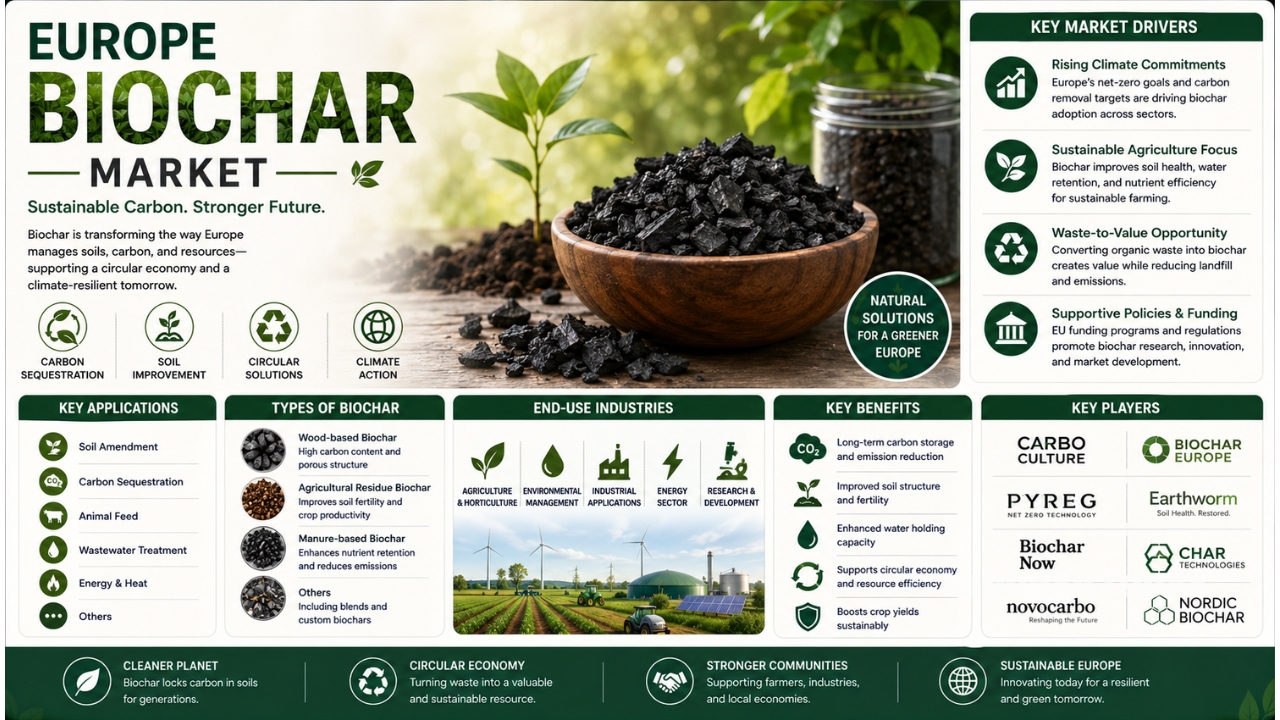
According to a report published by Market Research Future (MRFR), the European biocharBiochar is a carbon-rich material created from biomass decomposition in low-oxygen conditions. It has important applications in environmental remediation, soil improvement, agriculture, carbon sequestration, energy storage, and sustainable materials, promoting efficiency and reducing waste in various contexts while addressing climate change challenges. More market is projected to expand from 222.0 kilotons in 2026 to 1,338.3 kilotons by 2035, representing a compound annual growth rate (CAGR) of 22.1%. The primary driver behind this structural acceleration across European Union member states is regulatory integration rather than agricultural demand alone. Commercial trajectory is further bolstered by institutional project financing and off-take contracts, such as Novocarbo GmbH’s 5,000-tonne Hamburg facility supported by corporate off-take commitments and Swiss Biochar GmbH’s EUR 25 million carbon removal deal with Microsoft.
Historically, biochar market growth across Europe was constrained by a fragmented patchwork of national end-of-waste frameworks, elevated compliance costs, and supply chain inefficiencies. Additionally, a Joint Research Center study highlighted that fragmented biomassBiomass is a complex biological organic or non-organic solid product derived from living or recently living organism and available naturally. Various types of wastes such as animal manure, waste paper, sludge and many industrial wastes are also treated as biomass because like natural biomass these More logistics in Southern and Eastern Europe raised collection and transport expenditures by 35% to 40% compared to Northern Europe, directly squeezing operational margins and impeding cross-border commercial expansion.
To resolve these regulatory bottlenecks, the European Union introduced Component Material Category 14 (CMC14) under its revised Fertilising Products Regulation, formally recognizing biochar as a legitimate agricultural input across all 27 member states. This single framework replaces disparate national rules, providing standardized legal status for market participants. Simultaneously, technological solutions are diversifying, with gasificationGasification is a high-temperature, thermochemical process that converts carbon-based materials into a gaseous fuel called syngas and solid by-products. It takes place in an oxygen-deficient environment at temperatures typically above 750°C. Unlike combustion, which fully burns material to produce heat and carbon dioxide (CO2), gasification More gaining adoption in Nordic district-heating networks and hydrothermal carbonization addressing high-moisture waste streams without requiring pre-drying.
Full enforcement of CMC14 is estimated by the European Commission to reduce producer compliance costs by 15% to 20%, establishing a unified market baseline. This regulatory standardization, paired with long-term corporate off-take structures, supports projected growth across livestock applications, environmental filtration, and industrial substitution, which is expected to expand at a 24.1% CAGR through 2035. Consequently, the European biochar sector is transitioning from fragmented regional initiatives into a regulated, institutionally backed commodity market.


Leave a Reply